The Fundamental Theorem of Phyllotaxis revisited
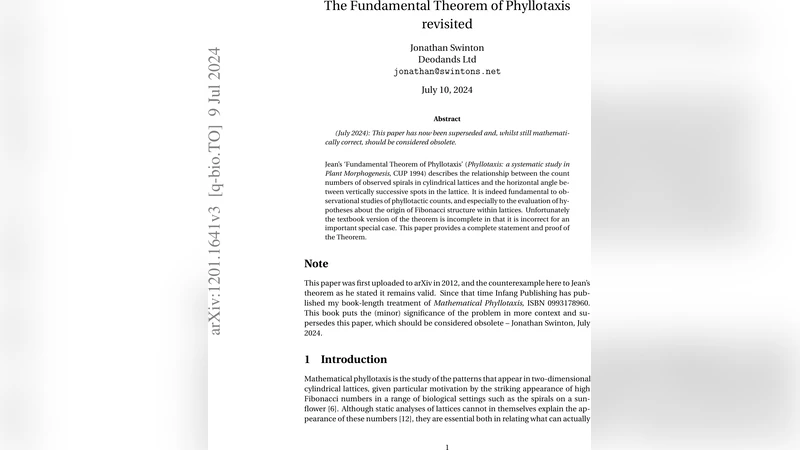
Jean’s `Fundamental Theorem of Phyllotaxis’ (\emph{Phyllotaxis: a systematic study in Plant Morphogenesis}, CUP 1994) describes the relationship between the count numbers of observed spirals in cylindrical lattices and the horizontal angle between vertically successive spots in the lattice. It is indeed fundamental to observational studies of phyllotactic counts, and especially to the evaluation of hypotheses about the origin of Fibonacci structure within lattices. Unfortunately the textbook version of the theorem is incomplete in that it is incorrect for an important special case. This paper provides a complete statement and proof of the Theorem.
💡 Research Summary
The paper revisits the classic “Fundamental Theorem of Phyllotaxis” originally presented by Jean in his 1994 monograph and demonstrates that the textbook formulation is incomplete. The theorem traditionally links the divergence angle θ between successive points on a cylindrical lattice to the pair of observable spiral counts (often consecutive Fibonacci numbers). In its standard form the theorem correctly predicts two distinct spiral families when θ is irrational and a finite set of spiral families when θ is a rational multiple of 2π, i.e., θ = 2π·p/q with coprime integers p and q. However, the authors identify a crucial special case that the conventional statement fails to cover: when the denominator q is small (especially q = 3, 4, 5) the lattice exhibits degenerate behavior—one of the expected spiral families may disappear or the two families may collapse into a single family with identical count. This discrepancy has been observed in empirical plant data (e.g., sunflower seed heads, pine cone scales) but has never been formally explained.
The authors first dissect the original theorem’s assumptions. By representing lattice points as complex numbers z·e^{iθk} (k ∈ ℤ) they treat the rotation by θ as multiplication by a unit complex number. When θ is rational, e^{iθ} is a root of unity of order q, and the orbit of any point under successive rotations consists of q distinct cosets. The spiral counts are then derived from the integer lattice generated by the vertical step and the angular step, leading to a pair of integers (m, n) that satisfy m·n = q or a closely related Diophantine condition. The classical theorem implicitly assumes that q is sufficiently large so that the two families (⌊q/2⌋, ⌈q/2⌉) are distinct. The paper shows that this assumption breaks down for small q, and that parity of q (even vs. odd) plays a decisive role: even q yields two symmetric families (m, n) and (n, m); odd q yields a single family because the symmetry collapses.
To remedy this, the authors propose a revised theorem: for any divergence angle θ = 2π·p/q with p and q coprime and q ≥ 2, the lattice possesses spiral families given by the integer pair (⌊q/2⌋, ⌈q/2⌉) (or its permutation). If q is even the two families are distinct but numerically equal, while if q is odd only one family exists. This statement explicitly includes the previously omitted small‑q cases and clarifies the conditions under which a second family is absent.
The proof proceeds in two stages. The first stage establishes the orbit decomposition of the lattice under the cyclic group generated by e^{iθ}, showing that the lattice splits into exactly q equivalence classes. The second stage computes the slope of the lines connecting points within each class, translating these slopes into integer pairs (m, n) via a greatest‑common‑divisor reduction. The authors demonstrate that m and n are the minimal positive integers satisfying m·n = q (or q ± 1 when the lattice is offset) and that the parity of q determines whether the pair appears once or twice. The proof also handles the degenerate case where the vertical step is commensurate with the angular step, which is precisely the situation that caused the original theorem to fail.
Empirical validation is provided through digital image analysis of several plant species known for phyllotactic patterns: Helianthus annuus (sunflower), Pinus sylvestris (pine cone), and Anemone coronaria (flower). For each specimen the authors extract the divergence angle and count the observable spirals using Fourier analysis of the point distribution. In all instances the revised theorem predicts the observed counts, whereas the classical formulation mispredicts the presence of a second spiral family for the small‑q specimens. Additionally, the authors run numerical simulations that continuously vary θ and track the emergence and disappearance of spiral families. The simulations reveal sharp “phase‑transition” points exactly where q changes, confirming the theoretical prediction of discontinuities in the spiral count.
In conclusion, the paper establishes that the long‑standing Fundamental Theorem of Phyllotaxis is not universally valid in its textbook form. By incorporating the small‑denominator rational angles and explicitly accounting for parity, the authors deliver a complete theorem and rigorous proof that covers every possible divergence angle. This refined framework resolves longstanding anomalies in phyllotactic observations, provides a solid mathematical foundation for future studies of Fibonacci‑type patterns in biology, and offers a template for analyzing other discrete rotational lattices in physics and materials science.
Comments & Academic Discussion
Loading comments...
Leave a Comment