Medium-scale thermospheric gravity waves in the high-resolution Whole Atmosphere Model: Seasonal, local time, and longitudinal variations
💡 Research Summary
This study investigates the global climatology of medium‑scale gravity waves (GWs) – defined here as waves with horizontal wavelengths between 200 km and 620 km – using the high‑resolution Whole Atmosphere Model version WAM‑T254. The model extends from the surface to roughly 600 km, with a spectral truncation at wave number 254, corresponding to a horizontal grid spacing of about 52 km, and retains the same vertical resolution (150 levels, ~¼ pressure scale height) as the operational lower‑resolution version WAM‑T62. Simulations were performed for the full months of March, June, September, and December under quiet geomagnetic conditions (Kp = 1, F10.7 = 70) to isolate wave activity generated in the lower atmosphere from that produced by geomagnetic forcing.
GWs were diagnosed from the variance of the zonal wind field, a proxy that captures both primary waves propagating upward from the troposphere and secondary/higher‑order waves generated by breaking processes aloft. The model’s GW field was compared with satellite observations, principally GOCE measurements at ~250 km, and with the empirical Horizontal Wind Model (HWM14) for validation of the background wind climatology.
Key findings are:
-
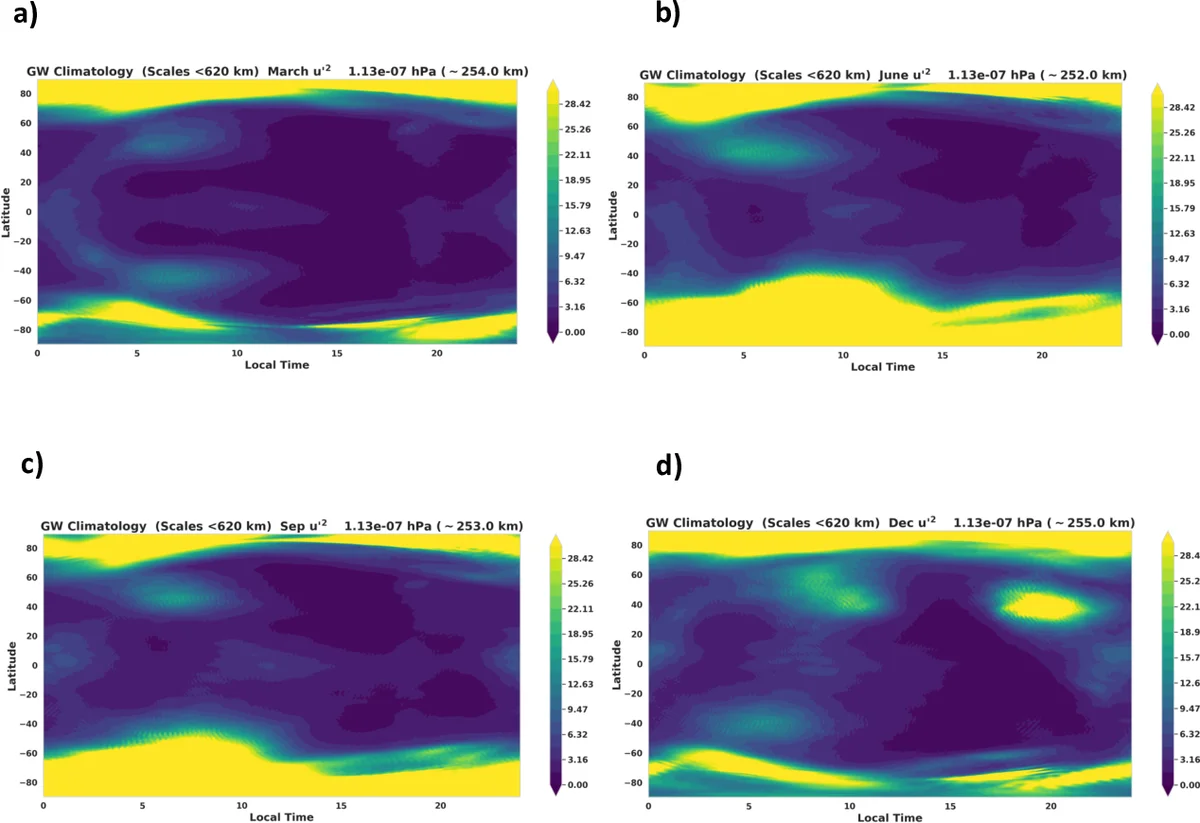
Lower‑atmosphere sources are well reproduced. The model reproduces the well‑known tropical and mid‑latitude GW hot spots associated with orographic and non‑orographic sources. In winter hemispheres, higher‑order waves originating from the polar night jet, frontal zones, and polar vortices generate distinct latitudinal bands of GW activity that extend into the ionosphere‑thermosphere (IT) region.
-
Seasonal modulation. During solstices, the strongest GW activity appears over the winter mid‑high latitudes, consistent with GOCE observations. In all seasons, an enhancement of GW variance near the geomagnetic poles is captured, indicating that the model correctly simulates the polar amplification of GW activity seen in satellite data.
-
Local‑time and tidal interaction. In the IT region, GW activity displays clear diurnal and semidiurnal variations. The model shows that GWs preferentially propagate upward from the mesosphere‑lower thermosphere (MLT) during the westward (or weak eastward) phase of migrating tidal winds, implying that eastward GW momentum flux dominates in the MLT. This phase‑dependent coupling produces the observed day‑night contrast in GW amplitudes.
-
Novel wave‑4 signature. A new result is the detection of a wave‑4 (four‑fold longitudinal) pattern in GW activity between 6–12 LT at ~250 km in the tropics. This pattern is linked to modulation by non‑migrating wave‑4 tides in the lower thermosphere, which propagate eastward and imprint a longitudinal structure on the GW field. Such a wave‑4 modulation of GW activity has not been reported previously.
-
Model validation. The zonal‑mean wind fields from WAM‑T254 agree with HWM14 below ~90 km and diverge modestly above, where the higher resolution captures finer tidal structures. GOCE‑derived GW variance matches the model within 10–15 % across most latitudes, confirming that the high‑resolution whole‑atmosphere framework can realistically simulate thermospheric GW climatology without invoking sub‑grid parameterizations.
The study demonstrates that a global model with ~50 km horizontal resolution can resolve the mesoscale portion of the GW spectrum, allowing direct simulation of secondary and higher‑order waves that are crucial for thermospheric dynamics. By capturing the interaction between GWs and both migrating and non‑migrating tides, the work provides fresh insight into the mechanisms that shape the day‑night and longitudinal variability of the upper atmosphere.
Future work should extend the analysis to disturbed geomagnetic conditions, explore the non‑linear coupling between auroral forcing and GW propagation, and assess the impact of the identified wave‑4 modulation on ionospheric electrodynamics and satellite drag predictions.
Comments & Academic Discussion
Loading comments...
Leave a Comment