Stark Control of Plexcitonic States in Incoherent Quantum Systems
Electro-optic control of quantum dots embedded in the plasmonic nanocavities enables active tuning of photonic devices for emerging applications in Quantum optics such as quantum information processing, entanglement and ultrafast optical switching. Here, we demonstrate the coherent control of plexcitonic states in (i) an off-resonant and (ii) a resonant coupled quantum systems through optical Stark effect (OSE). We analyze a hybrid plasmon-emitter system which exhibits tunable Fano resonance, Stark induced transparency (SIT) and vacuum Rabi splitting due to quadratic Stark shift in the degenerate states of quantum emitter (QE). In addition, a resonantly coupled system shows the signature of double Fano resonance due to Stark-induced splitting in a two-level QE. Our study shows that Stark tuning of plexcitons not only mitigates decoherence in the quantum system but it also stimulates on/off switching of spontaneous photon emission in the visible regime. Such tunable systems can be used to operate photonic integrated circuits (PIC) for applications in quantum computing and information processing.
💡 Research Summary
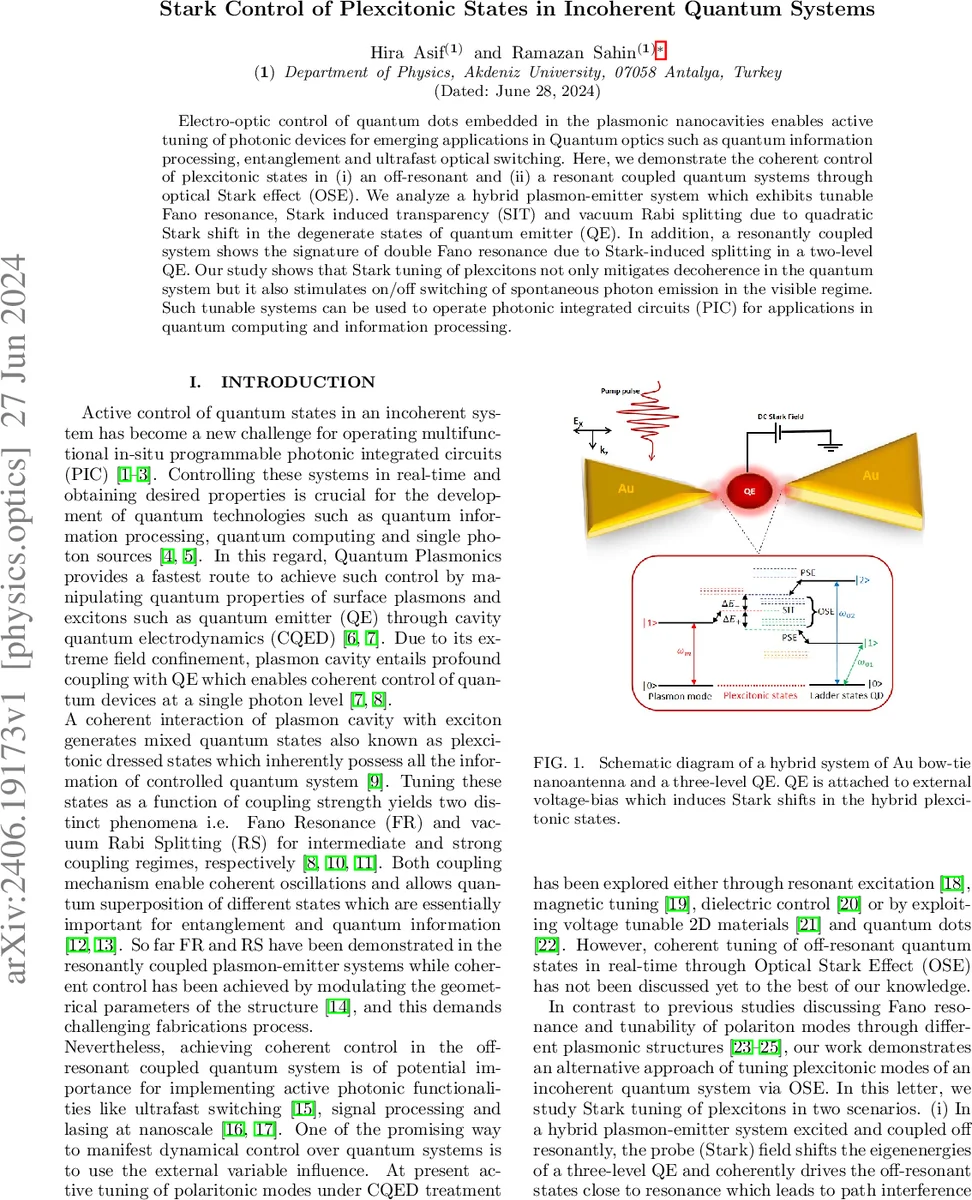
The manuscript by Asif and Şahin presents a comprehensive theoretical investigation of how the optical Stark effect (OSE) can be harnessed to actively control plexcitonic states in hybrid plasmon‑quantum‑emitter systems. The authors consider two distinct configurations: (i) an off‑resonant coupling between a gold bow‑tie nano‑antenna supporting a localized surface plasmon (LSP) mode and a three‑level quantum emitter (QE), and (ii) a resonant coupling where a two‑level QE is tuned into resonance with the plasmon. In both cases the QE is subjected to an external voltage bias that generates a static electric field. Within a second‑order perturbative treatment this field produces a quadratic Stark shift ΔE = −½ αE² of the excited states, where α is the polarizability derived from the Bohr radius.
The system is modeled as two coupled harmonic oscillators with a phenomenological coupling constant f. After applying the rotating‑wave and dipole approximations, the total Hamiltonian (Eq. 1) includes the plasmon detuning Δm, the Stark‑shifted QE detunings, and the interaction term iℏf( a†σ0j − aσ†0j ). Dissipation is incorporated via Markovian reservoirs, giving plasmon decay γm = 72 meV and QE decay rates γ0j. The Heisenberg‑Langevin equations of motion (Eqs. 2‑6) are solved numerically using a fourth‑order Runge‑Kutta scheme in MATLAB. The observable of interest is the scattered intensity Isca = |⟨σ0j⟩ + ⟨a⟩|², and the photoluminescence (PL) spectrum is obtained from a standard input‑output formalism (Eq. 7).
Off‑resonant case
With the bare plasmon frequency ωm ≈ 2.64 eV and QE transitions ω01 = 2.5 eV, ω02 = 2.7 eV, the system initially exhibits three plexcitonic peaks: lower plexciton (LP), plasmon mode (PM), and upper plexciton (UP). When the Stark field is switched on, the UP experiences a red‑shift while the LP blue‑shifts toward the plasmon frequency. For weak coupling (f = 0.01 ω0) the shifts are on the order of 20–30 meV; for intermediate coupling (f = 0.05 ω0) they increase to 26 meV (UP) and 39 meV (LP). As the shifted levels cross the plasmon resonance, a Fano interference pattern emerges together with a narrow transparency window at the plasmon frequency, which the authors term Stark‑Induced Transparency (SIT). The quadratic Stark shift also enlarges the vacuum Rabi splitting: the LP‑plasmon splitting reaches ≈226 meV and the UP‑plasmon splitting ≈194 meV, with the strong‑coupling regime reaching Ω ≤ 350 meV. PL calculations show a pronounced intensity maximum at the SIT point (Δm ≈ 0) and a clear on/off switching behavior as the Stark field is varied, demonstrating that the system can be toggled between bright and dark emission states in the visible range.
Resonant case
When the QE transition is tuned to ωge ≈ 2.68 eV, matching the plasmon, the applied Stark field lifts the degeneracy of the excited state, producing two Stark‑shifted levels separated by 2ΔE. Each of these couples to the plasmon mode, generating two distinct hybrid modes. Consequently, the spectrum displays a double Fano resonance: two asymmetric dips flank the central plasmon peak. For weak coupling (f = 0.02 ω0) the hybrid peaks appear at 2.61 eV and 2.72 eV; for intermediate coupling (f = 0.05 ω0) they shift to 2.52 eV and 2.80 eV. The Stark‑induced splitting also yields an additional Rabi splitting between the two hybrid modes, offering a route to multi‑channel spectral control.
Key insights and implications
- Quadratic Stark shift as a low‑power tuning knob – Because ΔE scales with E², modest voltages produce sizable energy shifts, enabling rapid, reversible control without altering the nanostructure geometry.
- Off‑resonant to resonant transition – The Stark field can drive an initially off‑resonant system into the strong‑coupling regime, effectively turning on coherent plexciton dynamics on demand.
- Stark‑Induced Transparency (SIT) – The emergence of a narrow transparency window at the plasmon frequency provides a mechanism for ultrafast optical switching and filtering.
- Double Fano resonance – In resonant configurations, Stark‑splitting creates two discrete pathways that interfere with the plasmon continuum, offering a platform for multi‑frequency quantum interference and potential entanglement generation.
- Decoherence mitigation – By dynamically aligning the QE and plasmon energies, the system reduces dephasing channels, which is crucial for quantum information processing.
Potential applications
The demonstrated ability to electrically modulate plexcitonic spectra suggests several practical uses: (i) voltage‑controlled on/off single‑photon sources for integrated quantum photonic circuits, (ii) ultrafast optical modulators operating in the visible regime, (iii) reconfigurable nanolasers where the gain medium (the QE) can be switched in and out of resonance, and (iv) multi‑channel quantum routers exploiting double Fano resonances. The authors also note that the approach can be extended to 2D materials (e.g., transition‑metal dichalcogenides) or other voltage‑tunable emitters, potentially lowering power consumption and increasing modulation bandwidth.
In summary, the paper provides a solid theoretical foundation for using the optical Stark effect to achieve real‑time, electrical control over plexcitonic states, bridging the gap between static nanofabrication‑based tuning and dynamic, low‑energy modulation required for future quantum photonic technologies.
Comments & Academic Discussion
Loading comments...
Leave a Comment