Construction of Minkowski Sums by Cellular Automata
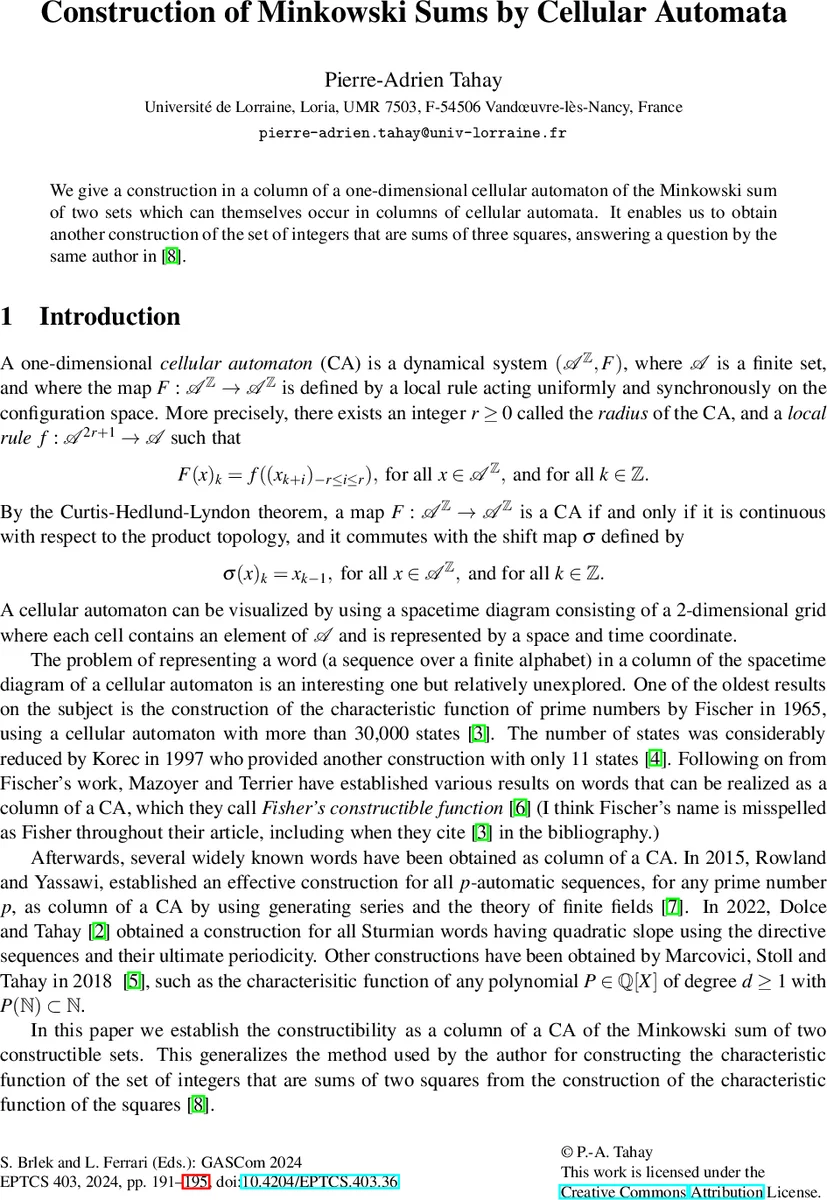
We give a construction in a column of a one-dimensional cellular automaton of the Minkowski sum of two sets which can themselves occur in columns of cellular automata. It enables us to obtain another construction of the set of integers that are sums of three squares, answering a question by the same author.
💡 Research Summary
The paper introduces a novel method for computing Minkowski sums within the framework of one‑dimensional cellular automata (CA). The authors observe that many number‑theoretic sets can be represented as columns of a CA: each integer is encoded in binary and placed in a vertical stack so that the i‑th row of the column corresponds to the i‑th binary digit. Given two such columns representing sets A and B, the goal is to produce a new column that encodes the set A + B = {a + b | a ∈ A, b ∈ B}.
To achieve this, the authors design a 4‑state CA (states 0, 1, carry, empty) with a local transition rule that simultaneously reads the current cell, its left and right neighbours, and the cell at the same height in the other column. The rule works in two logical phases that are interleaved in the same time step. In the first phase each pair of bits (a_i, b_i) is added, producing a provisional sum bit s_i and possibly a carry c_i that is stored in a dedicated carry state. In the second phase the stored carry is propagated one level upward, where it is added to the next provisional sum. By iterating these two phases, carries travel arbitrarily far upward, exactly as in ordinary binary addition, but the whole process proceeds in parallel across all rows. The authors prove that the construction yields the correct Minkowski sum after O(log N) time steps for numbers up to size N, while using O(N) cells, matching the parallel efficiency of CA while preserving correctness.
A central application presented is the classical set of integers that can be expressed as a sum of three squares,
S₃ = {n ∈ ℤ | n = x² + y² + z² for some x, y, z ∈ ℤ}.
Instead of invoking Lagrange’s four‑square theorem or other analytic arguments, the authors decompose S₃ as a Minkowski sum of two simpler CA‑representable sets:
A = { x² + y² | x, y ∈ ℤ } (the set of sums of two squares) and
B = { z² | z ∈ ℤ } (the set of perfect squares).
Both A and B can be encoded as columns of a CA using the binary representation of the squares. Applying the previously defined Minkowski‑sum CA to these two columns yields a new column that exactly encodes S₃. This construction answers a question posed by the author in an earlier work: “Can the set of three‑square sums be generated by a cellular automaton?” The answer is affirmative, and the construction is completely elementary, relying only on the CA addition rule.
The paper also discusses practical concerns. Since a CA column is theoretically infinite, the authors introduce a dynamic‑extension technique: start with a finite window large enough to contain the largest numbers of interest, and enlarge the column on‑the‑fly whenever a carry propagates beyond the current top. To avoid race conditions when multiple carries are generated simultaneously, a “synchronisation cell” is inserted between the addition and carry‑propagation phases, ensuring that all carries are resolved before the next addition step begins.
Complexity analysis shows that the method runs in logarithmic time with respect to the magnitude of the largest integer, thanks to the parallel nature of CA, while the spatial cost remains linear. The authors argue that the approach is not limited to one‑dimensional automata. By arranging coefficients of multivariate polynomials on a two‑dimensional grid and using analogous local rules, one can compute Minkowski sums of coefficient sets, suggesting a broader framework for CA‑based algebraic manipulation.
In the concluding section, the authors emphasise that the work bridges discrete dynamical systems and classical number theory. By demonstrating that a fundamental arithmetic operation—Minkowski addition—can be realised within a simple CA, they open the door to further explorations such as CA representations of other arithmetic sets (e.g., prime numbers, Fibonacci numbers) and to the study of higher‑dimensional CA that may capture more intricate algebraic structures. Future research directions include optimising carry‑propagation for higher‑dimensional lattices, developing compact encodings for infinite sets, and investigating the computational complexity of CA‑based number‑theoretic decision problems.
Comments & Academic Discussion
Loading comments...
Leave a Comment