Multi-place nonlocal systems
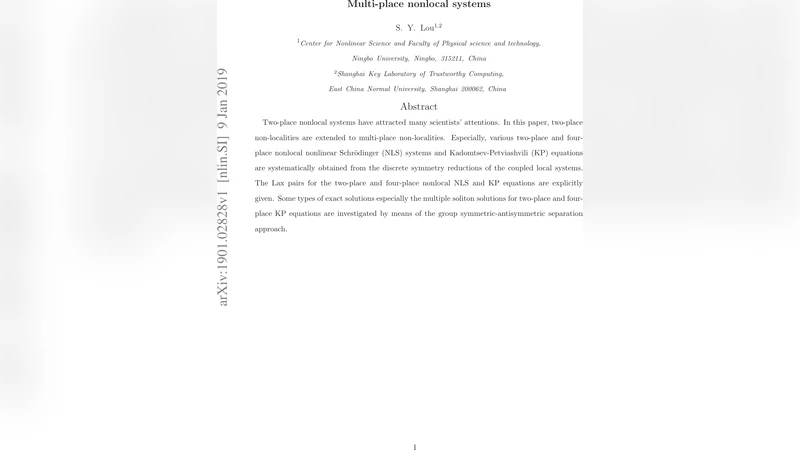
Two-place nonlocal systems have attracted many scientists’ attentions. In this paper, two-place non-localities are extended to multi-place non-localities. Especially, various two-place and four-place nonlocal nonlinear Schrodinger (NLS) systems and Kadomtsev-Petviashvili (KP) equations are systematically obtained from the discrete symmetry reductions of the coupled local systems. The Lax pairs for the two-place and four-place nonlocal NLS and KP equations are explicitly given. Some types of exact solutions especially the multiple soliton solutions for two-place and four-place KP equations are investigated by means of the group symmetric-antisymmetric separation approach.
💡 Research Summary
The paper “Multi‑place nonlocal systems” extends the rapidly growing field of two‑place (or Alice‑Bob) nonlocal integrable equations to a general framework that accommodates an arbitrary number of spatial‑temporal locations. The authors develop two complementary constructive methods. The first method starts from an m‑component coupled local system K_i(u_1,…,u_m)=0 and identifies a finite discrete symmetry group G={ĥg_0=I,ĥg_1,…,ĥg_{n‑1}} acting on the independent variables X={x_1,…,x_d,t}. By performing a suitable change of variables u_i=U_i(v_1,…,v_m) the original system is rewritten in terms of new fields v_j. Imposing the G‑symmetry reduction v_j=ĥg·v_k for appropriate group elements produces equations in which the fields at one point are linked to fields at distinct points (ĥg·X≠X). When this occurs the reduced system is a multi‑place nonlocal model. As a concrete illustration the authors take an eight‑element group G_1∪ĥC G_1 (parity in x, parity in y, time reversal, and complex conjugation) acting on a four‑component coupled Kadomtsev‑Petviashvili (KP) system (equation (6)). The eight symmetry‑reduced equations (9) include, for the subgroup {I,ĥC}, the ordinary local KP system, while the remaining reductions give genuine two‑place nonlocal KP equations.
The second method, termed “Consistent Correlated Bang” (CCB), begins with a single‑component integrable equation (the KP equation (11)) and “bangs” it into an m‑component system by introducing a linear superposition u=∑_{i=0}^{m‑1}u_i. Substituting this ansatz into the original equation yields a coupled system (14) with arbitrary source terms G_i that must satisfy a consistency condition (15). The fields u_i are then correlated through discrete operators ĥg_i, i.e. u_j=ĥg_j u_0, forming a finite group of order m. The consistency condition forces the source terms to be invariant under the same group, and the resulting equations inherit the nonlocal structure dictated by the operators. Choosing m=8 and the same eight‑element group as above reproduces a four‑place complex KP equation (19)–(20).
Having established the general machinery, the authors apply it to several classic integrable hierarchies. For the nonlinear Schrödinger (NLS) family they start from the AKNS system (23) and construct two four‑component extensions (29) and (30). Both extensions possess large discrete symmetry groups (16‑element and 24‑element respectively) generated by parity (P), time reversal (T), complex conjugation (C), field reflection (F), and field exchange (E_{q,r}). By selecting various group elements ˆf and ˆg they derive a comprehensive catalogue of nonlocal NLS equations: (i) the well‑known two‑place PT‑symmetric NLS (28); (ii) new two‑place equations involving combinations of P, T, and C; and (iii) six genuinely four‑place nonlocal NLS equations where the field depends on four distinct space‑time arguments (x,t), (−x,t), (x,−t), (−x,−t). Representative examples are equations (56) and (57).
For each nonlocal NLS and KP model the authors explicitly write down Lax pairs, guaranteeing integrability. The Lax pair for the four‑component AKNS system is given in matrix form (42)–(43); the two‑component AKNS Lax pair appears in (44)–(45). The four‑place KP equation inherits the same spectral problem, confirming that the nonlocal reductions preserve the zero‑curvature condition.
The paper also addresses exact solution construction. Using the “group symmetric‑antisymmetric separation” technique, the authors decompose a multi‑place field into a symmetric part (invariant under a subgroup of G) and an antisymmetric part (changing sign). Each part satisfies a standard KP equation, allowing the well‑known multi‑soliton formulas to be transplanted directly. Consequently, explicit multi‑soliton solutions for both two‑place and four‑place KP equations are obtained, illustrating how nonlocal interactions modify the phase shifts and interaction patterns while preserving solitonic stability.
In the concluding section the authors emphasize the conceptual significance of their work: (1) they provide a unified algebraic framework for generating multi‑place nonlocal integrable equations from any local coupled system; (2) the CCB method offers a systematic route to lift low‑dimensional models to higher‑dimensional nonlocal counterparts; (3) the explicit Lax pairs and soliton solutions demonstrate that the enlarged nonlocal hierarchy retains the hallmark features of integrability. Potential applications are suggested in areas where spatially separated but correlated dynamics arise, such as quantum entanglement across distant sites, parity‑time‑symmetric optics, and Bose‑Einstein condensates with nonlocal interactions. The authors acknowledge that physical realizations of the discrete operators (especially combined space‑time reflections) and the treatment of initial/boundary conditions for multi‑place equations remain open problems, and they propose numerical simulations and experimental designs as future directions.
Comments & Academic Discussion
Loading comments...
Leave a Comment