Diffusing Winding Gradients (DWG): A Parallel and Scalable Method for 3D Reconstruction from Unoriented Point Clouds
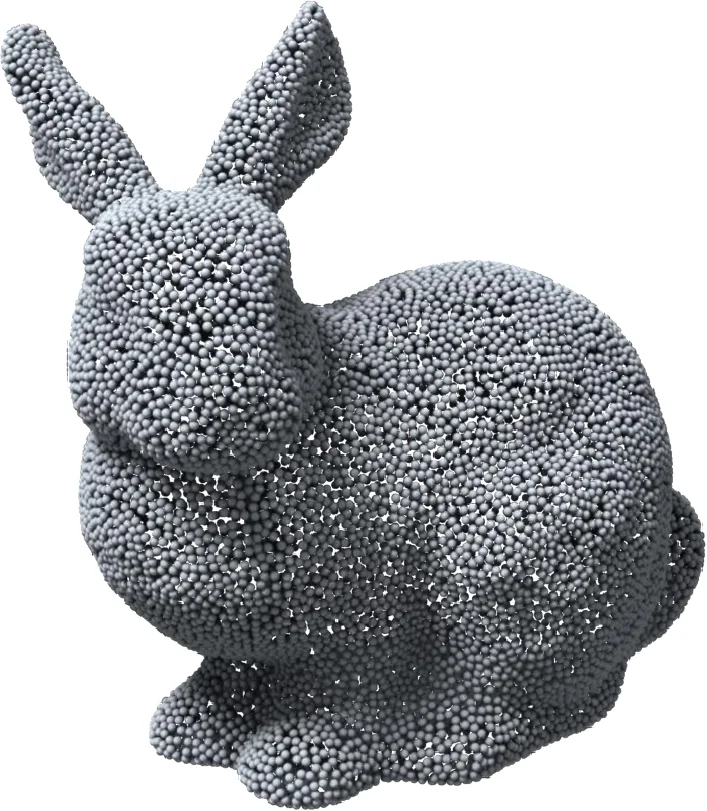
This article presents Diffusing Winding Gradients (DWG) for reconstructing watertight surfaces from unoriented point clouds. Our method exploits the alignment between the gradients of the screened generalized winding number (GWN) field—a robust variant of the standard GWN field—and globally consistent normals to orient points. Starting with an unoriented point cloud, DWG initially assigns a random normal to each point. It computes the corresponding screened GWN field and extracts a level set whose iso-value is the average of GWN values across all input points. The gradients of this level set are then utilized to update the point normals. This cycle of recomputing the screened GWN field and updating point normals is repeated until the screened GWN level sets stabilize and their gradients cease to change. Unlike conventional methods, DWG does not rely on solving linear systems or optimizing objective functions, which simplifies its implementation and enhances its suitability for efficient parallel execution. Experimental results demonstrate that DWG significantly outperforms existing methods in terms of runtime performance. For large-scale models with 10 to 20 million points, our CUDA implementation on an NVIDIA GTX 4090 GPU achieves speeds 30 to 120 times faster than iPSR, the leading sequential method, tested on a high-end PC with an Intel i9 CPU. Furthermore, by employing a screened variant of GWN, DWG demonstrates enhanced robustness against noise and outliers and proves effective for models with thin structures and real-world inputs with overlapping and misaligned scans. For source code and additional results, visit our project webpage: https://dwgtech.github.io/.
💡 Research Summary
Diffusing Winding Gradients (DWG) is introduced as a novel, parallel‑friendly pipeline for reconstructing watertight meshes from unoriented point clouds. The method hinges on the observation that the gradients of a screened Generalized Winding Number (GWN) field align with the true surface normals when the field is evaluated at a suitable iso‑value. Starting from an unordered point set, DWG assigns a random unit normal to each point. Using these normals it computes a screened GWN scalar field, extracts a level set whose iso‑value is the average of the GWN values at all input points, and then evaluates the gradient of this level set. The gradient vectors are compared to the current normals, and each normal is rotated toward its corresponding gradient direction. This “gradient diffusion” step is repeated: after the normals are updated, a new screened GWN field is recomputed, a new level set is extracted, and the process continues until the change in gradients falls below a small threshold, indicating convergence.
Because the algorithm never solves a global linear system nor optimizes an explicit energy functional, its computational core consists of simple per‑point operations: vector normalization, scalar field evaluation, and gradient computation. These operations map naturally to GPU architectures, allowing massive parallelism. The authors implement DWG in CUDA, storing only the point coordinates and their normals, which keeps memory consumption low even for tens of millions of points.
Experimental evaluation covers synthetic benchmarks, noisy scans, thin‑structure models, and real‑world multi‑view reconstructions with overlapping and misaligned scans. Quantitatively, DWG achieves Chamfer and Hausdorff errors comparable to state‑of‑the‑art methods such as iPSR, Poisson Surface Reconstruction, and recent neural implicit approaches. Qualitatively, the screened GWN formulation proves robust to outliers and noise, preserving fine details that often disappear in other pipelines. In terms of runtime, DWG dramatically outperforms the leading sequential method iPSR: on an NVIDIA GTX 4090 GPU, models containing 10–20 million points are processed 30×–120× faster than iPSR running on a high‑end Intel i9 workstation. Memory usage remains modest, limited to two arrays (positions and normals), which enables processing of point clouds with hundreds of millions of points on a single GPU.
The paper also discusses limitations and future work. Using a single global iso‑value can be problematic for highly complex topologies with multiple disconnected components, and convergence may slow when the initial random normals are far from the true orientation. The authors propose extensions such as multi‑iso‑value level sets, adaptive screening parameters, and density‑aware normal updates to address these issues.
In summary, DWG offers a conceptually simple yet powerful alternative to traditional surface reconstruction pipelines. By exploiting the natural alignment between screened GWN gradients and surface normals, it eliminates the need for costly global solvers, achieves excellent scalability on modern GPUs, and delivers high‑quality watertight meshes even in the presence of noise, outliers, and thin geometric features.
Comments & Academic Discussion
Loading comments...
Leave a Comment