3DMeshNet: A Three-Dimensional Differential Neural Network for Structured Mesh Generation
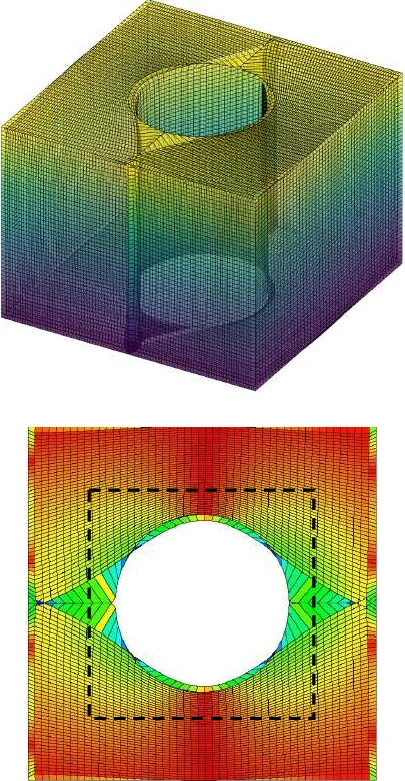
Mesh generation is a crucial step in numerical simulations, significantly impacting simulation accuracy and efficiency. However, generating meshes remains time-consuming and requires expensive computational resources. In this paper, we propose a novel method, 3DMeshNet, for three-dimensional structured mesh generation. The method embeds the meshing-related differential equations into the loss function of neural networks, formulating the meshing task as an unsupervised optimization problem. It takes geometric points as input to learn the potential mapping between parametric and computational domains. After suitable offline training, 3DMeshNet can efficiently output a three-dimensional structured mesh with a user-defined number of quadrilateral/hexahedral cells through the feed-forward neural prediction. To enhance training stability and accelerate convergence, we integrate loss function reweighting through weight adjustments and gradient projection alongside applying finite difference methods to streamline derivative computations in the loss. Experiments on different cases show that 3DMeshNet is robust and fast. It outperforms neural network-based methods and yields superior meshes compared to traditional mesh partitioning methods. 3DMeshNet significantly reduces training times by up to 85% compared to other neural network-based approaches and lowers meshing overhead by 4 to 8 times relative to traditional meshing methods.
💡 Research Summary
The paper introduces 3DMeshNet, a novel physics‑informed neural network designed for fast and high‑quality three‑dimensional structured mesh generation. Traditional mesh generation methods fall into two categories: algebraic approaches such as Transfinite Interpolation (TFI), which are fast but prone to element distortion and intersections on complex geometries, and PDE‑based methods that produce superior meshes at the cost of heavy computational effort. Recent data‑driven techniques either require large labeled datasets (supervised learning) or suffer from instability and long training times when using unsupervised physics‑informed approaches (e.g., MGNet). Moreover, most prior work focuses on 2‑D meshes, leaving 3‑D structured mesh generation largely unexplored.
Core Idea
3DMeshNet treats mesh generation as learning a smooth, bijective mapping (F: (\xi,\eta,\zeta) \rightarrow (x,y,z)) from a simple parametric cube (
Comments & Academic Discussion
Loading comments...
Leave a Comment