The Syllogistic with Unity
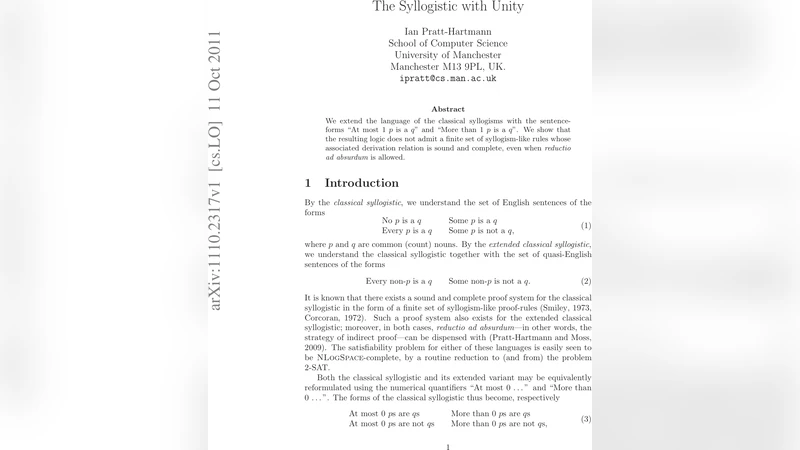
We extend the language of the classical syllogisms with the sentence-forms “At most 1 p is a q” and “More than 1 p is a q”. We show that the resulting logic does not admit a finite set of syllogism-like rules whose associated derivation relation is sound and complete, even when reductio ad absurdum is allowed.
💡 Research Summary
The paper investigates the effect of adding simple counting quantifiers to the classical syllogistic. The author introduces two new sentence forms, “At most i p are q” (written ∃≤i(p,q)) and “More than i p are q” (written ∃>i(p,q)), where i is a non‑negative integer. When i = 0 these formulas collapse to the traditional four categorical statements (No p is q, Some p is q, Every p is q, Some p is not q). The case i = 1 yields what the author calls the “syllogistic with unity”, i.e. the smallest non‑trivial extension of the classical system. More generally, for each integer z ≥ 0 the paper defines a language S_z (and its extended counterpart S†_z) that allows all quantifiers ∃≤i and ∃>i with 0 ≤ i ≤ z. The union over all z gives the full numerical syllogistic N (and its extended version N†).
The first technical contribution is a complexity analysis of the satisfiability problem for these languages. The classical syllogistic (S_0) and its extended version (S†_0) are known to be NLogSpace‑complete, reflecting their very limited expressive power. The author shows that as soon as any counting quantifier beyond i = 0 is permitted (i.e. for every z > 0) the satisfiability problem becomes NP‑complete. The NP‑hardness for S_1 is proved by a reduction from graph 3‑colorability, using a clever encoding of the “at most three p are p” constraint with only the unit‑level quantifiers. For the general case, a small‑model theorem is established: any satisfiable set of S_z‑formulas has a model whose domain size is bounded by (z + 1)·|Φ|, where Φ is the set of formulas. This yields an NP‑membership proof because a nondeterministic algorithm can guess such a bounded model and verify all formulas in polynomial time.
The second, and more novel, contribution concerns proof theory. The paper formalizes two notions of syllogistic derivation. The direct system ⊢_X is the usual natural‑deduction style: a finite set of premises Θ derives a conclusion θ if there is a tree of rule applications using a fixed set X of syllogistic rules. The indirect system ⟹_X extends ⊢_X with a single additional clause that implements reductio ad absurdum: if Θ together with a formula ψ leads to an absurdity (any formula of the form ∃>i(p,¬p)), then Θ derives ¬ψ. Both systems are sound by construction, because every rule in X is required to be semantically valid.
The central theorem states that for any finite set X of syllogistic rules in the language S_1 (or its extended version S†_1) the indirect system ⟹_X is not complete. In other words, there is no finite, rule‑based, syllogistic‑style calculus— even allowing indirect proof—that captures all valid entailments of the syllogistic with unity. The proof proceeds by assuming a finite X, constructing a “complete” set of formulas (for each atomic pair either the formula or its negation belongs to the set) that is consistent with the semantics but cannot be refuted using X. The construction exploits the fact that with the unit‑level quantifiers one can express constraints such as “at most one o is p” and “at most one o is ¬p”, which together force the domain to contain at most two objects of a certain type. By carefully arranging several such constraints the author builds a model that satisfies all premises but violates a conclusion that would be entailed in the full logic. Since the premises do not lead to a contradiction in the finite system, the conclusion cannot be derived, proving incompleteness.
The incompleteness result is then generalized: for every integer z ≥ 1, no finite set of syllogistic rules in S_z (or S†_z) yields a complete indirect derivation system. Consequently, the addition of any non‑zero counting bound already destroys the possibility of a finite, syllogism‑like axiomatization.
Finally, the paper compares the syllogistic with unity to a 19th‑century system proposed by William Hamilton, in which each categorical sentence carries an implicit existential quantifier and can be dualized to produce “All p are all q”. Under a natural interpretation of Hamilton’s “all‑all” as a statement of identity (∀x(p(x) → ∀y(q(y) → x = y)), the two systems share some superficial similarities (both can express that exactly one object satisfies a predicate). However, Hamilton’s language lacks the ability to assert “exactly one p is q” when p and q are distinct, and its proof theory does admit a complete syllogistic calculus if indirect reasoning is allowed. By contrast, the syllogistic with unity can express that exact‑one relationship but resists any finite complete axiomatization.
In summary, the paper demonstrates that the smallest quantitative extension of the classical syllogistic—adding the ability to say “at most one” and “more than one”—already brings about a dramatic shift in both computational and proof‑theoretic properties. Satisfiability jumps from NLogSpace‑complete to NP‑complete, and no finite set of syllogistic‑style inference rules (even with reductio) can capture all valid inferences. This result clarifies why the full numerical syllogistic, despite its apparently modest augmentation, behaves fundamentally differently from its classical predecessor.
Comments & Academic Discussion
Loading comments...
Leave a Comment