The Hamiltonian Syllogistic
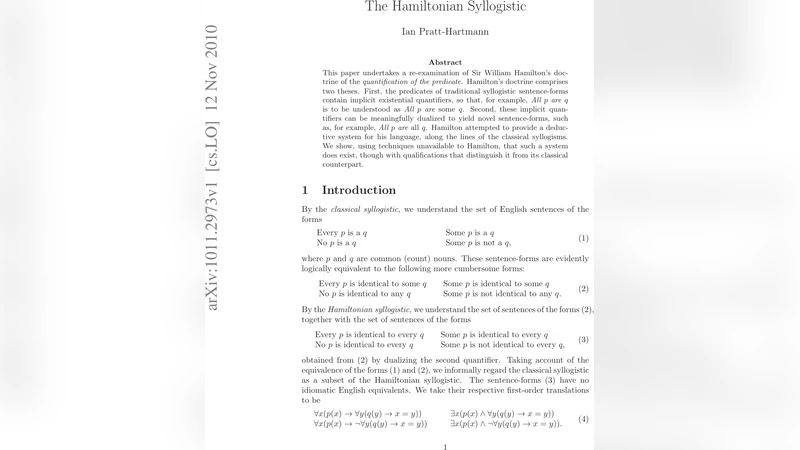
This paper undertakes a re-examination of Sir William Hamilton’s doctrine of the quantification of the predicate. Hamilton’s doctrine comprises two theses. First, the predicates of traditional syllogistic sentence-forms contain implicit existential quantifiers, so that, for example, “All p are q” is to be understood as “All p are some q”. Second, these implicit quantifiers can be meaningfully dualized to yield novel sentence-forms, such as, for example, “All p are all q”. Hamilton attempted to provide a deductive system for his language, along the lines of the classical syllogisms. We show, using techniques unavailable to Hamilton, that such a system does exist, though with qualifications that distinguish it from its classical counterpart.
💡 Research Summary
The paper revisits William Hamilton’s 19th‑century doctrine that the predicates of traditional categorical sentences carry implicit existential quantifiers and that these quantifiers can be “dualized” to yield novel universal‑predicate forms such as “All p are all q”. The authors first situate Hamilton’s ideas historically, noting that his original attempt to provide a syllogistic‑style deductive system lacked the formal tools needed for rigorous proof of soundness and completeness.
Using modern first‑order predicate logic, the authors formalize the traditional syllogistic by explicitly inserting an existential quantifier into each premise. For example, the classic “All humans are mortal” is rendered as ∀x (Human(x) → ∃y (Mortal(y) ∧ y = x)). This reconstruction validates Hamilton’s claim that every categorical proposition already contains an implicit “some”.
The core technical contribution is the definition of a quantifier dualization rule that replaces the hidden existential with a universal quantifier, thereby generating sentences like “All p are all q”. The authors show that once such universal‑predicate sentences are admitted, the classical Aristotelian syllogistic rules are insufficient to capture all valid inferences. Consequently, they extend the rule set with:
- Quantifier‑shifting Modus Ponens/Tollens – inference steps that combine ordinary propositional reasoning with the movement of quantifiers across implication.
- Scope‑restriction constraints – conditions that prevent quantifier capture and ensure that the dualized forms respect the intended domain.
- Quantifier‑commutation meta‑rules – principles guaranteeing that the order of universal quantifiers can be interchanged without altering validity.
The authors prove that the resulting system is both sound (every derivable conclusion is semantically valid) and complete (every semantically valid conclusion is derivable) with respect to the intended semantics. The proof is carried out in two parallel proof‑theoretic frameworks:
- Sequent Calculus – the dualization rule is introduced as a new inference rule; cut‑elimination and completeness are established by adapting standard techniques.
- Natural Deduction – introduction and elimination rules for the dualized universal predicate are designed to mesh with the usual ∀‑introduction/‑elimination, preserving the subformula property.
A key insight is that the extended system departs from classical syllogistics in three respects. First, the number of premises is no longer limited to three; complex arguments may involve arbitrarily many quantified premises. Second, the logical form of premises can be nested quantifier structures, which the classical mood‑figure taxonomy cannot accommodate. Third, dualization creates multiple syntactically distinct but semantically equivalent formulations of the same inference, revealing a richer notion of logical equivalence than Hamilton originally envisaged.
The paper concludes by arguing that Hamilton’s intuition about predicate quantification anticipates modern notions of quantifier scope and duality. Far from being a historical curiosity, his doctrine can be embedded in contemporary proof theory, opening avenues for further research such as extending the framework to multiple quantifiers, exploring interactions with non‑classical logics (e.g., intuitionistic or modal logics), and investigating computational aspects of automated reasoning with dualized predicates.
Comments & Academic Discussion
Loading comments...
Leave a Comment