n-Groupoids and Stacky Groupoids
We discuss two generalizations of Lie groupoids. One consists of Lie $n$-groupoids defined as simplicial manifolds with trivial $\pi_{k\geq n+1}$. The other consists of stacky Lie groupoids $\cG\rra M$ with $\cG$ a differentiable stack. We build a 1-…
Authors: Chenchang Zhu
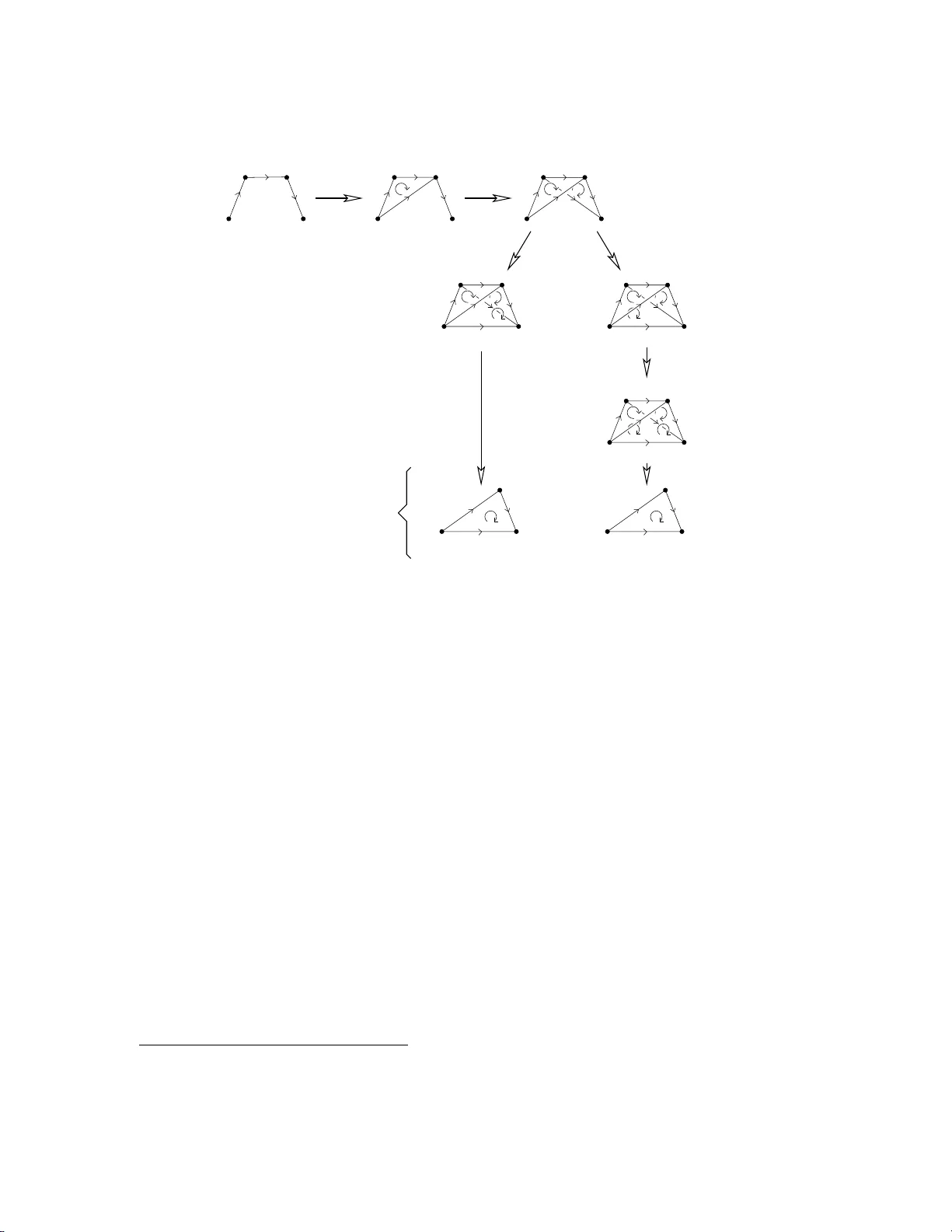
n -group oids and stac ky group oids Chenc hang Zh u ∗ Mathematisc hes Institut Bunsenstr. 3-5 D-37073 Göttingen German y (zh u@ uni-math.gwdg.de) April 23, 2024 Abstract W e discuss tw o genera lizations of Lie gr oupoids. One co nsists of Lie n -gr o upoids defined as simplicial manifolds with trivia l π k ≥ n +1 . The other consists o f stacky Lie group oids G ⇒ M with G a differen tiable stac k . W e build a 1 –1 corresp ondence be tw een Lie 2-gro upoids and stacky Lie group oids up to a certain Morita equiv alence. W e prov e this in a general set-up so that the s tatemen t is v alid in both different ial and top ological categories . Hyper co vers of higher g roupoids in v arious categor ies are also describ ed. KEY W ORDS stac ks, group oids, simplic ial o b jects, Morita equiv alence Con ten ts 1 In tro duction 2 2 n -group oid ob jects and morphisms in v arious categories 8 2.1 Hyp erco v ers of n -group oid ob jects . . . . . . . . . . . . . . . . . . . . . . . 9 2.2 Pull-bac k, generalize d morphism s and v arious Morit a equiv alences . . . . . 14 2.3 Cosk m , Sk m and finite data description . . . . . . . . . . . . . . . . . . . . 15 3 Stac ky groupoids in v arious categories 20 3.1 Go od c harts . . . . . . . . . . . . . . . . . . . . . . . . . . . . . . . . . . . . 24 3.2 The inv erse map . . . . . . . . . . . . . . . . . . . . . . . . . . . . . . . . . 28 4 2 -groupoids and stacky group oids 32 4.1 F rom sta c ky group oids t o 2-g r oupoids . . . . . . . . . . . . . . . . . . . . . 32 4.2 F rom 2- group oids to stac ky group oids . . . . . . . . . . . . . . . . . . . . . 35 4.3 One-to-one corresp ond ence . . . . . . . . . . . . . . . . . . . . . . . . . . . 40 ∗ Researc h partially supp orted by th e Liftoff fello wship 2004 of the Cla y Institute 1 1 In tro duction Recen tly there has b een m uc h interest in higher g r o up(oid)s, w h ic h general ize the notion of group(oid)s in v arious wa ys . Some of them tur n out to b e u na voidable to study pr oble ms in differen tial geometry . An example comes from the string group, whic h is a 3-connecte d co v er of S pin ( n ). More generally , to any compact simply c onnected group G one can asso ci ate it s string g r o up S tr ing G . It has v arious mo dels, give n by Stolz and T e ichner [34, 35] us ing an infin ite -d imen s io n al extension of G , by Brylinski [9] using a U (1)-ge r be with t he c onn ec tion o v er G , and recen tly b y B aez et al. [4] u sing Lie 2-groups and Lie 2-alge b ras. Henriques [21] constru cts the string group a s a higher group that w e study in this pap er and as an in tegration ob ject of a certain Lie 2-algebra with an integ ration pro cedure w hic h is also studied i n [18, 40, 43]. Other examples come f r om a kind of étale stac ky group oid (cal led a W einstein group oid) [37] built up on the v ery imp ortan t w ork of [12 , 13]. These stac ky group oids are the global ob jects in 1–1 corresp ondence with Lie algebroids. A Lie algebroid can b e u nderstoo d as a degree-1 su per manifold with a degree-1 h o mologica l v ector field, or more precisely as a v ector bund le A → M equip ped w it h a Lie brac k et [ , ] on the sectio ns of A and a vect or bundle morphism ρ : A → T M , satisfying a Leibniz rule, [ X, f Y ] = f [ X, Y ] + ρ ( X )( f ) Y . When the base M is a p oint , th e Lie algebroid b ecomes a Lie algebra. Notice that un like (finite-dimensional) Lie algebras wh ich alw ays ha v e asso ciated Lie groups, Lie algebroids do not alwa ys hav e associated Lie group oids [2, 3]. One needs to en ter the world of stac ky group oids to obtain the desired 1–1 corresp ondence. Since Lie algebroids are closely related to P oisson geomet r y , this result applies to complete the first step of W einstein’s program of qu a n tization of Poisso n manifolds: to asso ciate to P oisson manifolds their sym p le ctic group oids [41, 42]. It turns out that some “non-in tegrable” P oisson manifolds cannot h a v e symplectic (Lie) group oids. A solution to this problem is giv en in [38] with the ab o v e result so that every Poisson m anifold has a corresp onding stac ky symplectic g r oupoid. 2-group(oid)s w ere already studied in the early t w ent ieth c entury by Whitehea d and his fol lo we r s un der v arious terms, such as crossed mod ules. They are a lso studied from the asp ect of “gr-c hamp” (i.e. stac ky groups) by Breen [7]. Recen tly , v arious v ersions of 2-groups, with differen t strictness, ha ve b ee n stud ie d b y Baez’s school (the b est thing is to read their n-catego r y café on http:/ /golem.ph.utexas .edu/categ ory/ ). These authors also study a lot of develo p men ts on the sub jects surroun ding 2-groups s u c h as 2-bu ndles, 2-connectio n s and the relation with gerb es. It seems that it is required no w t o h a v e a u n iform metho d to describ e 2-groups so t hat it op ens a wa y to treat all higher group oids. I n this pap er, w e apply a simplicial metho d to describ e all h ig her group oid ob jects in v arious categori es in an elegan t wa y , and pro ve when n = 2, they are the same as stac ky group oid ob jects in these ca tegory . This id e a (set theoretica lly) was kno wn muc h earlier by Duskin and Glenn [14, 19]. Th e 0 -simplices cor- resp ond to the ob jects, the 1-simplices corresp ond to the arr ows (or 1-morph isms), an d the higher dimens ional simplices corresp ond to the h ig her morphisms. This metho d b ecomes m u ch more suitable when deali ng with the differen tial or top o logica l category . Recall that a simp li cial set (resp ec tiv ely manifold) X is made up of sets (resp ectiv ely 2 manifolds) X n and structure maps d n i : X n → X n − 1 (face maps) s n i : X n → X n +1 (degeneracy m ap s ) , for i ∈ { 0 , 1 , 2 , . . . , n } that sati sfy the co herence conditions d n − 1 i d n j = d n − 1 j − 1 d n i if i < j, s n i s n − 1 j = s n j +1 s n − 1 i if i ≤ j, d n i s n − 1 j = s n − 2 j − 1 d n − 1 i if i < j, d n j s n − 1 j = id = d n j +1 s n − 1 j , d n i s n − 1 j = s n − 2 j d n − 1 i − 1 if i > j + 1 . (1) The first t wo examples of simplicial sets are th e simplicial m -simplex ∆[ m ] and the horn Λ[ m, j ] with (∆[ m ]) n = { f : (0 , 1 , . . . , n ) → (0 , 1 , . . . , m ) | f ( i ) ≤ f ( j ) , ∀ i ≤ j } , (Λ[ m, j ]) n = { f ∈ (∆[ m ]) n | { 0 , . . . , j − 1 , j + 1 , . . . , m } * { f (0) , . . . , f ( n ) }} . (2) In fact the horn Λ[ m, j ] is a simplicial set obtained from the simplicial m -simplex ∆[ m ] b y taking a wa y its unique non-degenerate m -simplex as we ll as the j -th of its m + 1 non- degenerate ( m − 1)-simplices, as in the follo wing p ic tu re (in this p aper all the arrows are orien ted from bigger n umbers t o smaller num b ers): Λ[1,1] Λ[1,0] Λ[2,2] Λ[2,1] Λ[2,0] Λ[3,3] Λ[3,2] ... A simplicial set X is K an if an y map from the h o rn Λ[ m, j ] to X ( m ≥ 1, j = 0 , . . . , m ), extends to a map fr om ∆[ m ]. Let us call K an ( m, j ) the Kan condition for the horn Λ[ m, j ]. A K an simplicial set is therefore a simplicial set satisfying K an ( m, j ) for all m ≥ 1 and 0 ≤ j ≤ m . In the language of g r oupoids, the Kan cond it ion corresp onds to the possibilit y of comp osing and inv erting v arious morphisms. F or example, the existence of a comp osition for arro ws is giv en b y the condition K an (2 , 1), whereas the comp osition of an arrow with the in v ers e of another is give n by K an (2 , 0) and K an (2 , 2). a a b ab b a b −1 −1 Kan(2,2) Kan(2,0) b ab a Kan(2,1) (3) Note th at the comp osition of t wo arrows is in general not unique, b ut an y t wo of them can b e joined b y a 2-morph ism h giv en b y K an (3 , 2). 3 x y z x y z (ab) a b z h a b b ab 1 (ab) z ab (4) Here, h ough t t o b e a b ig on , but since w e do not ha ve an y b ig ons in a simplicial set, w e view i t as a triangle with one of its edge s dege nerate. The degenerate 1- simplex ab o v e z is denoted 1 z . In an n -group oid, the only w ell-defined comp osit ion la w is the one for n -morphisms . This motiv ates the f o llo wing definition. Definition 1.1 . An n -group oid ( n ∈ N ∪ ∞ ) X is a simplicial set that satisfies K an ( m, j ) for all 0 ≤ j ≤ m ≥ 1 and K an !( m, j ) for all 0 ≤ j ≤ m > n , where K an ( m, j ): Any ma p Λ[ m, j ] → X extends to a map ∆[ m ] → X . K an !( m, j ): Any map Λ[ m, j ] → X extends to a u nique m ap ∆[ m ] → X . An n - gr oup is an n -group oid for whic h X 0 is a p oint . When n = 2, th e y are d ifferen t from the v arious kinds of 2-group(oid)s or d o uble group oids in [5, 8] (see [20, App endix] for an explanation of the r el ation b et ween our 2-group and the o ne in [5]), and a re not exactly the s a me as in [30], as h e requires a c h oic e of comp ositio n and strict u nits; ho w eve r, they are the same as in [14]. A usual groupoid (cat egory with only isomo rphisms) is equiv alen t to a 1-group oid in the sense of Def. 1.1. Indeed, from a usual group oid, one can form a simplicial set whose n -simp lices are given b y s equ en ces of n comp osable arro ws. This is a standard construction called the nerve of a group oid and one can chec k that it satisfies the required Kan conditions. On the other hand, a 1-group oid X in the sense of Def. 1.1 giv es us a usu al group oid with ob jec ts and arro ws giv en r e sp ectiv ely b y the 0-simplices and 1-simplices of X . The unit is provided by the d e generacy X 0 → X 1 , the inv erse and comp osition are giv en b y the Kan conditions K an (2 , 0), K an (2 , 1) and K an (2 , 2) as in (3), and the asso ciativit y is giv en b y K an (3 , 2) and K an !(2 , 1). 4 a c b a c b a c b a c b a c b a c b ab ab bc c ab c ab Kan(2,1) Kan(2,1) Kan(2,1) Kan(3,2) (ab)c a(bc) a(bc) (ab)c a(bc) Kan!(2,1) => (ab)c = a(bc) Kan(2,1) Pro of of asso cia tivit y . This motiv ates the corresp onding defi n iti on in a category C with a singleton Grothendiec k pretop olog y T w hic h satisfies some additional mild assumptions (see Assump ti ons 2.1). W e shall assume C has all copro ducts. Definition 1.2. A singleton Gr othendie ck pr etop olo gy 1 on C is a collect ion of m o rphisms, called cov ers, su b ject the follo w ing three axioms: Isomorphisms are co v ers. The comp osition of tw o cov ers is a co v er. If U → X is a co v er and Y → X is a morp hism, th en the pull-bac k Y × X U exists, and the natural morp h ism Y × X U → Y is a c ov er. W e list examples of categories equipp ed w it h singleton Grothendiec k pretop o logies in T able 1, among which ( C i , T ′ i ) for i = 1 , 2 , 3 satisfy Assu m ptio ns 2.1 (with the terminal ob ject ∗ b eing a p oin t). Definition 1.3 . [21] An n -g roup oid ob ject X ( n ∈ N ∪ ∞ ) in ( C , T ) is a simplicial ob jec t in ( C , T ) that s a tisfies K an ( m, j ) for all 0 ≤ j ≤ m ≥ 1 a nd K an !( m, j ) 0 ≤ j ≤ m > n , where K an ( m, j ): The r e striction map hom(∆[ m ] , X ) → h o m(Λ[ m, j ] , X ) is a co v er in ( C , T ). K an !( m, j ): The restriction map hom(∆[ m ] , X ) → h om(Λ[ m, j ] , X ) is an isomorphism i n C . The notation hom ( S, X ), wh en S is a s implic ial set and X is a simplicial ob ject in C , has the same meaning as in [21, Section 2]; in the case of a L ie n - group oid [21, Def. 1.2], wh ic h 1 The original d efi nitio n of Grothendieck pretop olog y [1] requires a collection of morphisms U i → X for a co ver. But since w e a ssume that C has coproducts, a Grothend ie c k pretopology is given by a singleton Grothendiec k pretopology by declaring { U i → X } to b e a co ver if Π i U i → X is a cov er. H ence when coproducts exist, these tw o concepts are the same. 2 See [21, Section 4] for the conv ention on Banach manifolds that we use. 5 is an n -group oid ob ject in ( C , T ) = ( C 1 , T ′ 1 ), we can view simplicial sets ∆[ m ] and Λ[ m, j ] as simp lic ial manifolds with their discrete top ol ogy so th a t hom( S, X ) denotes th e set of homomorphisms of simplicial manifolds with its n a tural top olog y . Thus hom(∆[ m ] , X ) is just another name for X m . Ho w ev er it is n o t ob vious that h om(Λ [ m, j ] , X ) is still an ob ject in C , an d it is a result of [21, Corollary 2.5] (see Section 2 for details). Moreo ver, a Lie n -gr oup is a Lie n -group oid X where X 0 = pt . On the other hand, a stacky Lie (SLie) gr oup oid G ⇒ M , follo wing the concept of W einstein (W-) group oid in [37], is a group oid ob ject in the w orld of d iffe ren tiable stac ks with its b ase M an honest manifold. When G is also a manifold, G ⇒ M is ob viously a Lie group oid. W- gr oup oids , wh ic h are étale SLie group oids, provide a wa y t o build the 1– 1 corresp ondence with L ie algebroids. This concept can b e also adapted to stac ky group oids in v arious catego r ie s (see Def. 3 .4). Giv en these t wo higher generalizatio n s of Lie group oids, Lie n -g r oupoids and S Lie group- oids, arising f rom different motiv ations and constructions, w e ask th e follo wing questions: • Are SLie group oids the same as Lie n -group oids for s ome n ? • If not exa ctly , to whic h exten t they are th e same? • Is there a wa y to also realize Lie n -g r o up oids as int egration obj ects of Lie algebroids? In th is pap er, w e answ er the t w o first questions by Theorem 1.4. Ther e i s a one-to-one c orr esp ondenc e b etwe en SLie (r esp e ctive ly W- ) gr oup- oids and Lie 2 -gr oup oids (r esp e ctively Lie 2 -gr oup oids whose X 2 is étale over hom(Λ[2 , j ] , X ) ) mo dulo 1 -M orita e qui v a lenc es 3 of Lie 2 -gr oup oids. The last question will be answ ered p ositiv ely in a future w ork [43]: Theorem 1.5. L et A b e a Lie algebr oid and let Lmor ( − , − ) b e the sp ac e of Lie algebr oid homomo rphisms satisfying suitable b oundary c onditions. Then Lmor ( T ∆ 2 , A ) / Lmor ( T ∆ 3 , A ) ⇛ Lmor ( T ∆ 1 , A ) ⇒ Lmor ( T ∆ 0 , A ) , is a Lie 2 -gr oup oid c orr esp onding to the W- g r oup oid G ( A ) c onstructe d in [37] under the c orr esp ondenc e in the ab ove the or em. 3 Morita equiv alences preserving X 0 T able 1: Categorie s and pretop ol ogies Notatio n C co v er ( C 1 , T 1 ) Banac h manifolds 2 and smooth morphisms surjectiv e étale morphisms ( C 1 , T ′ 1 ) Banac h manifolds and smo oth morphisms su r jec tiv e submersions ( C 2 , T 2 ) T op ological spaces a nd c on tinuous morphisms surjectiv e étale morphisms ( C 2 , T ′ 2 ) T op ological spaces a nd c on tinuous morphisms surjectiv e con tinuous mo rphisms ( C 3 , T 3 ) Affine sc hemes and sm ooth morphisms surjectiv e étale morphisms ( C 3 , T ′ 3 ) Affine sc hemes and sm ooth morphisms surjectiv e smo oth morph isms 6 With a mild assump tion ab out “go o d c h a rts”, w e are able to prov e a stronger ve rsion of Theorem 1.4 in v arious other catego ries, suc h as top ologica l categories (see Theorem 4.8). If we view a m anifold as a set with additional structure, then we can view our S Lie group oid G ⇒ M as a group oid where the sp ace G o f arro ws is itself a catego r y with certain add iti onal structure. F rom this viewp oin t, our r esult is the analog u e in geometry of Duskin’s result [15] in ca tegory theory . Mo r e o ve r , our stac ks are required to be present able b y certain c harts in C . F or example, when ( C , T ) = ( C 1 , T ′ 1 ) the d ifferentia l categ ory , our stac ks are not just categories fibr ed in group oids ov er C 1 , but fur thermore can be present ed b y L ie group oids. They are c alled differenti able sta cks. Hence to prov e our result, we us e the equiv alence of the 2-category of differen tiable stac ks, morphisms and 2- m o rphisms a n d the 2-cate gory of Lie group oids, Hilsum–Skandalis (H.S.) bibun dles [28, 26] and 2-morphisms. This can b e view ed as an enric hm ent of Duskin’s set-theoretical metho d. Then of course, this enr ic hmen t requir e s a different approac h and solutions of man y tec hnical issues in geometry and top ology that we pr e pare in Section 2 and 3. F ur th erm o re, a su btle p oin t in th e theory of stac ks and group oids is that a stac k can b e present ed by m a n y Morita equiv alent group oids. Hence, for Theorem 1.4 and 4.8, w e also dev elop the theory of morphisms and Morita e quivalenc e of n -group oids, which is exp ecte d to b e useful in the theory of n -stac ks and n -gerb es and should corresp o nd to Morita equiv alence of stac ky group o ids in [10] when n = 2. The reader’s first guess ab out the morphisms of n -group oid ob jects in ( C , T ) is p robably that a morphism f : X → Y ough t to b e a simp li cial morphism, namely a collec tion of morphisms f n : X n → Y n in C that comm ute with faces and degeneracies. In the language of categories, this is just a n a tural transformation from the functor X to the fu n ct or Y . W e shall call suc h a natural transformation a strict map from X to Y . Unfortun ately , it is kno wn that, already in the case of u sual Lie group oids, such s t rict notio ns are not go o d enough. Indeed there a re strict maps that are not in v ertible ev en though they ought to b e isomorphisms. That’s why p eople in tro duced the notion of H.S. bibu n dles. Here is an example of suc h a map: consider a manifold M with an open co ver {U α } . The simplicial manifold X with X n = F α 1 ,...,α n U α 1 ∩ · · · ∩ U α n maps naturally to the constan t simp lic ial manifold M . All the fib ers of that map are simplices, in particular they are contrac tible simplicial sets. Ne vertheless, that map has no inv erse. The sec on d guess is then to define a sp ecia l cla s s of strict m ap s whic h we shall call hyp er c overs . A map from X to Y w ould then b e a zig-zag of strict maps X ∼ ← Z → Y , where the ma p Z ∼ → X is one of these h yp erco vers. This will be equiv alen t to bibundle approac h . The notion of hyp erco v er is neverthele ss v ery useful (e.g., to define sheaf cohomology of n -group oid ob jects in ( C , T )) and w e study it in Sect ion 2.1. W e also find some tec hnical impr o v emen ts of the concept of SLie group oid: it turn s out that an SLie group oid G ⇒ M alw a ys has a “go od group oid p resen tation” G of G , whic h p ossesses a strict group oid map M → G . Moreo ver the condition on the inv erse map can b e simp lified . Notation Cha rt G ⇒ M , H ⇒ N : stac ky group oids; ¯ s , ¯ t , ¯ e , ¯ i , m : source, target, iden tit y , inv erse and multiplicat ion of a stac ky group oid; G := G 1 ⇒ G 0 : a group oid presen tation of G ; s G , t G , e G , i G : the sour ce , target, iden tit y and inv erse of the group oid G resp ectiv ely; 7 s , t : G 0 → M : the morph isms presen ting ¯ s , ¯ t : G → M resp ectiv ely; η i , γ i : the face facing the vertex i , moreo v er γ i b elongs to G 1 ; η ij k , γ ij k : the face with v ertices i , j and k , moreo v er γ ij k b elongs to G 1 ; J l , J r : the left and the righ t momen t maps 4 of an H.S. bibundle E b et w een tw o group oid ob jects K 1 ⇒ K 0 and K ′ 1 ⇒ K ′ 0 , K 1 E J l ⑧ ⑧ ⑧ ⑧ ⑧ ⑧ ⑧ ⑧ J r ❅ ❅ ❅ ❅ ❅ ❅ ❅ ❅ K ′ 1 K 0 K ′ 0 . A c kno wledgments: Here I wo u ld like to thank Henrique Bur szt y n and Alan W einstein for their hosti ng a nd v ery helpful discussions. I also thank Laurent Bartholdi, Marco Z am b on and T oby Bartels for man y editing suggestions. I esp ecially thank André Henriques who p oin ted out to me the p ot en tial corresp ondence of stac ky g roup oids and Lie 2-group oids during the conference of “Group oids and Stac ks in Physics and Geometry” in CI RM- L umin y 2004. I o w e a lot to discussions with André. He con tributed the exac t definitions of Lie n -group oids and their hyp erco v ers, and also nice pictures! Also I thank Ezra Getzle r very m u ch for tell ing me the rela tion of h is work [18], n -group oids and our wo rk [37] during my trip t o Northw estern an d his conti n u ous commen ts to this w ork later on. I thank John Baez and T ob y Bartels fo r d isc ussions o n Grothendiec k pretop ologie s. Finally , I thank the referee a lot for m uch helpful advice. 2 n -group oid ob jects and morphisms in v arious categories Lie group oids and top olog ical group oids ha ve b een stu d ied a lot (see [11] for details). They are used to study foli ations, and more r ec ently orbifolds, differenti able stac ks and top olo gical stac ks [27, 6, 30, 17]. Here w e will try to con vince the reader that i t is fruitful to consider them within the con text of n -group oid ob jects (Def. 1.3), esp ecially if one wa nts to define and use sheaf cohomology . Our n -group oid ob jects live in a category C with a singleton Grothendiec k pretopology T satisfying the f ollo w ing prop ertie s: Assumptions 2.1. The c ate gory C has a terminal obje ct ∗ , and for any obje ct X ∈ C , the map X → ∗ is a c over. The pr etop olo gy T is sub c anonic al, which me ans tha t al l the r epr esentable functor s T 7→ hom( T , X ) ar e she aves. R e m ark 2.2 . These prop erties are ( only ) a part of Assumptions 2.2 in [21]. It turns out that we do n o t n ee d all the assumptions if w e do not deal with f urther sub jects, suc h as simplicial homotop y groups. 4 They are called momen t maps for th e follo wing reason: when w e hav e a H ami ltonian action of a Lie group K on a symplectic manifold E w ith a moment map J : E → k ∗ , th en the Lie group oid T ∗ K ⇒ k acts on E with t h e help of t he map E J − → k ∗ ; then this result w as generalized to any (symplectic) groupoid action in [25] keeping the n ame “momen t map” . 8 As in [21, Section 2], we sometimes talk ab out the limit of a diagram in C , b efore kno wing its existence. F or this p urp ose, we u se the Y oneda functor yon : C → { Sh ea ves on C } X 7→ ( T 7→ hom ( T , X )) to embed C to the category of shea v es on C . Hence a limit of ob ject s of C can alw ays b e view ed as the limit of the corresp onding representa b le shea ve s us in g yo n . The limit sheaf is represen table if and only if the original diagram has a limit in C . 2.1 H ypercov ers of n -groupoid objects First let us fi x some notation of pu ll- bac k spaces of th e form PB hom( A, Z ) → hom ( A, X ) ← hom( B , X ) , wh ere the maps are induced b y some fixed maps A → B and Z → X . T o a vo id the cum b ersome pull-bac k notat ion, w e shall denote these spaces b y A ? − → Z ↓ ↓ B ? − → X in the lay out, or hom ( A → B , Z → X ) in the text. This notati on ind icates that the sp ace parameterizes all commuti ng diagrams of the form A − → Z ↓ ↓ B − → X , where w e allo w the horiz on tal arro w s to v ary but we fix the v ertical o n es. Hyp erco v ers of n -group oid ob jects in ( C , T ) are v ery muc h inspired by h yp erco v ers of étale simplicial ob jects [1, 16] and b y Quillen’s t rivial fibrations for simplicial sets 5 [32]. Definition 2.3. A strict map f : Z → X of n -group oi d obj ects in ( C , T ) is a hyp er c over if the natural map from Z k = hom(∆ k , Z ) to the pull-bac k hom( ∂ ∆[ k ] → ∆[ k ] , Z → X ) = PB (hom( ∂ ∆[ k ] , Z ) → h om( ∂ ∆[ k ] , X ) ← X k ) is a c ov er for 0 ≤ k ≤ n − 1 a n d an isomorphism 6 for k = n . But in our case, w e need Lemma 2.4 to justify that hom( ∂ ∆[ k ] → ∆[ k ] , Z → X ) is an ob ject in C for 1 ≤ k so that this defin it ion m a k es sense. This is sp ecially surpr isi ng since the spaces hom( ∂ ∆[ m ] , Z ) need not b e in C (for example tak e n = 2, C the cate gory of Banac h m anifol d s, and Z the cross pro duct Lie group oid asso cia ted to the action of S 1 on R 2 b y r ot ation around the origin). T o simplify our notation, ։ and և alw ays d enot e co v ers in T . 5 In fact, ∞ -gro up oid ob jects in ( C , T ) are called K an simpli cial obje cts in ( C , T ) [21, Section 2]. 6 When n = ∞ , namely in the case of ∞ -group oid ob jects in ( C , T ), the requ irement of isomorphism is empty . 9 Lemma 2.4. L et S b e a finite c ol lapsible simplicial set 7 of any dimension, and T ( ֒ → S ) a sub-simplicial set of dimension ≤ m . L et f : Z → X b e a strict map of ∞ -gr oup oid obje cts in ( C , T ) such that hom( ∂ ∆[ l ] → ∆ [ l ] , Z → X ) ∈ C fo r al l l ≤ m and the natur al map 8 Z l → ∂ ∆[ l ] ? − → Z ↓ ↓ ∆[ l ] ? − → X is a c over for al l l ≤ m . Then the pul l-b ack hom ( T → S, Z → X ) exists in C . He nc e in p articular, hom ( ∂ ∆[ m + 1] → ∆[ m + 1] , Z → X ) exists in C . Pr o of. Let T ′ b e a sub-simplicial set obtained b y d el eting one l -simplex fr om T (without its b oundary , a n d T ′ → T includes the case of → ∆[0]). W e hav e a pu sh-out diagram T ′ ✲ T ∂ ∆[ l ] ✻ ⊂ ✲ ∆[ l ] . ✻ Applying the fu ncto r hom( − → S, Z → X ), this giv es a pull-bac k diagram T ′ ? − → Z ↓ ↓ S ? − → X ✛ T ? − → Z ↓ ↓ S ? − → X ∂ ∆[ l ] ? − → Z ↓ ↓ S ? − → X ❄ ✛ ∆[ l ] ? − → Z ↓ ↓ S ? − → X ❄ , whic h ma y b e co mbined with the pull-bac k diagram 7 See [21, Section 2]. 8 Since Z l = hom(∆[ l ] , Z ) maps naturally to hom(∆[ l ] , X ) and hom( ∂ ∆[ l ] , Z ), th ere i s a natural map from Z l to their fibre pro duct hom( ∂ ∆[ l ] → ∆[ l ] , Z → X ). 10 ∂ ∆[ l ] ? − → Z ↓ ↓ S ? − → X ✛ ∆[ l ] ? − → Z ↓ ↓ S ? − → X ∂ ∆[ l ] ? − → Z ↓ ↓ ∆[ l ] ? − → X ❄ ✛ ∆[ l ] ? − → Z ↓ ↓ ∆[ l ] ? − → X ❄ = Z l to gi v e yet another pull-bac k diagram T ′ ? − → Z ↓ ↓ S ? − → X ✛ T ? − → Z ↓ ↓ S ? − → X ∂ ∆[ l ] ? − → Z ↓ ↓ ∆[ l ] ? − → X ❄ ✛ ∆[ l ] ? − → Z ↓ ↓ ∆[ l ] ? − → X ❄ = Z l . (5) By indu c tion on the size of T ([21, Lemma 2.4] imp lie s the case when T = ∅ ) and the induction hyp ot h esis, we may assum e that the upp er left and lo w er left spaces in (5) are kno wn to b e in C . The b otto m arrow is a co v er by hyp othesis. T herefore b y the prop ert y of co v ers, the upp er right space is a lso in C , whic h is what w e w anted to prov e. As a bypro d uct of Lemma 2.4, w e h a v e: Lemma 2.5. If Z → X is a hyp er c over of n -gr oup oid obje cts in ( C , T ) , then for a se quenc e of sub sim plicial sets T ′ ⊂ T ⊂ S wher e S is c ol lapsible, the natur al map hom( T → S , Z → X ) → hom( T ′ → S, Z → X ) is a c over in C . In p articular , 1. the natur al map h o m( ∂ ∆[ m ] → ∆[ m ] , Z → X ) → X m is a c over, when we cho ose T ′ = ∅ , T = ∂ ∆[ m ] and S = ∆[ m ] ; 2. the natur al map Z m → hom(Λ[ m, j ] → ∆[ m ] , Z → X ) is a c over i n C , when we c h o ose ( T → S ) = (∆[ m ] id − → ∆ [ m ]) and ( T ′ → S ) = (Λ[ m, j ] ֒ → ∆[ m ]) ; 3. the natur al map h om( Λ[ m, j ] , Z ) → hom(Λ[ m, j ] , X ) is a c over in C , when we cho ose ( T → S ) = (Λ[ m, j ] id − → Λ[ m, j ]) and T ′ = ∅ ; 4. we have Z k ∼ = hom( ∂ ∆[ k ] → ∆[ k ] , Z → X ) , ∀ k ≥ n . (6) 11 Pr o of. W e use the same induction as in Lemma 2.4 and only h a v e to notice that the lo we r leve r map in (5) is a co ver, hen ce so is the upp er lev er m a p. Since comp osition of co ve rs is still a cov er, w e obtain the result by introdu c ing a sequence of subsimplicial sets T ′ = T 0 ⊂ T 1 ⊂ · · · ⊂ T j − 1 ⊂ T j , where eac h T i is obtained from T i − 1 b y remo ving a simplex. F or it em 4 , w e tak e ( T → S ) = ( ∂ ∆[ n + 1] ֒ → ∆[ n + 1]) a nd ( T ′ → S ) = (Λ[ n + 1 , j ] ֒ → ∆[ n + 1]), and use the fact that the lo wer lev er map in (5) is an isomorphism when l = n . W e obtain hom( ∂ ∆[ n + 1] → ∆[ n + 1] , Z → X ) ∼ = hom(Λ[ n + 1 , j ] → ∆[ n + 1] , Z → X ) = hom(Λ[ n + 1 , j ] , Z ) × hom(Λ[ n +1 ,j ] ,X ) X n +1 ∼ = Z n +1 , since X n +1 ∼ = hom(Λ[ n + 1 , j ] , X ). Th en ind ucti v ely , w e obtain th e r esult for all k ≥ n . Lemma 2.6. The c omp osition of hyp er c overs is stil l a hyp er c over. Pr o of. Th is is easy to v erify , and w e lea v e it to the rea der. Lemma 2.7. Given a strict map f : Z → X and a hyp er c over f ′ : Z ′ → X , the fibr e pr o duct Z × X Z ′ of n -gr oup oid obje cts in ( C , T ) is stil l an n -g r oup oid obje ct i n ( C , T ) . Pr o of. W e first notice that Z × X Z ′ is a simplicial ob ject (of sh ea ves on C ) with eac h la y er hom(∆[ m ] , Z × X Z ′ ) = Z m × X m Z ′ m . W e u se an induction to sh o w that Z × X Z ′ is an n -group oid ob ject in C . First w hen n = 0, Z ′ 0 ։ X 0 , hence Z 0 × X 0 Z ′ 0 is repr esentable in C and Z 0 × X 0 Z ′ 0 ։ ∗ . No w assume that hom (∆[ k ] , Z × X Z ′ ) ։ hom(Λ[ k , j ] , Z × X Z ′ ) is a co ver in C for 0 ≤ j ≤ k < m . By item 3 of Lemma 2.5, hom(Λ[ m, j ] , Z × X Z ′ ) is representa ble. When m < n , we need to show t hat hom(∆[ m ] , Z × X Z ′ ) ։ h om(Λ[ m, j ] , Z × X Z ′ ) is a c ov er in C ; when m ≥ n , w e need to sh ow that hom(∆[ m ] , Z × X Z ′ ) ∼ = hom(Λ[ m, j ] , Z × X Z ′ ) is an isomorphism in C . When m < n , applying X m ։ hom(Λ[ m, j ] , X ) to the south-east corner of the fol lowing p ull-bac k diagram in C , hom(Λ[ m, j ] , Z × X Z ′ ) ✲ hom(Λ[ m, j ] , Z ′ ) hom(Λ[ m, j ] , Z ) ❄ ✲ hom(Λ( m, j ) , X ) . ❄ By item 2 in Lemma 2.5 and the fact that Z is an n -group oi d obj ect in ( C , T ), w e ha ve Z ′ m ։ hom(Λ[ m, j ] → ∆[ m ] , Z ′ → X ) = hom(Λ[ m, j ] , Z ′ ) × hom(Λ( m,j ) ,X ) X m , Z m ։ hom(Λ[ m, j ] , Z ) . Th us b y Lemma 2.9, we h a v e th at hom(∆[ m ] , Z × X Z ′ ) ։ hom(Λ[ m, j ] , Z × X Z ′ ) is a cov er in C , w hic h completes the ind uctio n . When m ≥ n , the three ։ ’s ab o ve b ecomes three ∼ = ’s (see (6)). Hence the same pro of concludes hom(∆[ m ] , Z × X Z ′ ) ∼ = hom(Λ[ m, j ] , Z × X Z ′ ). 12 Lemma 2.8. Given Z , Z ′ and X n -gr oup oid obje cts in ( C , T ) , if f : Z → X is a hyp er c over and Z ′′ = Z × X Z ′ is stil l an n -gr oup oid obje ct in ( C , T ) , the natur al map Z ′′ − → Z ′ is a hyp er c over. Pr o of. App ly hom( ∂ ∆[ m ] → ∆[ m ] , − ) to the pull-bac k diagram Z ′ × X Z ↓ pr 2 Z ✲ Z ′ ↓ f ′ X Z ↓ id Z ❄ ✲ X ↓ id X . ❄ W e obtain a p ull-bac k diagram in C , ∂ ∆[ m ] ? − → Z ′ × X Z ↓ ↓ ∆[ m ] ? − → Z ✲ ∂ ∆[ m ] ? − → Z ′ ↓ ↓ ∆[ m ] ? − → X Z m = ∂ ∆[ m ] ? − → Z ↓ ↓ ∆[ m ] ? − → Z ❄ ✲ ∂ ∆[ m ] ? − → X ↓ ↓ ∆[ m ] ? − → X = X m . ❄ When m < n , notice th a t Z ′ m ։ hom( ∂ ∆[ m ] → ∆[ m ] , Z ′ → X ) , Z m ∼ = Z m , X m ∼ = X m ; (7) then using Lemma 2.9 (in the case L ∼ = A and M ∼ = B ), we c onclud e that Z m × X m Z m ։ hom( ∂ ∆[ m ] → ∆[ m ] , Z ′ × X Z → Z ) is a co ver in C . When m = n , w e only ha ve to c hange the ։ in (7) to ∼ = to obta in Z m × X m Z m ∼ = hom( ∂ ∆[ m ] → ∆[ m ] , Z ′ × X Z → Z ). Lemma 2.9. Given a pul l-b ack diagr am in C , B × A C / / C B / / A, c overs L → A , M → B , N → L × A C , and a morph ism M → L , then the na tur al map M × L N → B × A C is a c over. Mor e over when M → B and N → L × A C ar e isomorphisms, M × L N → B × A C i s an isomorphism . 13 Pr o of. W e form the follo wing p ull-bac k d ia gram (wh ere denotes u nimp orta nt pull-bac ks), M × L N / / N B × A C / / C / / 2 2 2 2 ❡ ❡ ❡ ❡ ❡ ❡ ❡ ❡ ❡ ❡ ❡ ❡ ❡ ❡ ❡ ❡ / / 6 6 ❧ ❧ ❧ ❧ ❧ ❧ L × A C 8 8 q q q q B / / A M / / 2 2 2 2 ❡ ❡ ❡ ❡ ❡ ❡ ❡ ❡ ❡ ❡ ❡ ❡ ❡ ❡ ❡ ❡ ❡ ❡ ❡ 3 3 B × A L / / 5 5 ❦ ❦ ❦ ❦ ❦ ❦ L 8 8 8 8 ♣ ♣ ♣ ♣ ♣ ♣ Since M maps to b oth B a n d L , there exists a morphism M → B × A L , fit in to the d ia gram ab o v e. Since L ։ A , all the ob jects in the diagram are repr esentable in C . Th en the natur al map M × L N → B × A C as a composition of co ve rs is a cov er itself. The s t atemen t on isomorphisms ma y b e pr ov en simila r ly . 2.2 P ull- back, generalized morphisms and v arious M orita equiv alences Let us first mak e the follo wing ob s erv ation: when n = 1 and C is the category of Banac h manifolds, h yp erco vers of n -group oid ob jects giv e the concept of equiv alence (or pull-bac k) of Lie group oids. W e explicitly study the case when n = 2: Let X b e a 2- group oid ob ject in C and let Z 1 ⇒ Z 0 b e in C with structure maps a s in (1) u p to the lev el m ≤ 1, and f m : Z m → X m preserving the stru ctur e maps d m k and s m − 1 k for m ≤ 1. Then hom ( ∂ ∆[ m ] , Z ) still make s sense for m ≤ 1. W e furth er supp ose f 0 : Z 0 ։ X 0 (hence Z 0 × Z 0 × X 0 × X 0 X 1 ∈ C ) and Z 1 ։ Z 0 × Z 0 × X 0 × X 0 X 1 . That is to say that the induced map fr o m Z m to the pull-bac k hom( ∂ ∆[ m ] → ∆[ m ] , Z → X ) is a co v er for m = 0 , 1. Then w e form 9 Z 2 = PB (hom ( ∂ ∆[2] , Z ) → hom( ∂ ∆[2] , X ) ← X 2 ) . It is easy to see that the pro of of Lemma 2.4 still gu arantee s Z 2 ∈ C . Moreo ve r there are d 2 i : Z 2 → Z 1 induced b y the n atural maps hom( ∂ ∆[2] , Z ) → Z 1 ; s 1 i : Z 1 → Z 2 b y s 1 0 ( h ) = ( h, h, s 0 0 ( d 1 0 ( h )) , s 1 0 ( f 1 ( h ))) , s 1 1 ( h ) = ( s 0 0 ( d 1 1 ( h )) , h, h, s 1 1 ( f 1 ( h ))); m Z i : Λ( Z ) 3 ,i → Z 2 via m X i : Λ( X ) 3 ,i → X 2 b y for example m Z 0 (( h 2 , h 5 , h 3 , ¯ η 1 ) , ( h 4 , h 5 , h 0 , ¯ η 2 ) , ( h 1 , h 3 , h 0 , ¯ η 3 )) = ( h 2 , h 4 , h 1 , m X 0 ( ¯ η 1 , ¯ η 2 , ¯ η 3 )) , and similarly for other m ’s. • 1 • 0 • 2 • 3 h 0 ? ? ⑧ ⑧ ⑧ ⑧ ⑧ ⑧ ⑧ ⑧ ⑧ h 1 o o _ _ ❄ ❄ ❄ ❄ ❄ ❄ ❄ ❄ ❄ h 3 h 2 ☎ ☎ ☎ ☎ ☎ h 5 k k ❱ ❱ ❱ ❱ ❱ ❱ ❱ ❱ ❱ s s h 4 Then Z 2 ⇛ Z 1 ⇒ Z 0 is a 2-group oid ob ject in ( C , T ), and we call it the pul l-b ack 2 -gr oup oid b y f . Moreo v er f : Z → X is a hyp erco v er with f 0 , f 1 and the natural map f 2 : Z 2 → X 2 . 9 Strictly sp eaking, Z is not a simplicial object, b ut hom( ∂ ∆[2] , Z ) as a fibre pro duct of Z 1 ’s ov er Z 0 ’s still makes sense. 14 Definition 2.10. A gener alize d morp hism b et w een t wo n -group oid obj ec ts X and Y in ( C , T ) consists of a zig-zag of strict m aps X ∼ ← Z → Y , wh ere the map Z ∼ → X is a h yp erco ver. Prop osition 2.11. A c omp osition of gene r alize d morphis ms is stil l a gener alize d morphism. Pr o of. Th is follo ws from Lemmas 2.6, 2.7 and 2.8. Definition 2.12. T wo n -g roup oid ob jects X and Y in ( C , T ) are Morita e quivalent if there is another n -group oid ob ject Z in ( C , T ) and maps X ∼ ← Z ∼ → Y suc h that b oth maps are h yp erco vers. By Lemmas 2.6, 2.7 and 2.8, this definition d oes give a n equiv alence relat ion. W e call it M o rita e quivalenc e of n -group oid ob jects in ( C , T ). Ho we ver, Morita equiv alen t Lie 2-group oids corresp ond to Morita equiv alen t SLie group- oids [10]. Hence to obtain isomorphic stac ky group oid ob jects, we need a stricter equiv alence relation. Prop osition-Definition 2.13. A strict map of n -group oi d objects f : Z → X is a 1 - hyp er c over if it is a h yp erco ver w ith f 0 an isomorphism. T wo n -group oid ob jects X and Y in ( C , T ) are 1-Morita equiv alen t if there is an n -group oid obj e ct Z in ( C , T ) and map s X ∼ ← Z ∼ → Y such that b oth m ap s are 1-h yp erco vers. This giv es an equiv alence relation b et w een n -group oid objects, and we c all it 1 - Morita e quivalenc e . Pr o of. It is easy to see that the composition of 1-h yp erco vers is still a 1-h yp erco v er. W e just ha v e to not ice t hat if b oth hypercov ers f : Z → X and f ′ : Z ′ → X are 1 -h yp erco vers, then the natural maps Z 0 ← Z 0 × X 0 Z ′ 0 → Z ′ 0 are isomorph isms since Z 0 × X 0 Z ′ 0 ∼ = Z 0 ∼ = X 0 ∼ = Z ′ 0 . R e m ark 2.14 . F or a 1-hyp ercov er Z → X , since f 0 : Z 0 ∼ = X 0 , w e hav e hom ( ∂ ∆ 1 , Z ) = hom( ∂ ∆ 1 , X ). So the condition on f 1 in De f. 2.13 b ecomes f 1 : Z 1 ։ X 1 . 2.3 Cosk m , Sk m and finite data description Often the con ven tional w a y with only fin it e la yers of data to und ersta nd Lie group(oid)s is more conceptual in differen tial geome try . F or a fi nite description of an n -g roup oid, we in tro duce the functors Sk m and Cosk m from the category of simplicial ob j ec ts in shea v es on C to itself [15, Section 2]. It is easy to describ e Sk m : Sk m ( X ) k = X k when k ≤ m and Sk m ( X ) k only h as degenerated simplices coming from X m when k > m . Then Cosk m is the righ t adjoin t; that is, hom(Sk n ( Y ) , X ) ∼ = hom( Y , Cosk n ( X )) . Presumably , Sk m can b e easily defined as a functor f rom the category of simplicial ob jects in C to itself. But Cosk n in volv es taking limit. I f C do es n ot ha v e all limits, we need to go to the catego ry of shea v es. T o use the r esult of [15] without further complications, w e need to introdu ce the concept of p oin t (see [33, Section 4]). Definition 2.15. A poin t is a functor p from the c ategory of shea v es on C to that o f sets, whic h preserve s finite limit sand small c olimits. A colle ction of points P of ( C , T ) is called join tly conserv ativ e , when a mo rphism φ : F → G in the catego ry of shea ves on C is an isomorphism if and only if p ( φ ) : p ( F ) → p ( G ) is a n isomorphism of sets for all p ∈ P . 15 It is shown in [33, Pr o p.4.2] that the category of Banac h manifolds with surjectiv e submersions has jointl y conserv ativ e collec tion of p oin ts. Prop osition 2.16. If X is an n -gr oup oid obje ct in ( C , T ) , which has jointly c onservative p oints, then Cosk n +1 ( X ) = X . Pr o of. T ak e a p oin t p , since p pr ese rv es finite limit, p (Cosk n +1 ( X )) = Cosk n +1 ( p ( X )) = p ( X ). The la s t step of equal it y follo ws fr om the set-theoretical versio n of this iden tity , whic h is sho wn in [1 5 , Section 2 ]. By the prop ert y of join tly c onserv ativ eness, w e hav e Cosk n +1 ( X ) = X . This tells u s that it is p ossible to describ e an n -group oid ob ject with only the first n la y ers and s o me extra data. Th e idea is to let X n +1 := Λ[ n + 1 , j ]( X ), whic h is a certain fibre pro duct in volving X k ≤ n ; then we p rodu ce X by X = Cosk n +1 Sk n +1 ( X n +1 → X n → · · · → X 0 ) . (8) When n = 1, th is is a group oid ob ject in ( C , T ), as we ha ve demonstrated in the introd ucti on. Set-theoretic ally , t hese extra data are work ed out when n = 1 , 2 in [15]. W e hereb y w ork out th e case of n = 2 in an enric h ed category ( C , T ), where representibili t y in C needs to b e tak en care of. The extra data for a 2-group oid ob ject are asso c iativ e “3-mult ip li cations” . F ollo wing the notion of simplicial ob jects, we call d m i and s m j the face and degeneracy maps b et wee n X i ’s, for i = 0 , 1 , 2; t hey still satisfy the coherence condition in (1). T o simplify the notation and matc h it with the d efinitio n of group oids, we u se the notation t for d 1 0 , s for d 1 1 and e for s 0 0 . Then we can safely omit the upp er ind ice s for d 2 i ’s and s 1 i ’s. Act u al ly w e will omit the upp er indices wh enev er it do es not cause confusion. Simila r ly to the horn spaces hom(Λ[ m, j ] , X ), giv en only these three la yers, w e define Λ( X ) m,j to b e the space of m element s i n X m − 1 glued along elemen ts in X m − 2 to a horn shap e without the j -th fac e. 1,1 (X) Λ Λ (X) 1,0 Λ Λ (X) (X) 2,2 Λ Λ Λ (X) Λ (X) (X) 2,1 2,0 3,3 (X) Λ 3,2 (X) ... 3,2 Here one imagines eac h j -dimens io n al face as an elemen t in X j . F or example, Λ( X ) 2 , 2 = X 1 × s ,X 0 , s X 1 , Λ( X ) 2 , 1 = X 1 × t ,X 0 , s X 1 , Λ( X ) 2 , 0 = X 1 × t ,X 0 , t X 1 , . . . , Λ( X ) 3 , 0 = ( X 2 × d 2 ,X 1 ,d 1 X 2 ) × d 1 × d 2 , Λ( X ) 2 , 0 ,d 1 × d 2 X 2 . W e remark that items (1a) and (1b) in th e prop osition-definitio n b elo w imply th at the Λ( X ) 2 ,j ’s and Λ( X ) 3 ,j ’s are represent ab le in C . Then wit h this condition w e can d efi n e 3 -multiplic ations as morphisms m i : Λ( X ) 3 ,i → X 2 , i = 0 , . . . , 3. With 3-m ultiplications, there are n at ural maps b et ween Λ( X ) 3 ,j ’s. F or example, Λ( X ) 3 , 0 → Λ( X ) 3 , 1 , b y ( η 1 , η 2 , η 3 ) → ( m 0 ( η 1 , η 2 , η 3 ) , η 2 , η 3 ) . 16 It is reaso n able to ask them to b e isomorphisms. In fact, se t t heoretical ly , this simply says that the follo w ing four equations are equ iv alen t to eac h other: η 0 = m 0 ( η 1 , η 2 , η 3 ) , η 1 = m 1 ( η 0 , η 2 , η 3 ) , η 2 = m 2 ( η 0 , η 1 , η 3 ) , η 3 = m 3 ( η 0 , η 1 , η 2 ) . Prop osition-Definition 2.17. A 2-group oi d ob ject in ( C , T ) can b e also describ ed by three la y ers X 2 ⇛ X 1 ⇒ X 0 of ob j ec ts in C and the follo w ing data : 1. the face and degeneracy maps d n i and s n i satisfying (1) for n = 1 , 2 as exp lained ab o ve , suc h that (a) [1-Kan] t and s are co vers; (b) [2-Kan] d 0 × d 2 : X 2 → Λ( X ) 2 , 1 = X 1 × t ,X 0 , s X 1 , d 0 × d 1 : X 2 → Λ( X ) 2 , 2 = X 1 × s ,X 0 , s X 1 , a n d d 1 × d 2 : X 2 → Λ( X ) 2 , 0 = X 1 × t ,X 0 , t X 1 are co v ers. 2. morp hisms (3-m ultiplications), m i : Λ( X ) 3 ,i → X 2 , i = 0 , . . . , 3 . suc h that (a) the induced morp hisms ( by m j as ab o v e) Λ( X ) 3 ,i → Λ( X ) 3 ,j are all isomor- phisms; (b) the m i ’s are compatible with the face and degenerac y maps: η = m 1 ( η , s 0 ◦ d 1 ( η ) , s 0 ◦ d 2 ( η )) whic h is equiv alen t to η = m 0 ( η , s 0 ◦ d 1 ( η ) , s 0 ◦ d 2 ( η )) , η = m 2 ( s 0 ◦ d 0 ( η ) , η , s 1 ◦ d 2 ( η )) whic h is equiv alen t to η = m 1 ( s 0 ◦ d 0 ( η ) , η , s 1 ◦ d 2 ( η )) , η = m 3 ( s 1 ◦ d 0 ( η ) , s 1 ◦ d 1 ( η ) , η ) whic h is equiv alen t to η = m 2 ( s 1 ◦ d 0 ( η ) , s 1 ◦ d 1 ( η ) , η ) . (9) (c) the m i ’s are asso ciati v e, that is, for a 4-simplex η 01234 , • 1 • 0 • 4 • 2 • 3 E E ☛ ☛ ☛ ☛ ☛ ☛ ☛ ☛ ☛ ☛ ☛ ⑧ ⑧ ⑧ ⑧ ⑧ ⑧ ⑧ ⑧ ⑧ o o Y Y ✸ ✸ ✸ ✸ ✸ ✸ ✸ ✸ ✸ ✸ ✸ ❄ ❄ ❄ ❄ ❄ ❄ ❄ ❄ ❄ ☎ ☎ ☎ ☎ ☎ d d ❏ ❏ ❏ ❏ ❏ ❏ ❏ ❏ ❏ ❏ ❏ + + ❱ ❱ ❱ ❱ ❱ ❱ ❱ ❱ ❱ s s ❣ ❣ ❣ ❣ ❣ ❣ ❣ ❣ ❣ ❣ ❣ ❣ ❣ ❣ ❣ O O (10) if we are given f a ces η 0 i 4 and η 0 ij in X 2 , where i, j ∈ { 1 , 2 , 3 } , then the follo wing t wo metho ds to determine the face η 123 giv e the same elemen t in X 2 : i. η 123 = m 0 ( η 023 , η 013 , η 012 ); ii. w e first obtain η ij 4 ’s using the m i ’s o n the η 0 i 4 ’s; th en w e ha v e η 123 = m 3 ( η 234 , η 134 , η 124 ) . 17 R e m ark 2.18 . S et -theoretically , this definition is that of [14]. In fact, it is enough to use one of the four m ultiplicatio n s m j as th erein, since one determines the others by item 2a. Ho we ver, we use all the four multiplica tions here and later on in the pro of to mak e it geometric ally more d ir ect. Here w e see that this i dea also applies w ell to, and ev en brings con ve n ie nce to, other ca tegories. F or example, in the case of a Lie 2-group oid, i.e. when C is the ca tegory of Banac h manifolds with su rject iv e subm ers io n s as co ve rs, although the surjectivit y of the maps in the 2-Kan condition (1b) insures the existence of the usual (2-) m ultiplication m : X 1 × t ,X 0 , s X 1 and inv erse i : X 1 → X 1 as explained in the introd ucti on, these t wo maps are not necessarily con tin uous, or smo oth, and m is not necessarily associativ e on the nose. F or example, the Lie 2-group oids coming from in tegrating Lie algebroids ha v e t w o mo dels [43]: the finite- dimensional one d oes not hav e a con tin uous 2-m ultiplication and the infinite-dimensional one has a smo oth multiplica tion whic h do es n ot satisfy associativit y on the nose. On the other hand, only ha ving the usu al 2-m ultiplication m and inv erse m ap i , it is not guarantee d that the maps in the 2-Kan condition (1b) are submersions eve n when m and i are smo ot h. But b eing submersions is in tur n very imp ortan t to p r o v e that X n ≥ 3 are smo oth manifolds. Hence in the differen tial categ ory , we cannot replace the 2-Kan condition b y the u sual 2-m u lt ip li cation and in v erse. The nerv e of X 2 ⇛ X 1 ⇒ X 0 T o sho w that w hat we defined just now is the same as Def. 1.3, we form the nerve of a 2-group oid X 2 ⇛ X 1 ⇒ X 0 in Prop-Def. 2.17. W e first define X 3 = { ( η 0 , η 1 , η 2 , η 3 ) | η 0 = m 0 ( η 1 , η 2 , η 3 ) , ( η 1 , η 2 , η 3 ) ∈ Λ( X ) 3 , 0 } . Then X 3 ∼ = Λ( X ) 3 , 0 is repr esentable in C . Moreo v er, w e h a v e the obvio us f ace and degen- eracy maps b et ween X 3 and X 2 , d 3 i ( η 0 , η 1 , η 2 , η 3 ) = η i , i = 0 , . . . , 3 s 2 0 ( η ) = ( η , η , s 0 ◦ d 1 ( η ) , s 0 ◦ d 2 ( η )) , s 2 1 ( η ) = ( s 0 ◦ d 0 ( η ) , η , η , s 1 ◦ d 2 ( η )) , s 2 2 ( η ) = ( s 1 ◦ d 0 ( η ) , s 1 ◦ d 1 ( η ) , η , η ) . The coherency (9) insu res that s 2 i ( η ) ∈ X 3 . It i s also n ot hard to see t h at these maps together with the d ≤ 2 i ’s a nd s ≤ 1 i ’s sa tisfy (1) for n ≤ 3. Then th e nerve can b e easily describ ed by (8). Mo re concretely , X m is m ad e up of those m -simplices whose 2-faces are ele m en ts of X 2 and suc h that eac h set of four 2-faces gluing together as a 3-simplex is an elemen t of X 3 . That is, X m = { f ∈ hom 2 ( sk 2 (∆ m ) , X 2 ) | f ◦ ( d 0 × d 1 × d 2 × d 3 )( sk 3 (∆ m )) ⊂ X 3 } , where hom 2 denotes the homomorphisms restricted to the 0 , 1 , 2 lev el and X 2 is unders to o d as th e to wer X 2 ⇛ X 1 ⇒ X 0 with all degeneracy and face maps. Then there are ob vious face and deg eneracy maps wh ic h naturally satisfy (1). Ho we ver what is n on trivial is that the asso ciat ivit y of the m i ’s assu r es that X m is represen table in C . W e pro ve this by an inductiv e argument . Let S j [ m ] b e the th e con tractible simplicial set whose sub-faces a ll con tain the v ertex j and whose only non- degenerate faces are of dimensions 0, 1 and 2. Then similarly to [21, Lemma 2.4], w e now 18 sho w that hom 2 ( S j [ m ] , X 2 ) is represen table in C . S ince S j [ m ] is co n structed by add ing 0 , 1 , 2-dimensional faces, it is formed by the pro cedure S ′ / / S Λ[ m, j ] O O / / ∆[ m ] O O with m ≤ 2. The dual pull-bac k diagram sho ws that hom 2 ( S j [ m ] , X 2 ) is represen table by induction hom 2 ( S ′ , X 2 ) hom 2 ( S, X 2 ) o o hom 2 (Λ[ m, j ] , X 2 ) hom 2 (∆[ m ] , X 2 ) , o o since hom 2 (∆[ m ] , X 2 ) → hom 2 (Λ[ m, j ] , X 2 ) are co vers by items 1a and 1b in the P r op-D ef 2.17. Next we use indu ct ion to sh o w that X m = hom 2 ( S 0 [ m ] , X 2 ). Similarly we will hav e X m = hom 2 ( S j [ m ] , X 2 ). It is clear that ˜ f ∈ X m restricts to ˜ f | S 0 [ m ] ∈ hom 2 ( S 0 [ m ] , X 2 ). W e only ha ve to sh o w that f ∈ hom 2 ( S 0 [ m ] , X 2 ) extends uniquely to ˜ f ∈ X m . It is certainly true for n = 0 , 1 , 2 , 3 just by definition. Supp ose X m − 1 = hom 2 ( S 0 [ m − 1] , X 2 ). Then to get f ∈ hom 2 ( S 0 [ m ] , X 2 ) f rom f ′ ∈ h o m 2 ( S 0 [ m − 1] , X 2 ), we add a new p oin t m and ( m − 1) new faces (0 , i, m ), i ∈ { 1 , 2 , . . . , m − 1 } and dye them red 10 . Using 3-mult iplicatio n m 0 , we can d et ermine face ( i, j, m ) b y (0 , i, m ), (0 , j, m ) and (0 , i, j ) and dye these newly decided faces blue. No w we w an t to see that eac h of th e four faces attac hed to gether are in X 3 ; then f is extended to ˜ f ∈ X m . W e consider v arious cases: 1. if none of the four faces cont ains t he verte x m , then b y the induction condition, they are in X 3 . 2. if one of the four faces conta in s m , th en there are three faces con taining m ; w e again ha ve tw o sub-cases: (a) if those t hree co ntain only one blue face of the form ( i, j, m ), i, j ∈ { 1 , . . . , ( m − 1) } , then the four faces m ust cont ain thr ee r ed faces and one blu e face. A ccording to our construction, these four faces are in X 3 ; (b) if those three con tain more than one blue face, then they must con tain exactly three blue faces. Then according to asso ciativi t y (inside the 5-gon (0 , i, j, k , m )), these four faces are a lso in X 3 . No w w e finish th e indu ct ion, hen ce X m is representable in C a nd it is determined b y the first three la yers. S imila r ly we can p ro v e hom(Λ[ m, j ] , X ) = hom 2 ( S 0 [ m ] , X 2 ). Hence hom(Λ[ m, j ] , X ) = X m , and we finish the pro of of the Prop-Def. 2.17, which is s u mmarize d in the follo w ing t w o lemmas: Lemma 2.19. The nerve X of a 2 -gr oup oid obje ct X 2 ⇛ X 1 ⇒ X 0 in ( C , T ) as in Pr op-Def. 2.17 is a 2 -gr oup oid obje ct in ( C , T ) as i n Def. 1.3. 10 More p reci sely , they are th e image of these under the map f . 19 Lemma 2.20. The first thr e e layers of a 2 -gr oup oid obje ct in ( C , T ) as in Def. 1.3 is a 2 -gr oup oid obje ct in ( C , T ) as in Pr op-Def. 2.17. Pr o of. Th e pro of is m ore complicat ed and similar to the case of 1-group oids in the intro- duction. Here we p oin t out that the 3-multiplic ations m j are giv en by K an !(3 , j ) and the asso ci ativit y is giv en b y K an !(3 , 0) and K an (4 , 0). 3 Stac ky group oids in v arious categories Giv en a catego r y C with a sin gleton Grothendiec k p reto p olog y T (not nece s s arily satis- fying Assumptions 2.1), w e can d ev elop the theory of stac ks [1]. The Y oneda lemma also holds here; namely w e can em b ed C int o the 2-cate gory of stac ks built u pon ( C , T ). W e call suc h stac ks r epr esentable stacks . Moreo v er, w eak er than this, a kind of nice stac k, which w e call a pr esentable sta ck , corresp onds to the group oid ob jects in C . F or this one needs another singleto n Grothendieck pretopology T ′ . The theory of pr ese n table stac ks i n ( C , T , T ′ ) (see T able 2) has b een develo p ed ov er the past few decades in the algebraic category , where they are kno w n as Delign–Munford (DM) stac ks and Artin stac ks in the éta le and general ca ses respectiv ely (see for example [39] for a go od s u mmary), and recen tly in the differenti al category by [6, 24, 31] and [27] (in the con text of orb ifo lds) and the top olog ical category b y [17, 24, 29]. W e refer the reader to these references for these concepts and only sk etc h the idea here. First, to d isti nguish, we call a co ve r in top olog y T ′ a pr oje ction . W e call a morphism f : X → Y b et ween stac ks in ( C , T ) a r epr esentable pr oje ction if for ev ery map U → Y for U ∈ C , the p ull-bac k map X × U Y → U is a pro jection in C (this implies th a t X × U Y is represen table in C ). A morphism f : X → Y b et w een stac ks in ( C , T ) is an epimorphism if for ev ery U → Y with U ∈ C , there exists a co ver V → U in T fit in the follo wing 2-comm utativ e diagram V ∃ / / U ∀ X f / / Y . Then a pr esentable stack 11 in ( C , T , T ′ ) is a stac k X whic h p ossesses a chart X ∈ C suc h that X → X is a repr e sen table pro jectio n and an epimorph ism w .r.t. T . T o define the 2-category of group oids in ( C , T , T ′ ), we need to define fi rst a surje ctive pr oje ction b et ween presen table stac ks. W e adopt th e definition in [37, Secti on 3], whic h is that f : X → Y is a pr oje ction if X × Y Y → Y is a p rojection where X and Y are c harts of X and Y resp ectiv ely . f is further a surje ctive pr oje ction if it is an epimorphism of stac ks. If f : X → Y is a sur ject ive pro jection from a pr e sen table stac k to an ob ject in C , t hen th e fibre pr oduct X × Y Z for an y map Z → Y is again a present able stac k. Then a gr oup oid obje ct in ( C , T , T ′ ) is as we imagine: G := G 1 ⇒ G 0 with G i ∈ C , all the group oid structur e maps m o rphisms in C , and source and target maps sur ject ive pro jections. One subtle p oin t is that for a principal G bun dle X o ve r S , the map X → S has to b e a surjectiv e pro jection. 11 This is a slightly different set-up to that in the u sual references, but it says ex ac tly th e same thing by [6, Lemma 2.13]. 20 The u p shot of this theory is that the 2-categ ory of present able stac ks is equiv alen t to the 2-cate gory of group oids 12 in ( C , T , T ′ ). This implies that a p resen table stac k is presente d b y a group oid ob ject (whic h may not b e unique), and a morph ism b et w een present able stac ks is presen ted by an H.S. bibu ndle. There is also a co r respond ence on the lev el of 2-morphisms. Moreo v er, we h a v e Lemma 3.1. If T ′ satisfies A ssumptions 2.1 with terminal obje ct ∗ ′ and any map X → ∗ ′ is an epimorphism w.r.t. T for al l X ∈ C , then surje ctive pr oje ctions serve as c overs of a c ertain singleton Gr othendie ck pr etop olo gy T ′′ which satisfies A ssumptions 2.1 . Pr o of. Th e only thing wh ic h is n ot obvio us is to c hec k that if Z → X is an epimorphism in ( C , T ) and Y → X is a morphism in C , then the p ull-bac k Y × X Z → Y is still an epimorphism in ( C , T ), for X , Y , Z ∈ C . F or an y U → Y , w e ha ve a comp osed morphism U → X . Sin c e Z → X is an epimorphism, there exi sts a c ov er V → U in T , such that the rectangle diagram in the diagram b elo w comm utes V / / % % U Z × X Y / / Y Z / / X. Hence there exists a m orp hism V → Z × X Y suc h that the up-leve l small square comm u te s; that is, Z × X Y → Y is an epimorphism. Therefore b y definition, we hav e Corollary 3.2. The gr oup oid obje cts and H.S. morphisms in ( C , T , T ′ ) ar e exactly the same as the ( 1 -) gr oup oid obje cts and H.S. morphisms in ( C , T ′′ ) . W e list p ossib le ( C , T , T ′ ) and T ′′ with their theory of p resen table sta c ks in T able 2. T able 2: Example of c ategories for a theory of presen table stac ks Theory of ( C , T , T ′ ) co v ers of T ′′ presen ted b y Differen tiable stac ks ( C 1 , T 1 , T ′ 1 ) same as T ′ 1 Lie group oi d s T op ological stac ks ( C 2 , T 2 , T ′ 2 ) surjectiv e maps with local sec- tions top olo gical group oids Artin sta c ks ( C 3 , T 3 , T ′ 3 ) same as T ′ 3 group oid sc hemes with extra conditions 12 In the algebraic category , usually we need more conditions for such a group oid to present an algebraic stac k . F or example, ( t , s ) : G 1 → G 0 × G 0 is separa ted and quasi-co mpact [2 2 , Prop. 4.3.1]. But in the differentia l and top olo gical categories, we do not require extra conditions. See T able 2. 21 F rom no w on, w e restrict ourselv es t o only the first t wo situations described in T able 2; that is, when w e men tion ( C , T , T ′ ) and T ′′ , it is either ( C 1 , T 1 , T ′ 1 ) and T ′′ 1 or ( C 2 , T 2 , T ′ 2 ) and T ′′ 2 . R e m ark 3.3 . The definition of a group oid ob ject in ( C , T , T ′ ) is the same as a group oid ob ject in ( C , T ′ ) ev en though we hav e to us e T to define epimorphisms. F or example, Lie group oids are the group oid ob jects in ( C 1 , T 1 , T ′ 1 ) and also the group oid ob jects in ( C 1 , T 1 ), since b oth require the sour c e and target to b e sur jec tiv e su bmersions. T op ologic al group oids are the group oid ob jects in ( C 2 , T 2 , T ′ 2 ) requirin g source and target to b e su rject iv e maps with lo cal sections. But with the iden tity section, the conditions for th e source and target naturally hold. Hence top ologic al group oids are also the group oid ob jects in ( C 2 , T ′ 2 ). Ho w ever the definition of H.S. morphisms in ( C , T , T ′ ) and ( C , T ′ ) is not necessarily the same. Hence when the condition in Lemma 3.1 is satisfied, the definition of n -g r oupoid in ( C , T ′′ ) and ( C , T ′ ) is not necessarily the same. Definition 3.4 (stac ky group oid) . A stac ky group oid ob ject in ( C , T , T ′ ) o ver an ob ject M ∈ C consists of the follo wing data: 1. a presen table stac k G ; 2. (source and t arget) maps ¯ s , ¯ t : G → M whic h are surjectiv e pro jectio n s; 3. (m u lt ip li cation) a map m : G × ¯ s ,M , ¯ t G → G , sati sfying the foll o wing prop erties: (a) ¯ t ◦ m = ¯ t ◦ p r 1 , ¯ s ◦ m = ¯ s ◦ pr 2 , where pr i : G × ¯ s ,M , ¯ t G → G is the i -t h p rojection map G × ¯ s ,M , ¯ t G → G ; (b) asso ci ativit y up to a 2-morphism; i.e., there is a 2-morphism a b et we en maps m ◦ ( m × id ) and m ◦ ( id × m ); (c) the 2-mo rphism a sat isfi es a higher coherence d esc r ibed as foll ows: let the 2- morphisms on the eac h face of the cub e b e a i 13 arranged in the follo win g w a y: fron t face (the one wit h the most G ’s) a 1 , bac k a 5 ; up a 4 , down a 2 ; left a 6 , rig h t a 3 : G × M G × M G m × id & & ▼ ▼ ▼ id × m G × M G × M G × M G id × id × m 3 3 ❢ ❢ ❢ ❢ ❢ ❢ ❢ ❢ ❢ ❢ ❢ ❢ ❢ ❢ m × id × id ) ) ❘ ❘ ❘ id × m × id G × M G m G × M G × M G id × m 3 3 ❣ ❣ ❣ ❣ ❣ ❣ ❣ ❣ ❣ ❣ ❣ ❣ ❣ m × id G × M G m & & ▼ ▼ ▼ ▼ ▼ ▼ G × M G × M G id × m 3 3 ❢ ❢ ❢ ❢ ❢ ❢ ❢ ❢ ❢ ❢ ❢ ❢ ❢ ❢ ❢ ❢ ❢ m × id ) ) ❘ ❘ ❘ ❘ ❘ ❘ G . G × M G m 3 3 ❣ ❣ ❣ ❣ ❣ ❣ ❣ ❣ ❣ ❣ ❣ ❣ ❣ ❣ ❣ ❣ ❣ W e require ( a 6 × id ) ◦ ( id × a 2 ) ◦ ( a 1 × id ) = ( id × a 5 ) ◦ ( a 4 × id ) ◦ ( id × a 3 ) . 13 All the a i ’s are generated by a , except th at a 4 is id . 22 4. (iden tit y section) a m o rphism ¯ e : M → G s u c h that (a) the i den tities m ◦ (( ¯ e ◦ ¯ t ) × id ) b l = ⇒ id , m ◦ ( id × ( ¯ e ◦ ¯ s )) b r = ⇒ id , hold 14 up to 2-morphisms b l and b r . Or equiv alen tly there are tw o 2-mo rphisms m ◦ ( id × ¯ e ) b r → pr 1 : G × ¯ s ,M M → G , m ◦ ( ¯ e × id ) b l → pr 2 : M × M , ¯ t G → G , g ¯ e ( y ) → g ¯ e ( x ) g → g where y = ¯ s ( g ) and x = ¯ t ( g ). (b) the rest riction of b r and b l on m ◦ ( ¯ e × ¯ e ) b l = ⇒ b r ¯ e are the same; (c) the c omp osed 2-morphism b elo w, with y = ¯ s ( g 2 ), g 1 g 2 b − 1 r − − → ( g 1 g 2 ) ¯ e ( y ) a − → g 1 ( g 2 ¯ e ( y )) b r − → g 1 g 2 is t he iden tit y; 15 (d) similarly with x = ¯ t ( g 1 ), g 1 g 2 b − 1 l − − → ¯ e ( x )( g 1 g 2 ) a − 1 − − → ( ¯ e ( x ) g 1 ) g 2 b l − → g 1 g 2 is t he iden tit y; (e) with x = ¯ s ( g 1 ) = ¯ t ( g 2 ), g 1 g 2 b − 1 l − − → ( g 1 ¯ e ( x )) g 2 a − → g 1 ( ¯ e ( x ) g 2 ) b r − → g 1 g 2 , is t he iden tit y . 14 In particular, by combining with the surjectivit y of ¯ s and ¯ t , one has ¯ s ◦ ¯ e = id , ¯ t ◦ ¯ e = id o n M . In fact if x = ¯ t ( g ), then ¯ e ( x ) · g ∼ g and ¯ t ◦ m = ¯ t ◦ pr 1 imply that ¯ t ( ¯ e ( x )) = ¯ t ( g ) = x . 15 W e can also state th is without any reference to ob jects. W e notice that pr 1 ◦ ( m × id ) and m ◦ ( pr 1 × pr 2 ) are the same map from G × M G × M M to G , but as the diagram indicates, G × M G × M M pr 1 × pr 2 id × ( m ◦ ( id × ¯ e )) m × id / / G × M M m ◦ ( id × ¯ e ) pr 1 G × M G m / / G , (11) they are related also via a sequence of 2-morph i sms: pr 1 ◦ ( m × id ) b − 1 r ⊙ id − − − − − → m ◦ ( id × ¯ e ) ◦ ( m × id ) a − → m ◦ ( i d × ( m ◦ ( id × ¯ e ))) id ⊙ ( id × b r ) − − − − − − − → m ◦ ( pr 1 × pr 2 ) , (12) where ⊙ d enotes conjunction of 2-morphisms, so that for example b − 1 r : pr 1 → m ◦ ( id × ¯ e ) is a 2-morphism, id : m × id → m × id is a 2-morphism, and the conjunction b − 1 r ⊙ id gives a 2-morphism b et ween the composed morphisms pr 1 ◦ ( m × i d ) b − 1 r ⊙ id − − − − − → m ◦ ( id × ¯ e ) ◦ ( m × id ). W e require that the comp ose d 2-morphisms b e id , that is that ( id ⊙ ( id × b r )) ◦ a ◦ ( b − 1 r ⊙ id ) = id , where ◦ is simply th e composition of 2-morphisms. 23 5. (in verse) an isomorphism of s t ac ks ¯ i : G → G suc h that, the follo w ing iden tities m ◦ ( ¯ i × id ◦ ∆) ⇒ ¯ e ◦ ¯ s , m ◦ ( id × ¯ i ◦ ∆) ⇒ ¯ e ◦ ¯ t , hold up to 2-morphisms, where ∆ is the diagonal map: G → G × G . W e are sp ec ially i n terested in the d ifferen tial cat egory . Definition 3.5. Wh en ( C , T , T ′ ) is the differen tial category ( C 1 , T 1 , T ′ 1 ), we call a stac ky group oid ob ject G ⇒ M a stacky Lie gr oup oid ( SLie gr oup oid for short). When G is furthermore an étale d iffe ren tiable stac k and the identit y e is an immersion of differen tiable stac ks, w e cal l it a W einstein gr oup oid ( W-gr oup oid for short). R e m ark 3.6 . This defin it ion of W-group oi d is d ifferent fr om the one in [37]: here w e add v arious h ig her coherences on 2-morphisms which mak e the definition stricter but still allo w the W-g roup oids G ( A ) and H ( A ), whic h are th e in tegration ob jects of the Lie algebroid A constructed in [37]. Hence w e remo ve “Moreo ver, restri c ting to the identit y section, the ab o ve 2-morphism s b et ween maps are the id 2-morphisms. Namely , for example, the 2-morphism α induces the i d 2-morphism b et ween the following tw o maps: m ◦ (( m ◦ ( ¯ e × ¯ e ◦ δ )) × ¯ e ◦ δ ) = m ◦ (¯ e × ( m ◦ ( ¯ e × ¯ e ◦ δ )) ◦ δ ) , where δ is the diagonal map: M → M × M . ” since it is implied b y item 4 b and item 4 c. On the other hand , we do not add higher coherence s for the 2-morphism s in volvi ng the inv erse map. This is b ecause we can alw ays find c ′ r and c ′ l that satisfy correct higher coherence conditions, p ossibly with a mo dified inv erse map. See S ection 3.2. With some patience, w e can c hec k that the list of coherences on 2-morphisms giv en here ge n erat es all the p ossible coherences o n these 2-morphisms. In fact, item 4c and item 4d are redund an t (see [2 3, Chapter VI I.1]) . But we list them here since it mak es more con ve n ie n t for us to use later. W e also n otice that th e cub e condition (3c) is the same as the p en tagon c ondition [(( g h ) k ) l → ( g ( hk )) l → g (( hk ) l ) → g ( h ( kl ))] = [(( gh ) k ) l → ( g h )( kl ) → g ( h ( kl ))] . 3.1 Go o d c harts Giv en a stac ky group oi d G ⇒ M in ( C , T , T ′ ), the ident it y map ¯ e : M → G corresp onds to an H.S. morphism from M ⇒ M to G 1 ⇒ G 0 for some present ation of G . But it is not clear whether M em b eds in to G 0 . It is not e ven ob vious whether there i s a map M → G 0 . In general , one could ask: if there is a map from an M ∈ C to a present able stac k G , when can one find a c hart G 0 of G suc h that M → G lifts to M → G 0 , namely w hen is the H.S. morphism M ⇒ M to G 1 ⇒ G 0 a strict group oid morphism ? If the stac k G is étale, can we find an é tale c hart G 0 ? If su c h G 0 exists, w e cal l it a go o d chart or go o d étale chart if it is furthermore étal e, and w e call G 1 ⇒ G 0 a go o d gr oup oid pr esentation for the map M → G . W e show the existence of go o d (é tale) c harts in the differen tial cate gory ( C 1 , T 1 , T ′ 1 ) b y the follo wing lemmas. I t turn s out that the étale case is easier and when M → G is an immersion w e can a lwa ys ac hiev e an étal e c hart. Lemma 3.7. F or an immersion ¯ e : M → G fr om a manifold M to an étale stack G , ther e is an é ta le chart G 0 of G such that ¯ e lifts to an emb e dding e : M → G 0 . 24 Pr o of. T ak e an arbitrary étale c h art G 0 of G . T he id ea is to find an “op en neigh b orho od ” U of M in G with the prop ert y that M embeds in U and there is an étale represen table map U → G . Since G 0 → G is an étale c h art, in particular epimorphic, G 0 ⊔ U → G is an étale representa b le epimorphism 16 , that is, a new étale c hart of G . T hen the lemma is pro ven since M ֒ → G 0 ⊔ U is an embeddin g . No w w e lo o k for suc h a U . Since ¯ e : M → G is an immersion, th e p ull-bac k M × G G 0 → G 0 is an immersion and M × G G 0 → M is an étale epimorp h ism. W e co v er M b y small enough op en charts V i so that eac h V i lifts to an isomorphic op en chart V ′ i on M × G G 0 . Then V ′ i → G 0 is an immersion, so locally it is an em b edding. Therefore we ca n d ivi de V i in to even smaller op en charts V i j suc h that V i j ∼ = V ′ i j → G 0 is an emb edding. Hence w e migh t assu me that the V i ’s form an op en co v ering of M such that ¯ e lifts to em b edd ings e i : V i ֒ → G 0 . Th is app ears in the language of Hilsum–Skandalis (H.S.) b i bundles as the diagram on the righ t: V ′ i ⊂ M × G G 0 / / G 0 V i ⊂ M / / G M G 1 V ′ i ⊂ M × G G 0 J r & & ▼ ▼ ▼ ▼ ▼ ▼ ▼ ▼ ▼ ▼ ▼ J l w w ♥ ♥ ♥ ♥ ♥ ♥ ♥ ♥ ♥ ♥ ♥ ♥ M ⊃ V i σ i 7 7 ♥ ♥ ♥ ♥ ♥ ♥ ♥ ♥ ♥ ♥ ♥ ♥ G 0 . Here e i = J r ◦ σ i . S ince the action of G 1 on th e H.S. bibu ndle is free and transitiv e, there exists a u nique group oid bisection g ij suc h that e i · g ij = e j on the ov erlap V i ∩ V j . Since G 1 ⇒ G 0 is étal e, the bisection g ij extends uniquely to ¯ g ij on an op en set ¯ U ij ⊂ G 1 . Moreo v er, there exist op en sets U i ⊃ e i ( V i ) of G 0 suc h that e i ( V i ∩ V j ) ⊂ t G ( ¯ U ij ) =: U j i ⊂ U i , e j ( V i ∩ V j ) ⊂ s G ( ¯ U ij ) =: U ij ⊂ U j . Since e j · g − 1 ij = e i , whic h implies that g j i = g − 1 ij , these sets are w ell-defined. V i g ij V j’ V j U j U j’ g ij’ U i Because of uniqueness and b ecause g ij · g j k = g ik , we ha ve ¯ g ij · ¯ g j k = ¯ g ik on the op en subsets ¯ U ij k := { ( ¯ g ij , ¯ g j k , ¯ g ik ) : ¯ g ij · ¯ g j k exists and is in ¯ U ik } . Then e i ( V i ∩ V j ∩ V k ) ⊂ U ij k := t G ( I m ( ¯ U ij k → ¯ U ij )) ⊂ U j i ∩ U k i ⊂ U i , and similarly for j and k . T herefore with these U ’s we are in the situation of a germ of manifolds of M d efined as b elo w. A germ of manifol ds at a p oint m is a series of manifolds U i con taining the p oin t m suc h that eac h U i agrees wit h U j in a smaller op en set ( m ∈ ) U j i ⊂ U i b y x ∼ f j i ( x ), with f j i : U i → U j satisfying the co cycle condition f k j ◦ f j i = f k i . A c omp atible riemannian metric of a germ of m an ifolds consists of a r ie mannian metric g i on eac h U i suc h that t w o 16 Note t hat b eing étale implies b eing submersive. 25 suc h riemannian metrics g i and g j on U i and U j agree w ith eac h other in the sense that g i ( x ) = g j ( f j i ( x )) in a s m a ller op en set (p ossibly a su bset of U j i ). With this, one can define the exp onen tial map exp at m u sing the usual exp onen tial map of a riemann ia n manifold, pro vided the germ is finite, meaning that there are fin it ely man y manifolds in the germ (whic h is true in our case, since V i in tersects finitely man y other V j ’s). Then exp giv es a Hausdorff manifold c ontaining m . If a series of locally finite manifolds U i and morphisms f j i form a germ of m a nifolds for ev ery p oin t of a manifold M , we call it a germ o f manifolds of M . Here lo cal finiteness means that any op en set in M is con tained in finitely man y U i ’s and M has the top ology induced by the U i ’s, th at is that M ∩ U i is op en in M . W e can alw a ys endo w eac h of these with a co m pati b le riema nnian metric, b egi nning with an y riemannian metric g i on U i and mo difying it to th e sum g ′ i ( x ) := P k ,x ∈ U ki g k ( f k i ( x )) (with f ii ( x ) = x ) at eac h p oin t x ∈ U i . In this situation, one can tak e a tu b ular neigh b orho o d U of M by the e xp map of the germ. Then U i s a Hausdorff manifold. Applying the ab o v e construction to our situation, we ha ve a Hausdorff manifold U ⊃ M w it h the s a me dimension as G 0 . U is basic ally glued b y small enough o p en subsets ˜ U i = U ∩ U i con taining the V i ’s along ˜ U ij := U ∩ U ij so that the gluing result U is still a Hausdorff m a nifold. Therefore U is presente d by ⊔ ˜ U ij ⇒ ⊔ ˜ U i , whic h maps to G 1 ⇒ G 0 via U ij ∼ = ¯ U ij ֒ → G 1 . So there is a map π : U → G . S in ce th e ˜ U i → G 0 are étale maps, b y th e tec hnical lemma b elo w, π is a r e presen table é tale map. Lemma 3.8. Given a manifold X a nd an (étale) differ e ntiable stack Y , a map f : X → Y is an (étale) r epr esentable submersion if and only i f ther e exists an (étale) chart Y 0 of Y such that the induc e d lo c al maps X i → Y 0 ar e (étale) submersions, wher e { X i } is an op en c overing of X . Pr o of. F or any V → Y , X i × Y V = X i × Y 0 Y 0 × Y V is represen table and X i × Y V → V is an (étale) submersion since X i → Y 0 and Y 0 → Y are represen table (étale ) s u bmersions. Since the X i ’s glue together to X , the X i × Y V with the inherited gluing maps glue to a manifold X × Y V . Since b eing an (étale) su bmersion is a lo cal prop ert y , X × Y V → V is an (éta le) submersion. X i × Y V ) ) ❚ ❚ ❚ ❚ ❚ ❚ ❚ ❚ ❚ ❚ ❚ ❚ ❚ ❚ ❚ y X k × Y V u u ❥ ❥ ❥ ❥ ❥ ❥ ❥ ❥ ❥ ❥ ❥ ❥ ❥ ❥ ❥ X j × Y V ⇐ X i ( ( P P P P P P P P P P P P P P P y X k w w ♥ ♥ ♥ ♥ ♥ ♥ ♥ ♥ ♥ ♥ ♥ ♥ ♥ ♥ ♥ X j R e m ark 3. 9 . If ¯ e is the iden tity map o f a W-group oid G ⇒ M , then a n op en neighborh oo d of M in U has an induced lo cal group oid structure from the stac ky groupoid structure [37, Section 5]. W e further pro v e the same lemma in the non-é tale case . 26 Lemma 3.10. F or a morphism ¯ e : M → G fr om a manifold M to a diffe r entiable stack G , ther e is a chart G 0 of G such that ¯ e lifts to an emb e dding e : M → G 0 . Pr o of. W e fo llo w the pr oof of the étale case, but r e place “éta le map” with “submersion” . W e need a U with a represen table submersion to G and an em b edding of M in to U . Th ere are tw o differences: first, V i em b eds in V ′ i instead of b eing isomorphic to it, and w e do n o t ha ve an em b edding V ′ i ֒ → G 0 ; second, since G 1 ⇒ G 0 is not étale , the bisection g ij do es not exte nd uniquely to some ¯ g ij and w e cannot ha v e the cocycle condition immediat ely . The first difference is easy to comp ensate for: giv en an y morphism f : N 1 → N 2 , we can alw a ys view it as a comp osition of an em b edding and a submersion as N 1 id × f ֒ → N 1 × N 2 pr 2 ։ N 2 . In our case, we ha v e the decomp osition M × G G 0 ֒ → H 0 ։ G 0 ; then we use the pull-bac k group oid H 1 := G 1 × G 0 × G 0 H 0 × H 0 o ve r H 0 to replace G . Th us w e obtain an em b edding V ′ i → H 0 and so an em b edding V i → H 0 . Then since H 1 ⇒ H 0 is Morita equiv alen t to G 1 ⇒ G 0 , w e just ha ve to replac e G b y H o r call H our new G . It w as not p ossible to do so in the étale case since H 0 migh t not b e an étal e c hart of G . F or the second difference, firs t of all w e could assume M to b e co nnected to constru ct suc h a U . Otherwise w e tak e the disjoin t union of suc h U ’s for eac h connected compon ent of M . Then tak e any V i and consider all the c harts V j in tersecting V i . W e c h oose ¯ g ij extending g ij on an op en set ¯ U ij . As b efo re w e define the o p en sets U i , the U j ’s and t he U ij ’s. Then for V j and V j ′ b oth in tersecting V i , w e c ho ose ¯ g j j ′ to b e t he one extending (see b elo w) ¯ g − 1 ij ¯ g ij ′ with s G ( ¯ g − 1 ij ¯ g ij ′ ) in the triple in tersection ¯ g − 1 ij ′ · ( ¯ g ij · U j ) ∩ U j ′ , where m ultiplication applies when it c an. Since the ¯ g ’s are local bisections, ¯ g · − is an isomorph ism . Identi fying via these isomorph ism s , w e view and denote the ab o v e intersect ion as U j ′ ij for simplicit y . No w we clarify in whic h sense and wh y the extension alw a ys exists. Let us assume dim M = m , dim G i = n i . Here w e iden tify eac h V j with its emb edded image in G 0 and require ev ery V j to b e r el ativ ely closed in U j . Then since w e are dealing with local charts, w e might assu me that b oth t G and s G of G 1 ⇒ G 0 are just pro jections from R n 1 to R n 0 . A section of s G is a ve ctor v alued fun ct ion R n 0 → R n 1 / R n 0 , and its b eing a bisec tion, namely also a section o f t G , is an op en condition. That is, w e ca n alw ays pertur b a section to get a b isection. L e t U j ′ ij := s G ( I m ( ¯ U j ij ′ → ¯ U ij ′ )) ⊂ U j ′ where ¯ U j ij ′ and ¯ U ij ′ are defined as b efore in Lemma 3.7. If w e can extend ¯ g − 1 ij ¯ g ij ′ and g j j ′ from U j ′ ij ∪ e j ′ ( V j ∩ V j ′ ) to a bisection ¯ g j j ′ suc h that { s G ( ¯ g j j ′ ) } is an op en set in U j ′ , then w e obtain a bisection ¯ g j j ′ from U j j ′ := ¯ g − 1 j j ′ ( { t G ( ¯ g j j ′ ) } ∩ U j ) to U j ′ j := { t G ( ¯ g j j ′ ) } ∩ U j . It is easy to see that the U j j ′ ∼ = U j ′ j are open in G 0 since { t G ( ¯ g j j ′ ) } ∼ = { s G ( ¯ g j j ′ ) } . Therefore we are done as lo n g as we can exte n d a smooth function f from the un io n of an op en submanifold O with a closed submanifold V of an o p en set B ⊂ R n 0 to the wh ol e B . Since V is closed, using its tubular neighborh o o d and partition of unit y , we can first extend f from V to B as ˜ f . T hen f 1 = f − ˜ f | O ∪ V is 0 on V . W e s h rink the op en set O a little bit to O i suc h that V ∩ O ⊂ O 2 ⊂ O 1 ⊂ O . Then w e alwa ys ha v e a smo oth function p on B with p | ¯ O 2 = 1 and p | B − O 1 = 0. Then the extension function ˜ f 1 is defined by ˜ f 1 ( x ) = ( f 1 ( x ) · p ( x ) x ∈ O , 0 otherwise . It is easy to see that ˜ f 1 is smo oth, and it agrees with f 1 on O 2 and V b ecause V − O 2 = V − O 1 ⊂ B − O 1 and p | V − O 2 = 0. Hence ˜ f + ˜ f 1 extends f | O 2 ∪ V . No w we extend the 27 ¯ g − 1 ij ¯ g ij ′ ’s to ¯ g j j ′ ’s; then the ¯ g ’s satisfy the co cyc le condition o n smaller op en sets of t he triple in tersections U j ′ ij b y construction. Then we view V i ∪ ( S j : V i ∩ V j 6 = ∅ V j ) as one chart. Notice that a connected manifol d is path connected. Also notice that w e d id n’t u s e any to p ological prop ert y of V i or U i . This construction will eve ntually extend to the wh o le manifold M and obtain the desired ¯ g ij ’s. Therefore w e a r e again in the situation of a ge rm of manifol ds and w e can apply the p roof of Lemma 3.7 to get t he result. 3.2 The inv erse map In th is section, w e pro ve that the axi oms in vo lving the in verse map in the defi n iti on o f stac ky group oid ca n b e described b y the m ultiplicatio n and the i den tity . Let G ⇒ M b e a stac ky group oid ob j ec t in ( C , T , T ′ ), and G := G 1 s G ⇒ t G G 0 a goo d group oid present ation of G as describ ed in Sect ion 3.1. S o there is a map e : M → G 0 presen ting ¯ e . W e lo ok at the diag ram G × M G m − → G ¯ e ← − M and its corresp onding group oid picture, G 1 × s G s ,M , t G t G 1 G 1 M E m J r ! ! ❇ ❇ ❇ ❇ ❇ ❇ ❇ ❇ J l w w ♦ ♦ ♦ ♦ ♦ ♦ ♦ ♦ ♦ ♦ ♦ ♦ E ¯ e J r ❆ ❆ ❆ ❆ ❆ ❆ ❆ ❆ J l ~ ~ ⑥ ⑥ ⑥ ⑥ ⑥ ⑥ ⑥ ⑥ G 0 × s ,M , t G 0 G 0 M (13) where E m and E ¯ e = G 1 × t G ,G 0 ,e M are bib u ndles p resen ting the m u lt iplicatio n m and iden tit y ¯ e of G resp ectiv ely . W e can form a left G × s ,M , t G mo dule E m × G 0 E ¯ e /G . Examining the G action on E ¯ e , w e see that the geo metric quotien t, ( E m × G 0 E ¯ e ) /G = E m × J r ,G 0 ,e M , • 1 • 0 • 2 1 1 ❝ ❝ ❝ ❝ ❝ ❝ ❝ ❝ ❝ ❝ ❝ ❝ ❝ o o D D ✡ ✡ ✡ (14) is represent able in C b y Lemma 3.11; and we see that the n at u ral map G 0 × s ,M , s G 0 pr 2 − − → G 0 is a pro jection. This space should b e p ic tured as the dia gram ab o ve f r om the viewpoint of 2-group oids. Moreo ver there is a left G 1 × s G s ,M , t G t G 1 action (whic h migh t not b e f ree and prop er). Therefore, we can view it as a left G m odule with the left action of the first cop y of G and a right G op mo dule with the left action of the second cop y of G . Here G op is G with the opp osite g roup oid st ructure. Lemma 3.11. The morphism ( pr 2 ◦ J l ) × J r : E m → G 0 × s ,M , s G 0 is a pr oje ction. Pr o of. Let f 1 : G × ¯ s ,M , ¯ t G → G × ¯ s ,M , ¯ s G b e giv en by ( g 1 , g 2 ) 7→ ( g 1 · g 2 , g 2 ), i.e. f 1 = m × pr 2 ; let f 2 : G × M G → G × M G b e giv en b y ( g 1 , g 2 ) 7→ ( g 1 · g − 1 2 , g 2 ). Since we h a v e ( g 1 , g 2 ) f 1 7→ ( g 1 g 2 , g 2 ) f 2 7→ (( g 1 g 2 ) g − 1 2 , g 2 )) ∼ ( g 1 , g 2 ) , 28 and ( g 1 , g 2 ) f 2 7→ ( g 1 g − 1 2 , g 2 ) f 1 7→ (( g 1 g − 1 2 ) g 2 , g 2 )) ∼ ( g 1 , g 2 ) , f 1 ◦ f 2 and f 2 ◦ f 1 are isomorphic to id via 2-morphisms. Therefore f 1 is an isomorphism of stac ks. Therefore E m × pr 2 ◦ J l ,G 0 , t G G 1 , presen ting f 1 , is a Morita bibund le from the Lie group oid G 1 × M G 1 ⇒ G 0 × M G 0 to G 1 × M G 1 ⇒ G 0 × M G 0 . Hence the tw o moment maps J l (of E m ) and J r × s G are sur j ec tive pro jections. M oreo v er J r × s G is in v arian t u n der the l eft group o id action of G 1 × M G 1 , so in p a rticular u nder the action of t he second cop y . Notice that a G in v ariant pro jectio n X → Y descends to a pro jection X/G → Y if the G action is pr incipal , in b oth of our t wo cases. As a result, the morph ism ( pr 2 ◦ J l ) × J r : E m → G 0 × M G 0 is a pro jection. Moreo v er since the left group oid action of G 1 × M G 1 is principal on the b ibundle E m × pr 2 ◦ J l ,G 0 , t G G 1 , th e induced action of the fi rst copy of G 1 on the qu o tien t E m is principal. Lemma 3.12. The bibund le (14) is a Morita e quivalenc e fr om G to G op with moment maps pr 1 ◦ J l and pr 2 ◦ J l . Pr o of. Th e left action of G i s principal follo wed b y the p rincipal action of G on E m pro ven in Lemma 3.11, and the pr oof of the pr incipal it y o f the G op action is similar (one considers G 1 × G 0 E m ). R e m ark 3. 13 . Another fibre p rodu ct E m × pr 2 ◦ J l ,G 0 ,e M is isomorphic to G 1 trivially via b r . But the morphisms w e use to construct the fibre p rodu ct are differen t. Notice that usin g the in v erse op eration, a G op mo dule is also a G mod ule. I n other w ord s , the ab o v e lemma says that E m × J r ,G 0 ,e M is a Morita b ibundle b et w een G and G where the righ t G action is via the left action of the second cop y o f G × M G comp osed with the in v ers e . With this viewp oint , we hav e a stronger statemen t: Lemma 3.14. A s Morita bibund les fr om G to G , E m × J r ,G 0 ,e M and E i ar e isomorphic. Pr o of. W e kno w fr o m the p r operty of E i that g · g − 1 ∼ 1; that is, there is an isomorphism of H.S. bibu ndles (( G 1 × s G ,G 0 ,J l E i ) × t G × J r ,G 0 × M G 0 E m ) /G 1 × M G 1 ∼ = G 0 × e ◦ t ,G 0 , t G G 1 , where G 0 × e ◦ t ,G 0 , t G G 1 presen ts the map e ◦ ¯ t : G → M → G . W e will fir st sho w that E m × G 0 M also has this prop ert y . Let ( γ 3 , η 1 , η 0 ) ∈ (( G 1 × G 0 ( E m × J r ,G 0 ,e M )) × G 0 × M G 0 E m ) (see (15)). • 2 • 0 • 3 η 1 1 1 ❝ ❝ ❝ ❝ ❝ ❝ ❝ ❝ ❝ ❝ ❝ ❝ ❝ o o D D ✡ ✡ ✡ • 2 • 0 • 3 • 1 1 1 ❝ ❝ ❝ ❝ ❝ ❝ ❝ ❝ ❝ ❝ ❝ ❝ ❝ o o D D ✡ ✡ ✡ 4 4 ✐ ✐ ✐ ✐ ✐ ✐ ✐ ✐ ✐ ✐ ✐ ✐ Z Z ✹ ✹ ✹ O O γ 3 η 1 η 0 (15) Since the righ t action of G 1 on E m is principal (no w viewing E m as a bibund le from G × M G to G ), we ha v e an isomorphism Φ : E m × J l ,G 0 × M G 0 ,J l E m ∼ = E m × J r ,G 0 , t G G 1 . (16) 29 The righ t G 1 × M G 1 action is ( γ 3 , η 1 , η 0 ) · ( γ 1 , γ 2 ) = ( γ 3 · γ 1 , (1 , γ − 1 2 ) · η 1 , ( γ 1 , γ 2 ) − 1 · η 0 ) . (17) Noticing that J l ( η 1 ) = J l (( γ 3 , 1) η 0 ) = ( s G ( γ 3 ) , pr 2 ( J l ( η 0 )) = pr 2 ( J l ( η 1 ))) , w e ha ve a morph ism in C , ˜ φ : ( G 1 × G 0 ( E m × J r ,G 0 ,e M )) × G 0 × M G 0 E m ) → G 0 × e ◦ t ,G 0 , t G G 1 , b y ( γ 3 , η 1 , η 0 ) 7→ ( t G ( γ 3 ) , pr G ◦ Φ ( η 1 , ( γ 3 , 1) η 0 )) . F ur th er, ˜ φ is in v arian t under the righ t action (17) b eca use the righ t actio n and left action on a bibu ndle comm ute. Th erefore, ˜ φ descends t o a morphism in C , φ : (( G 1 × G 0 ( E m × J r ,G 0 ,e M )) × G 0 × M G 0 E m ) /G 1 × M G 1 → G 0 × e ◦ t ,G 0 , t G G 1 . Moreo v er, φ is an isomorph ism by (16) and the fact that the fi rst cop y G 1 acts on G 1 b y m u ltiplication. It is not hard to c hec k that φ is equiv arian t and commute s with the moment maps of the bibund le s . Therefore, (( G 1 × G 0 ( E m × J r ,G 0 ,e M )) × G 0 × M G 0 E m ) /G 1 × M G 1 ∼ = G 0 × e ◦ t ,G 0 , t G G 1 as H.S. bibund le s . O ne pro ceeds similarly to pr ov e the other symmetric isomorphism cor- resp onding to g − 1 · g ∼ 1. Let ϕ b e t he comp ose d isomorphism (( G 1 × G 0 ( E m × J r ,G 0 ,e M )) × G 0 × M G 0 E m ) /G 1 × M G 1 → (( G 1 × G 0 E i ) × G 0 × M G 0 E m ) /G 1 × M G 1 . (18) Supp ose ϕ ([(1 g , η 1 , η 2 )]) = ([(1 g , ˜ η 1 , ˜ η 2 )]) (w e can stil l assume that the first co m ponent is 1 b ecause the G 1 × M G 1 action on b oth sides is rig h t multiplicat ion b y the first cop y; w e can assume that they a re 1 a t the same p oint b ecause ϕ comm utes with the m o men t maps on the left leg). Examining the morphisms inside the fibre pro ducts, we h a v e pr 1 ◦ J l ( η 2 ) = t G (1 g ) = pr 1 ◦ J l ( ˜ η 2 ) = g . Since ϕ c ommutes with the momen t maps o n the r ig ht le g, w e ha ve J r ( η 2 ) = J r ( ˜ η 2 ) . Similarly to the p roof of Lemma 3.11, we can sho w that G 1 × s G ,G 0 , pr 1 ◦ J l E m is a Morita bibund le from G × M G to G × M G . Then (1 g , η 2 ) and (1 g , ˜ η 2 ) are b oth in G 1 × s G ,G 0 , pr 1 ◦ J l E m and their images u n der the right momen t map s G × J r are b oth ( g, J r ( η 2 )). By p rincipalit y of this left G 1 × M G 1 action, there is a u nique ( γ 1 , γ 2 ) ∈ G 1 × M G 1 suc h that ( γ 1 , γ 2 ) · (1 , η 2 ) = (1 , ˜ η 2 ) . 30 Therefore γ 1 = 1 and (1 , γ 2 ) · η 2 = ˜ η 2 . This left G 1 × M G 1 action on E m is e xactly th e left G 1 × M G 1 action on the second co p y of E m in (18). Using this γ 2 , w e ha v e (1 , ˜ η 1 , ˜ η 2 ) · (1 , γ 2 ) = (1 , γ − 1 2 ) · (1 , ˜ η 1 , ˜ η 2 ) = (1 , η ′ 1 , η 2 ) . Therefore the isomorph ism ϕ : [(1 g , η 1 , η 2 )] 7→ [(1 g , η ′ 1 , η 2 )] induces a map ψ : E m × G 0 M → E i b y η 1 7→ η ′ 1 . It’s routine to c hec k that ψ is an isomorphism of M orita bibundles. W e h a v e seen in this lemma that the 2-identit ies satisfied by E i are actually natur ally satisfied by E m × J r ,G 0 ,e M . Notice that for the first part of the pro of, w e didn’t use any information inv olving t he inv erse map. Our conclusion is that th e inv erse map represented b y E i can b e replaced by E m × J r ,G 0 ,e M without any further conditions (not ev en on the 2- morphisms) b ecause the natural 2-morphisms coming along with the b ibundle E m × J r ,G 0 ,e M naturally go well with the other 2-morph isms, the a ’s and b ’s. Prop osition 3.15. A stacky gr oup oid G in ( C , T , T ′ ) c an also b e define d by r eplacing the axioms involving i nv e rs es by the axiom that E m × J r ,G 0 ,e M is a M o rita bibund le fr om G to G op for some go o d pr esentation G of G . Pr o of. It is clear from Lemma 3.14 that the existence of the inv erse m ap guaran tees that the bibu ndle E m × J r ,G 0 ,e M is a Morita bibu n dle from G to G op for a go o d presen tation G of G . On the ot h er hand , if E m × J r ,G 0 ,e M is a Morita bibundle from G to G op for some presen tation G of G , then we construct the inv erse map i : G → G b y this bibun dle. Because of the nice prop erties of E m × J r ,G 0 ,e M that we ha v e prov en in the first half of Lemma 3.14, this newly defined in verse map satisfies all the axioms that the in verse map satisfies. R e m ark 3.16 . T his theorem holds also for W- group oids and the pro of is similar. R e m ark 3.17 . There is similar treatmen t of the anti p o d e in h opfish alg ebras [36]. In fact SL ie groups are a geometric version of hopfish algebras. The geometric qu ot ient (14) corresp onds to hom A ( ǫ , ∆ ) in th e case of h opfish algebra. Th us the new definition of SLie group mo dulo 2-morphisms is analogous to the d efinitio n of hopfish algebra. Sometimes the in v erse map of a stac ky group oid is g iv en b y a s p ecific group oid isomor- phism i : G → G on some pr esentat ion (for example G ( A ) and H ( A ) in [37] and (quasi-)Hopf algebras as the algebra co unt er-p a rt). Lemma 3.18. The inverse map of a stacky gr oup oid G in ( C , T , T ′ ) is given by a gr oup- oid iso morphism i : G → G for some pr esentation G if and only if on this pr esentation, E m × J r ,G 0 ,e M is a trivial right G princip al bund le over G 0 . Pr o of. It f o llo ws from Lemma 3.14 and the fact that the in v erse is giv en b y a morp hism i : G → G if and only if the bibundle E i is t rivial. 31 4 2 -group oids and stac ky group oids 4.1 F rom stac ky group oids to 2 -group oids Supp ose G ⇒ M is a stac ky group oid ob ject in ( C , T , T ′ ); in this section we construct a corresp onding 2-group oid ob ject X 2 ⇛ X 1 ⇒ X 0 in ( C , T ′′ ). When G ⇒ M is an S Lie group oid, wh a t we construct is a Lie 2-group oid. When G ⇒ M is further a W-group oid, the corresp onding Lie 2-group oid is 2 -étale ; that is, the maps X 2 → hom(Λ[2 , j ] , X ) are étale for j = 0 , 1 , 2. Theorem 4.1. A stacky gr oup oid obje c t G ⇒ M in ( C , T , T ′ ) with a go o d chart G 0 of G c orr esp onds to a 2 -gr oup oid obje ct X 2 ⇛ X 1 ⇒ X 0 in ( C , T ′′ ) . A W-gr oup oid with a g o o d étale chart c orr esp onds to a 2 -étale Lie 2 -gr oup oid. The construction of X 2 ⇛ X 1 ⇒ X 0 Giv en a stac ky group oid ob ject G ⇒ M in ( C , T , T ′ ) and a go od group oid present ation G 1 ⇒ G 0 of G , let E m b e the H.S. bimo dule presen ting the morphism m . Let J l : E m → G 0 × M G 0 and J r : E m → G 0 b e the momen t maps of the bimo dule E m . Notice th a t for a stac ky g roup oid, g · 1 ≃ g up to a 2-morph ism ; that is, m | G × M M ≃ id up to a 2-morphism. T ranslating this into group oid language, J − 1 l ( G 0 × M M ) and G 1 are the H.S. b imodules presenting m | G × M M and id r espectiv ely . By the d efinitio n of stac ky group oids, the isomorphism is provi d e d by b r : J − 1 l ( G 0 × M M ) → G 1 . Similarly , we h av e the isomorp h ism b l : J − 1 l ( M × M G 0 ) → G 1 . W e construct X 0 = M , X 1 = G 0 , X 2 = E m with the stru ct u re maps d 1 0 = s , d 1 1 = t : X 1 → X 0 , d 2 0 = pr 2 ◦ J l , d 2 1 = J r , d 2 2 = pr 1 ◦ J l : X 2 → X 1 , s 0 0 = e : X 0 → X 1 , s 1 0 = b − 1 l ◦ e G , s 1 1 = b − 1 r ◦ e G : X 1 → X 2 (19) where pr i is the i -th pro jection G 0 × M G 0 → G 0 . Item 4b in Def. 3.4 imp lies that s 1 0 ◦ s 0 0 = s 1 1 ◦ s 0 0 . The other coherence conditions in (1) are imp li ed by the fact that the 2-morphism preserv es momen t maps. W e still n ee d the 3-multiplic ation maps m i : Λ( X ) 3 ,i → X 2 i = 0 , . . . , 3 . Let us first construct m 0 . Notice th at in the 2-associativ e diagram, we hav e a 2-morphism a : m ◦ ( m × id ) → m ◦ ( id × m ). T ranslating this into the language of group oids, w e ha v e the follo wing isomorphism of bimo dules: a : (( E m × G 0 G 1 ) × G 0 × M G 0 E m ) / ( G 1 × M G 1 ) → (( G 1 × G 0 E m ) × G 0 × M G 0 E m ) / ( G 1 × M G 1 ) . (20) The plan of pro of is to tak e ( η 1 , η 2 , η 3 ) ∈ Λ( X ) 3 , 0 . Then ( η 3 , 1 , η 1 ) represents a class in ( E m × G 0 G 1 ) × G 0 × M G 0 E m / ∼ (w e wr it e ∼ when it is c lear whic h group oid action is meant ). Moreo v er, its image under a can b e represen ted b y (1 , η 0 , η 2 ); that is, a ([( η 3 , 1 , η 1 )]) = [(1 , η 0 , η 2 )] . Then w e arriv e naturally a t η 0 . 32 No w w e prov e it strictly . T o simplify our notat ion, we call the le f t and righ t hand sides of (20) L and R r espectiv ely . Since the action on G 1 ’s is b y multiplica tion, we ha v e G 1 principal bundles ˜ L → L = ˜ L/G 1 and ˜ R → R = ˜ R/G 1 , where ˜ L = E m × J r ,G 0 , pr 1 J l E m , ˜ R = E m × J r ,G 0 , pr 2 J l E m , with G 1 principal ac tions ( η 3 , η 1 ) · γ ′ = ( η 3 γ ′ , ( γ ′ , 1) − 1 η 1 ) , ( η 0 , η 2 ) · γ ′ = ( η 0 γ ′ , (1 , γ ′ ) − 1 η 2 ); they are p resen ted b y diag rams • 3 • 0 • 2 • 1 o o g 3 g 2 o o _ _ ❄ ❄ ❄ ❄ ❄ ❄ ❄ ❄ ❄ ❄ g 1 O O η 3 η 4 , • 3 • 0 • 2 • 1 o o g 3 ⑧ ⑧ ⑧ ⑧ ⑧ ⑧ ⑧ ⑧ ⑧ ⑧ g 2 o o g 1 O O η 2 η 0 whic h all toget her fit inside • 1 • 0 • 2 • 3 g 1 ? ? ⑧ ⑧ ⑧ ⑧ ⑧ ⑧ ⑧ ⑧ ⑧ g 2 o o _ _ ❄ ❄ ❄ ❄ ❄ ❄ ❄ ❄ ❄ g 3 ☎ ☎ ☎ ☎ ☎ k k ❱ ❱ ❱ ❱ ❱ ❱ ❱ ❱ ❱ s s ❣ ❣ ❣ ❣ ❣ ❣ ❣ ❣ ❣ ❣ ❣ ❣ ❣ ❣ ❣ W e imagine that the j -dimensional faces of the picture are elemen ts of X j . W e also put g i ’s in the picture to h el p. W e view a : ( g 1 g 2 ) g 3 → g 1 ( g 2 g 3 ), and η 3 ∈ E m is resp onsible for g 1 g 2 , etc . Similarly to Lemma 3.11, ( pr 1 ◦ J l ) × J r : E m → G 0 × t ,M , t G 0 is a G prin cipal bund le with left G action induced b y the second cop y of the G × M G bib undle action on E m . Hence w e ha ve E m × G 0 × M G 0 E m ∼ = G 1 × s G ,G 0 , pr 2 ◦ J l E m , ( ˜ η 2 , η 2 ) 7→ ( γ , η 2 ) , w it h ˜ η 2 = (1 , γ ) η 2 whic h giv es rise to an isomorphism ˜ φ in C , E m × J r ,G 0 , pr 2 J l E m × G 0 × M G 0 E m ∼ = E m × J r ,G 0 , pr 2 J l E m × pr 2 J l ,G 0 , s G G 1 , giv en by ˜ φ ( η 0 , ˜ η 2 , η 2 ) = ( η 0 γ , η 2 , γ ) . Moreo v er ˜ φ i s G equiv arian t w.r.t. the follo w ing G actions ( η 0 , ˜ η 2 , η 2 ) · γ ′ = ( η 0 γ ′ , (1 , γ ′ ) − 1 ˜ η 2 , η 2 ) , ( η 0 , η 2 , γ ) · γ ′ = ( η 0 , η 2 , γ ′− 1 γ ) . Hence it g ives an isomorphism in C b et wee n the qu ot ients, φ : R × G 0 × M G 0 ,J l E m ∼ = ˜ R. W e ha ve a commuta tive diagram Λ( X ) 3 , 0 ( η 1 ,η 2 ,η 3 ) 7→ η 2 / / ( η 1 ,η 2 ,η 3 ) 7→ [( η 1 ,η 3 )] E m J l L a / / R / / G 0 × M G 0 . (21) 33 Hence there exists a morphism in C from Λ( X ) 3 , 0 to the fibre pro duct R × G 0 × M G 0 ,J l E m ∼ = ˜ R , and m 0 is defined as the comp osition of morphisms Λ( X ) 3 , 0 → ˜ R pr 1 − − → E m . F or other m ’s, w e precede in a similar fashion. More precisely , for m 1 one can make the same d efinitio n as for m 0 but using a − 1 . I t is ev en easie r to define m 2 and m 3 . Thus w e realize that giv en an y three η ’s, w e can alwa ys put them in the same sp ots as w e did for m 0 . Then any three of them determine the fourth. Hence the m ’s are c ompatible with eac h other. Pro of that what we construct is a 2 -group oid By Prop-Def. 2.17, to sho w that the ab o v e construction giv es us a 2-g r oupoid in ( C , T ′′ ), w e just ha ve to sho w that the m i ’s satisfy the coherence cond itions, asso ciati vit y and the 1-Kan and 2-Kan co n ditio ns. Condition 1-Kan is implied by the fact that s , t : G 0 ⇒ M are p r ojections; K an (2 , 1) is implied by the fact that the moment map J l : E m → G 0 × s ,M , t G 0 is a pr ojection; K an (2 , 2) is implied by Lemma 3.11; and K an (2 , 0) can b e prov en similarly . The c oherence conditions The first identit y in eq. (9) corresp onds to an iden tit y of 2-morphisms, 1 · ( g 2 · g 3 ) a ∼ (1 · g 2 ) · g 3 ∼ g 2 · g 3 = 1 · ( g 2 · g 3 ) ∼ g 1 · g 2 . More pr ec isely , restrict the t wo bimo dules in (20) to M × M G 0 × M G 0 ; then w e get E m on the left h and sid e b ecause J − 1 l ( M × M G 0 ) b l ∼ = G 1 and ( G 1 × M G 1 ) × G 0 × M G 0 E m /G 1 × M G 1 = E m . In fact, the elemen ts in ( E m × G 0 G 1 ) × G 0 × M G 0 E m | M × M G 0 × M G 0 / ∼ ha v e the form [( s 0 ◦ d 2 ( η ) , 1 , η )], and th e isomorphism to E m is g iv en b y [( s 0 ◦ d 2 ( η ) , 1 , η )] 7→ η . Similarly for the righ t hand side; i.e., [( s 0 ◦ d 1 ( η ) , 1 , η )] 7→ η giv es the other isomorphism. By 4d in Def. 3.4, the comp osition of the first and the inv erse of the second map is a (restricted to the restricte d bimo dules), so w e ha ve a ([( s 0 ◦ d 2 ( η ) , 1 , η )]) = ([(1 , η , s 0 ◦ d 1 ( η )) ]) , whic h implies the fir st ident ity in (9 ) . Th e rest follo ws similarly . Asso c iativit y T o pro ve th e associativit y , we u se the cu b e condition 3c in De f. 3.4. Let η ij k ’s denote the faces in X 2 fitting in d iag r a m (22). Supp ose we are giv en the faces η 0 i 4 ∈ X 2 and the faces η 0 ij ∈ X 2 . Then w e h a v e tw o wa ys to d etermine the face η 123 using m ’s as describ ed in Prop-Def. 2.17. W e w ill s ho w b elo w that these t w o constructions giv e the same element in X 2 . T r a nslate the cub e condition in to th e language of group oids. The morphism s b ecome H.S. bibu ndles and the 2-morphisms b ecome the morphisms b et we en these bibundles. The cub e condition tells us that the follo wing t wo comp ositions of morphisms are the same (where for simplicit y , w e omit the base s p ac e of the fibre pro ducts and the group oids by whic h w e tak e quotien ts): ( E m × G 1 × G 1 ) × ( E m × G 1 ) × E m / ∼ ← → (( g 1 g 2 ) g 3 ) g 4 id × a − → ( E m × G 1 × G 1 ) × ( G 1 × E m ) × E m / ∼ ← → ( g 1 g 2 )( g 3 g 4 ) id − → ( G 1 × G 1 × E m ) × ( E m × G 1 ) × E m / ∼ ← → ( g 1 g 2 )( g 3 g 4 ) id × a − → ( G 1 × G 1 × E m ) × ( G 1 × E m ) × E m / ∼ ← → g 1 ( g 2 ( g 3 g 4 )) 34 and ( E m × G 1 × G 1 ) × ( E m × G 1 ) × E m / ∼ ← → (( g 1 g 2 ) g 3 ) g 4 a × id − → ( G 1 × E m × G 1 ) × ( E m × G 1 ) × E m / ∼ ← → ( g 1 ( g 2 g 3 )) g 4 id × a − → ( G 1 × E m × G 1 ) × ( G 1 × E m ) × E m / ∼ ← → g 1 (( g 2 g 3 ) g 4 ) a × id − → ( G 1 × G 1 × E m ) × ( G 1 × E m ) × E m / ∼ ← → g 1 ( g 2 ( g 3 g 4 )) . T r a cing th e elemen t ( η 034 , ( η 023 , 1) , ( η 012 , 1 , 1)) through the first and second comp osition, it should end up as the same elemen t. So w e ha ve [(( η 012 , 1 , 1)) , ( η 023 , 1) , η 034 ] id × a 7→ [(( η 012 , 1 , 1) , (1 , η 234 ) , η 024 )] id 7→ [((1 , 1 , η 234 ) , ( η 012 , 1) , η 024 )] id × a 7→ [((1 , 1 , η 234 ) , (1 , η 124 ) , η 014 )] , • 1 • 0 • 4 • 2 • 3 g 1 E E ☛ ☛ ☛ ☛ ☛ ☛ ☛ ☛ ☛ ☛ ☛ ⑧ ⑧ ⑧ ⑧ ⑧ ⑧ ⑧ ⑧ ⑧ g 2 o o Y Y ✸ ✸ ✸ ✸ ✸ ✸ ✸ ✸ ✸ ✸ ✸ ❄ ❄ ❄ ❄ ❄ ❄ ❄ ❄ ❄ g 3 ☎ ☎ ☎ ☎ ☎ d d ❏ ❏ ❏ ❏ ❏ ❏ ❏ ❏ ❏ ❏ ❏ + + g 4 ❱ ❱ ❱ ❱ ❱ ❱ ❱ ❱ ❱ s s ❣ ❣ ❣ ❣ ❣ ❣ ❣ ❣ ❣ ❣ ❣ ❣ ❣ ❣ ❣ O O (22) where b y definition of m 0 , η 234 = m 0 ( η 034 , η 024 , η 023 ) and η 124 = m 0 ( η 024 , η 014 , η 012 ), and [(( η 012 , 1 , 1) , ( η 023 , 1) , η 034 )] a × id 7→ [((1 , η 123 , 1) , ( η 013 , 1) , η 034 )] id × a 7→ [((1 , η 123 , 1) , (1 , η 134 ) , η 014 )] a × id 7→ [((1 , 1 , η 234 ) , (1 , η 124 ) , η 014 )] , where by definition of m 0 , η 123 = m 0 ( η 023 , η 013 , η 012 ) and η 134 = m 0 ( η 034 , η 014 , η 013 ). Th e re- fore, the last map tell s us that η 123 = m 3 ( η 234 , η 134 , η 124 ) . Therefore associativit y holds! Commen ts on t he étale condition It is easy to see th at if G 1 ⇒ G 0 is an étale Lie group oid, b y pr incipal it y of the right G action on E m , t he moment map E m → G 0 × M G 0 is an étale L ie group oid. Moreo ver sin ce E m → Λ( X ) 2 ,j = Λ[2 , j ]( X ) is a su rjecti v e submersion b y K an (2 , j ), b y dimension counti n g, it is furthermore an étale map. 4.2 F rom 2 -groupoids to stac ky group oids If X is a 2-group oid ob ject in ( C , T ′′ ), then G 1 := d − 1 2 ( s 0 ( X 0 )) ⊂ X 2 , which is the set of bigons, is a group oid o ver G 0 := X 1 (Lemma 4.3). Here w e might n o tice that there is another natural c h o ice for the space of bigons, namely ˜ G 1 := d − 1 0 ( s 0 ( X 0 )). But G 1 ∼ = ˜ G 1 b y the follo wing observ ation: giv en an element η 3 ∈ G 1 , i t fits in the follo wing picture, • 0 • 1 • 2 • 3 O O o o k k ❱ ❱ ❱ ❱ ❱ ❱ ❱ ❱ ❱ f f ▼ ▼ ▼ ▼ ▼ ▼ ▼ ▼ ▼ ▼ ✗ ✗ ✗ j j ❱ ❱ ❱ ❱ ❱ ❱ ❱ ❱ ❱ In this picture, 1 → 0 a nd 2 → 3 are degenerate, and η 2 , η 1 are degenerat e. 35 Then m 0 giv es a morphism ϕ : G 1 → ˜ G 1 , (23) and m 3 giv es the inv erse. Therefore we migh t consider only G 1 . Then G 1 ⇒ G 0 presen ts a stac k whic h has an additional group oid structure. Theorem 4.2. A 2 -gr oup oid o b je ct X i n ( C , T ′′ ) c orr esp onds to a stacky gr oup oid obje ct G ⇒ X 0 with a go o d chart in ( C , T , T ′ ) , wher e G is pr esente d by the gr oup oid obje ct G 1 ⇒ G 0 . A 2 -étale Lie 2 -gr oup oid c orr esp onds to a W-gr oup oid with a go o d étale chart. W e pro ve this theorem b y sev eral lemmas. Ab out the stack G Lemma 4.3. G 1 ⇒ G 0 is a gr oup oid obje ct in ( C , T ′′ ) . Pr o of. Th e target a nd source maps are giv en b y d 2 0 and d 2 1 . The iden tit y G 0 → G 1 is giv en b y s 1 0 : X 1 → X 2 . The image of s 1 0 is in G 1 ( ⊂ X 2 ). Their compatibilit y conditions are implied b y the compatibilit y conditions of the stru ct u re maps of simplicial manifolds. S ince G 1 is t he pull-bac k of X 2 d 1 × d 2 ։ X 1 × d 1 ,X 0 ,d 0 X 1 b y the map X 1 → X 1 × d 1 ,X 0 ,d 0 X 1 , with g 7→ ( s 0 ( d 1 ( g )) , g ) , s G = d 1 : G 1 → X 1 is a sur jec tive pr ojection. Similarly t G is a lso a surjectiv e pro jec tion. The m ultiplication is g iven b y the 3-multi p lic ation of X . • 0 • 1 • 2 • 3 7 7 ♦ ♦ ♦ m m ❭ ❭ ❭ ❭ ❭ ❭ ❭ ❭ ❭ ❭ ❭ k k ❱ ❱ ❱ ❱ ❱ ❱ ❱ ❱ ❱ R R ✪ ✪ ✪ p p ❛ ❛ ❛ ❛ ❛ ❛ ❛ ❛ e e ▲ ▲ ▲ ▲ In this picture, η 3 = s 0 ◦ s 0 ( d 1 0 ◦ d 2 2 ( η 2 )) is the degenerate face corresp onding to the p oin t 0 (= 1 = 2). More p r ec isely , an y ( η 0 , η 2 ) ∈ G 1 × s G ,G 0 , t G G 1 fits in t he ab o ve picture. W e define η 0 · η 2 = m 1 ( η 0 , η 2 , η 3 ). Then the asso ci ativit y of the 3-m ultiplicatio ns ensu res the asso ciativit y of “ · ” . The inv erse is also giv en by 3-m ultiplications: η − 1 2 = m 0 ( η 1 , η 2 , η 3 ) with η 1 = s 1 0 ( d 2 1 ( η 2 )) the degenerate f a ce in s 1 0 ( X 1 ). It is cle ar from the co n structio n that al l the structure maps are morphisms in C . R e m ark 4.4 . A similar construction sh o ws that ˜ G 1 ⇒ G 0 , with t = d 1 2 and s = d 1 1 , is a group oid ob ject in ( C , T ′′ ) isomorp h ic to G 1 ⇒ G 0 via the map ϕ − 1 (see e quation (23)). Pro of that G ⇒ M is a stac ky groupoid ob ject in ( C , T , T ′ ) Source and target maps There are thr e e maps d 2 i : X 2 → X 1 = G 0 and they (as the momen t maps of the action) eac h corresp ond to a group oid action. The actions a r e similarly giv en b y the 3-m ultiplications as the multiplica tion of G 1 . Th e axioms of the actions are giv en by the asso ciativit y . F or example, for d 2 1 , any ( η 0 , η 2 ) ∈ X 2 × d 2 1 ,X 1 , t G G 1 fits inside t he foll owing picture: • 0 • 1 • 2 • 3 _ _ ❄ ❄ ❄ ❄ ❄ ❄ ❄ ❄ ❄ ☎ ☎ ☎ ☎ ☎ k k ❱ ❱ ❱ ❱ ❱ ❱ ❱ ❱ ❱ O O e e ▲ ▲ ▲ ▲ ▲ ▲ ▲ o o In th is picture, 1 → 0 is a d e generate edge and η 3 = s 0 ◦ d 2 2 ( η 2 ) is a degenerate f a ce. (24) 36 Then η 0 · η 2 := m 1 ( η 0 , η 2 , s 0 d 2 2 ( η 0 )) . (25) Moreo v er, notice that th e four w ays to comp ose so urce, targe t and face maps G 1 s G ⇒ t G G 0 d 1 0 ⇒ d 1 1 X 0 only g ive t w o different maps: d 1 0 s G and d 1 1 t G . They are surjectiv e pro jections since the d 1 i ’s, s G and t G are suc h, and they give the source and target maps ¯ s , ¯ t : G ⇒ X 0 where G is the presen table stac k p resen ted by G 1 ⇒ G 0 . T herefore ¯ s a n d ¯ t are also surj ectiv e pro jectio ns (similarly to Lemma 4.2 in [37]). W e use these t wo maps to form the pr oduct group oid G 1 × d 1 0 s G ,X 0 ,d 1 1 t G G 1 ⇒ G 0 × d 1 0 ,X 0 ,d 1 1 G 0 (26) whic h present s the stac k G × ¯ s ,X 0 , ¯ t G . Multiplication Lemma 4.5. ( X 2 , d 2 2 × d 2 0 , d 2 1 ) is a n H.S. bimo dule fr om the pr o duct gr oup oid (26) to G 1 ⇒ G 0 . Pr o of. By K an (2 , 1), d 2 2 × d 2 1 is a surjectiv e pro jection from X 2 to G 0 × d 1 0 ,X 0 ,d 1 1 G 0 , so we only ha ve to sh o w that the right action of G 1 ⇒ G 0 on X 2 is free and transitive . This is implied b y K an (3 , j ) and K an (3 , j )! resp ectiv ely . T r ansitivity : an y ( η 1 , η 0 ) s u c h that d 2 0 ( η 1 ) = d 2 0 ( η 0 ) and d 2 2 ( η 0 ) = d 2 2 ( η 1 ) fi ts inside picture (24). Then there exists η 2 := m 2 ( η 0 , η 1 , η 3 ) ∈ G 1 , ma king η 0 · η 2 = η 1 . F r e eness : if ( η 0 , η 2 ) ∈ X 2 × d 1 ,X 1 , t G G 1 satisfies η 0 · η 2 (= m 1 ( η 0 , η 2 , η 3 )) = η 0 , then η 2 = m 2 ( η 0 , η 0 , η 3 ), and η 3 is degenerate. Thus b y 2a in Prop-Def. 2.17, m 2 ( η 0 , η 0 , η 3 ) = s 1 0 (3 → 1) is a deg enerate fa ce. Therefore η 2 = 1. Therefore X 2 giv es a morphism m : G × X 0 G → G . Lemma 4.6. With th e sour c e and tar get maps c onstructe d ab ove, m is a multiplic ation of G ⇒ X 0 . Pr o of. By construction, it is clear that ¯ t ◦ m = ¯ t ◦ pr 1 and ¯ s ◦ m = ¯ s ◦ pr 2 , where pr i : G × ¯ s ,X 0 , ¯ t G → G is the i -th pro jecti on (see the picture b elo w). ◦ 1 • 0= ¯ t m = ¯ t pr 1 • 2= ¯ s m = ¯ s pr 2 ? ? ⑧ ⑧ ⑧ ⑧ ⑧ ⑧ ⑧ ⑧ ⑧ o o _ _ ❄ ❄ ❄ ❄ ❄ ❄ ❄ ❄ ❄ T o show the associativit y , w e rev erse the argument i n Section 4.1. There, w e used the 2-morphism a to co n struct the 3-m ultiplicatio ns. No w w e use the 3-m u lt iplicatio n s and their asso ciativit y to construct a . Giv en the tw o H.S. b ibundles p resen ting m ◦ ( m × id ) and m ◦ ( id × m ) r esp ectiv ely , we wan t to construct a map a as in (20), wh ere E m = X 2 and M = X 0 . Giv en an y elemen t in ( X 2 × G 0 G 1 ) × G 0 × X 0 G 0 X 2 /G 1 × X 0 G 1 , as in Sectio n 4.1, the idea is that w e can write it in the form of [( η 3 , 1 , η 1 )], with ( η 1 , η 2 , η 3 ) ∈ h om (Λ[3 , 0] , X ) for some η 2 . Then we define a ([( η 3 , 1 , η 1 )]) := [(1 , η 0 := m 0 ( η 1 , η 2 , η 3 ) , η 2 )] . 37 As before, w e need to s trictify the proof via diagra m c hasing. Similarly to (21), w e ha ve hom(Λ[3 , 0] , X ) ( η 1 ,η 2 ,η 3 ) 7→ ( η 0 ,η 2 ) / / ( η 1 ,η 2 ,η 3 ) 7→ [( η 1 ,η 3 )] ˜ R / / E m J l L a / / R / / G 0 × M G 0 (27) Hence w e should sho w that t he definition of a do es not dep en d on the c hoice of η 1 , η 3 and η 2 set-theoreti cally , and then a is a morphism in C . W e first sho w the fi rst statemen t. First of all (see the picture b elo w), • 1 • 1 ′ < 1 • 0 • 2 • 3 ? ? ⑧ ⑧ ⑧ ⑧ ⑧ ⑧ ⑧ ⑧ ⑧ o o s s _ _ ❄ ❄ ❄ ❄ ❄ ❄ ❄ ❄ ❄ ☎ ☎ ☎ ☎ ☎ v v k k ❱ ❱ ❱ ❱ ❱ ❱ ❱ ❱ ❱ s s ❣ ❣ ❣ ❣ ❣ ❣ ❣ ❣ ❣ ❣ ❣ ❣ ❣ ❣ ❣ F F In this picture, 1 → 1 ′ is a deg enerate e d ge and η 01 ′ 1 , η 1 ′ 12 are d eg enerate faces. if w e c ho ose a differen t ˜ η 2 , since ( η 1 , η 2 , η 3 ) and ( η 1 , ˜ η 2 , η 3 ) are b oth in hom(Λ[3 , 0] , X ), we ha ve d 2 2 ( η 2 ) = d 2 2 ( ˜ η 2 ) and d 2 1 ( η 2 ) = d 2 1 ( ˜ η 2 ). So η 2 = η 013 and ˜ η 2 = η 01 ′ 3 form a degenerate horn. By K an (3 , 0) there exists γ = γ 1 ′ 13 ∈ G 1 suc h that (1 , γ ) · ˜ η 2 (= γ · ˜ η 2 ) = η 2 , that is η 013 = m 1 ( γ , η 01 ′ 3 , s 1 1 (0 → 1)). Then by asso cia tivit y and the defin it ion of the righ t G 1 action (25), we ha ve m 0 ( η 023 , η 01 ′ 3 , η 01 ′ 2 ) = η 1 ′ 23 = η 123 · γ . T herefore w e ha v e [(1 , η 1 ′ 23 , ˜ η 2 )] = [(1 , η 123 , η 2 )]. So the c hoice of η 2 will not affect the d efinitio n of a . Secondly (see the follo win g pict u re), • 1 • 0 0 ′ > 0 • • 2 • 3 ? ? ⑧ ⑧ ⑧ ⑧ ⑧ ⑧ ⑧ ⑧ ⑧ o o _ _ ❄ ❄ ❄ ❄ ❄ ❄ ❄ ❄ ❄ ☎ ☎ ☎ ☎ ☎ k k ❱ ❱ ❱ ❱ ❱ ❱ ❱ ❱ ❱ s s ❣ ❣ ❣ ❣ ❣ ❣ ❣ ❣ ❣ ❣ ❣ ❣ ❣ ❣ ❣ O O 9 9 e e o o In this picture, 0 ′ → 0 is a degenerate edge and η 00 ′ 1 , η 00 ′ 3 are degenerat e face s. if we c ho ose a different ( ˜ η 3 = η 0 ′ 12 , 1 , ˜ η 1 = η 0 ′ 23 ), such that η 3 = ˜ η 3 · γ 00 ′ 2 and ˜ η 1 = ( γ 00 ′ 2 , 1) · η 1 = γ 00 ′ 2 · η 1 for a γ 00 ′ 2 ∈ G 1 , then by associativit y we ha v e ( ˜ η 1 , η 2 , ˜ η 3 ) ∈ hom(Λ[3 , 0] , X ) and m 0 ( ˜ η 1 , η 2 , ˜ η 3 ) = η 123 = m 0 ( η 1 , η 2 , η 3 ) . So this choic e will not affect a eit her. In all our cases, for a set-theoretical map to b e a morphism in C , we only hav e to v erify it T -lo ca lly . Luc kily , our su rject iv e pro jections d o ha v e T -lo cal s e ctions and hom(Λ[3 , 0] , X ) → L , b eing a comp ositi on of t wo su rjecti v e pr ojections hom(Λ[3 , 0] , X ) = ˜ L × G 0 × M G 0 E m → ˜ L and ˜ L → L , is a surjecti v e pro jection. No w the higher coherence of a follo ws from the asso cia tivit y b y the same argument as in Sect ion 4.1. Iden tity No w w e notic e that s 0 : X 0 ֒ → G 0 and e G ◦ s 0 : X 0 ֒ → G 1 , with e G the iden tit y of G , form a group oid morphism f rom X 0 ⇒ X 0 to G 1 ⇒ G 0 . This giv es a morphism ¯ e : X 0 → G on the l ev el of stac ks. Lemma 4.7. ¯ e is the identity of G . 38 Pr o of. Recall from Def. 3.4 that w e need to show th at there is a 2-morphism b l b et w een the t wo maps m ◦ ( ¯ e × id ) and pr 2 : X 0 × X 0 , ¯ t G → G , an d similarly a 2-morphism b r . In our case, the H.S. bib undles presen ting these t wo maps are X 2 | X 0 × X 0 , t G 0 and G 1 resp ectiv ely and they a re the same b y constru ct ion, hence b l = id . F or b r , b y Remark 4. 4 , we ha ve X 2 | G 0 × s ,X 0 X 0 = ˜ G 1 , so the isomorphism ϕ − 1 : ˜ G 1 → G 1 is b r . Item 4b is implied by s 1 0 ◦ s 0 0 = s 1 1 ◦ s 0 0 . By Remark 3.6, we only need to sh o w item 4e. T ranslating it in to the languag e of group oids and bibun dles, we obtain G 1 × X 0 X 0 × X 0 G 1 G 1 × X 0 G 1 G 1 ˜ G 1 × X 0 G 1 v v ❧ ❧ ❧ ❧ ❧ ❧ ❧ ❧ ❧ ❧ ❧ ❧ ❧ ❧ ' ' ❖ ❖ ❖ ❖ ❖ ❖ ❖ ❖ ❖ ❖ ❖ ❖ X 2 z z t t t t t t t t t t ❆ ❆ ❆ ❆ ❆ ❆ ❆ ❆ G 0 × X 0 X 0 × X 0 G 0 G 0 × X 0 G 0 G 0 G 1 × X 0 G 1 i i ❘ ❘ ❘ ❘ ❘ ❘ ❘ ❘ ❘ ❘ ❘ ❘ ❘ ❘ 7 7 ♦ ♦ ♦ ♦ ♦ ♦ ♦ ♦ ♦ ♦ ♦ X 2 e e ❏ ❏ ❏ ❏ ❏ ❏ ❏ ❏ ❏ ❏ > > ⑥ ⑥ ⑥ ⑥ ⑥ ⑥ ⑥ ⑥ Corresp onding to item 4e, we need to sho w that the follo wing diagrams comm ute: ( ˜ G 1 × X 0 G 1 ) × G 0 × X 0 G 0 X 2 / ∼ a / / b r ( G 1 × X 0 G 1 ) × G 0 × X 0 G 0 X 2 / ∼ b l t t ✐ ✐ ✐ ✐ ✐ ✐ ✐ ✐ ✐ ✐ ✐ ✐ ✐ ✐ ✐ ✐ ✐ ( G 1 × X 0 G 1 ) × G 0 × X 0 G 0 X 2 / ∼ [( η 3 = η 012 , 1 , η 1 = η 023 )] ✤ / / ❴ [(1 , η 123 = η 0 , η 013 = η 2 )] ✭ id ? s s ❤ ❤ ❤ ❤ ❤ ❤ ❤ ❤ ❤ ❤ ❤ ❤ ❤ ❤ ❤ ❤ ❤ ❤ [( η 00 ′ 1 , 1 , η 1 )] . Let us exp lain the diagram: An elemen t [( η 3 , 1 , η 1 )] ∈ ( ˜ G 1 × X 0 G 1 ) × G 0 × X 0 G 0 X 2 / ∼ fits inside picture (28) 17 , and its image under a is [(1 , η 123 , η 013 )]. • 0 ′ > 0 • 0 • 2 W W ✴ ✴ ✴ s s ❢ ❢ ❢ ❢ ❢ ❢ ❢ ❢ ❢ ❢ ❢ F F ✌ ✌ ✌ ✌ ✌ ✌ ✌ ✌ ✌ ✌ • 1 • 3 ? ? ⑧ ⑧ ⑧ ⑧ ⑧ ⑧ ⑧ ⑧ ⑧ : : t t t t t t t t t t t o o W W ✴ ✴ ✴ ✴ ✴ ✴ ✴ _ _ ❄ ❄ ❄ ❄ ❄ ❄ ❄ ❄ ❄ o o In this picture, 0 ′ → 0 , 2 → 1 are degenerate edges and all the faces con taining one of them are degenerat e except for η 00 ′ 1 , η 012 and η 123 . (28) By the construction of b r , η 00 ′ 1 = b r ( η 3 ). W e only need to sho w that η 00 ′ 1 · η 2 = η 0 · η 1 . This is implied by the follo w ing: W e consider the 3- simplices (0 , 0 ′ , 2 , 3), (0 ′ , 1 , 2 , 3) and (0 , 0 ′ , 1 , 3), we hav e η 1 = η 0 ′ 23 , η 0 · η 0 ′ 23 = η 0 ′ 13 and η 00 ′ 1 · η 2 = η 0 ′ 13 accordingly . 17 Now to a void confusion, we call a face by its three vertices, for example n ow η 1 = η 023 . 39 In verse By Prop. 3.15, we only hav e to show that the actions of G and G op on X 2 × d 2 1 ,G 0 M , ind uced resp ectiv ely by the first and second comp onent s of the le ft a ction of G 1 × M G 1 ⇒ G 0 × M G 0 , are pr incipal (see (13)). W e prov e this for the first copy of G 1 ; the pro of for the second is similar. An elemen t ( η 3 , η 1 , s 0 ◦ s 0 ( d 1 1 ◦ d 2 1 ( η 1 ))) ∈ G 1 × s G ,G 0 ,d 2 2 X 2 × d 2 1 ,G 0 M fits inside the follo wing picture: • 0 • 1 • 2 • 3 7 7 ♦ ♦ ♦ m m ❭ ❭ ❭ ❭ ❭ ❭ ❭ ❭ ❭ ❭ ❭ k k ❱ ❱ ❱ ❱ ❱ ❱ ❱ ❱ ❱ R R ✪ ✪ ✪ 0 0 ❛ ❛ ❛ ❛ ❛ ❛ ❛ ❛ e e ▲ ▲ ▲ ▲ In this picture, η 2 = s 0 ◦ s 0 ( d 1 1 ◦ d 2 1 ( η 1 )) is the degenerate face corresp onding to the p oin t 0 (= 1 = 3). Then the freeness of the action is implied b y K an !(3 , 0), and the transitivit y of the action is implied by K an (3 , 0). Commen ts on t he étale condition If the X 2 → Λ[2 , j ]( X ) are étale maps b et ween smo oth manifolds, then the moment map J l : E m ∼ = X 2 → G 0 × s ,M , t G 0 is étale. By principalit y of the righ t action of th e L ie group oid G 1 ⇒ G 0 , it is an ét ale group oid. This concludes the proof of the Theorem 4. 2 . 4.3 One-to-one corr espondence In th is section, w e use t w o lemmas to pro v e the follo wing theorem: Theorem 4.8. Ther e is a 1 – 1 c orr esp ondenc e b etwe en 2 -gr oup oid obje cts in ( C , T ′′ ) mo dulo 1 -Morita e qui v a lenc e and those st acky gr oup oid obje cts i n ( C , T , T ′ ) whose identity ma ps have go o d charts. By Section 3.1, go o d c harts (resp ectiv ely go od étale c h a rts) alw a ys exist for SLie group- oids (resp ec tiv ely W-group oids), s o w e ha ve Theorem 4.9. Ther e is a 1 – 1 c orr esp ondenc e b e tw e en Lie 2 -gr oup oids (r esp e ctively 2 - étale Lie 2 -gr oup oids) mo dulo 1 -Morita e quiv alenc e and SLie gr oup oids (r esp e ctively W- gr oup oids). W-group oids are isomorphic if and only if they are isomorphic as SLie group oids, and 1-Morita equiv alen t 2-étale Lie 2-group oids are 1-Morita equiv alen t L ie 2-group oids. There- fore the étale v ersion of the theorem is imp lie d b y the general case and w e only ha ve to pro ve the general case. F or the lemma b elo w, we fix our n o tation: X and Y are 2-group oid ob jects in ( C , T ′′ ) in the s en s e of Prop-Def. 2.17; G 0 = X 1 and H 0 = Y 1 ; X 0 = Y 0 = M . G 1 and H 1 are the s pac es of b ig ons in X and Y , namely d − 1 2 ( s 0 ( X 0 )) and d − 1 2 ( s 0 ( Y 0 )) resp ectiv ely; b oth G 1 ⇒ G 0 and H 1 ⇒ H 0 are group oid ob jects, and they presen t presen table stac ks G and H resp ecti v ely . Moreo ver G ⇒ M and H ⇒ M are stac ky group oids. Lemma 4.10. If f : Y → X is a hyp er c over, then 1. the gr oup oid H 1 ⇒ H 0 c onstructe d fr om Y satisfies H 1 ∼ = G 1 × G 0 × M G 0 H 0 × H 0 with the pul l-b ack gr oup oid structur e (ther efor e G ∼ = H ); 2. the ab ove map ¯ φ : H ∼ = G induc es a stacky gr oup oid i so morphism; that is, 40 (a) ther e ar e a 2 -morph i sm a : ¯ φ ◦ m H → m G ◦ ( ¯ φ × ¯ φ ) : H × M H → G and a 2 -morphis m b : ¯ φ ◦ ¯ e H → ¯ e G : M → G ; (b) b etwe en maps H × M H × M H → G , ther e is a c ommutative diagr am of 2 - morphis ms ¯ φ ◦ m H ◦ ( m H × id ) a H / / a ¯ φ ◦ m H ◦ ( id × m H ) a m G ◦ ( m G × id ) ◦ ¯ φ × 3 a G / / m G ◦ ( id × m G ) ◦ ¯ φ × 3 , wher e by abuse of notation a denotes the 2 -morphisms ge ne r ate d by a such as a ⊙ ( a × id ) ; (c) b etwe en map s M × M H → G and maps H × M M → G ther e ar e c ommutative diagr ams of 2 -morphisms ¯ φ ◦ m H ◦ ( ¯ e H × id ) b H l / / a ⊙ b ¯ φ ◦ pr 2 id m G ◦ ( ¯ e G × id ) ◦ ( id × ¯ φ ) b G l / / pr 2 ◦ ( id × ¯ φ ) m H ◦ ( id × ¯ e H ) b H r / / a ⊙ b ¯ φ ◦ pr 1 id m G ◦ ( id × ¯ e G ) ◦ ( ¯ φ × id ) b G r / / pr 2 ◦ ( id × ¯ φ ) . Pr o of. Since Y 2 ∼ = hom( ∂ ∆ 2 , Y ) × hom( ∂ ∆ 2 ,X ) X 2 , w e ha v e H 1 = d − 1 2 ( s 0 ( Y 0 )) = d − 1 2 ( s 0 ( X 0 )) × d 1 × d 0 ,X 1 × M X 1 Y 1 × M Y 1 = G 1 × t G × s G ,G 0 × M G 0 H 0 × M H 0 = G 1 × t G × s G ,G 0 × G 0 H 0 × H 0 , where the last step follo w s from the facts that ( t G × s G )( G 1 ) ⊂ G 0 × M G 0 and that f preserv es simplicial stru ct u res. Th e m u lt iplicatio n on H 1 (resp ectiv ely G 1 ) is give n by 3- m u ltiplications on Y 2 (resp ectiv ely X 2 ). Therefore H has the pull-bac k group oid structure since Y is the p ull-bac k of X . So item 1 is prov en. W e d enot e by φ i : H i → G i the group oid morphism. Here φ 0 = f 1 , and φ 1 is a restriction of f 2 . T o prov e 2a, we tr ans la te it in to the foll owing group oi d d ia gram: H 1 × M H 1 w w ♦ ♦ ♦ ♦ ♦ ♦ ♦ ♦ ♦ ♦ ♦ ♦ E m H = Y 2 s s ❣ ❣ ❣ ❣ ❣ ❣ ❣ ❣ ❣ ❣ ❣ ❣ ❣ ❣ ❣ ❣ ❣ ❣ ❣ ❣ ❣ ❣ ) ) ❙ ❙ ❙ ❙ ❙ ❙ ❙ ❙ ❙ ❙ ❙ ❙ ❙ ❙ ❙ ❙ H 1 } } ⑤ ⑤ ⑤ ⑤ ⑤ ⑤ ⑤ ⑤ G 1 × M G 1 H 0 × M H 0 w w ♦ ♦ ♦ ♦ ♦ ♦ ♦ ♦ ♦ ♦ ♦ ♦ E m G = X 2 s s ❣ ❣ ❣ ❣ ❣ ❣ ❣ ❣ ❣ ❣ ❣ ❣ ❣ ❣ ❣ ❣ ❣ ❣ ❣ ❣ ❣ ❣ * * ❱ ❱ ❱ ❱ ❱ ❱ ❱ ❱ ❱ ❱ ❱ ❱ ❱ ❱ ❱ ❱ ❱ ❱ ❱ ❱ ❱ ❱ G 1 H 0 . } } ④ ④ ④ ④ ④ ④ ④ ④ G 0 × M G 0 G 0 W e need to sho w that th e follo wing comp ositions of bibu ndles are isomorphic: ( Y 2 × G 0 G 1 ) /H 1 (= Y 2 × H 0 H 0 × G 0 G 1 /H 1 ) a ∼ = H 0 × M H 0 × G 0 × M G 0 X 2 (= H 0 × M H 0 × G 0 × M G 0 G 1 × M G 1 × G 0 × M G 0 X 2 /G 1 × M G 1 ) . (29) 41 By item 1, an y elemen t in ( Y 2 × G 0 G 1 ) /H 1 can b e written as [ ( η , 1)] with η ∈ Y 2 , and w e construct a b y [( η , 1)] 7→ ( d 2 ( η ) , d 0 ( η ) , f 2 ( η )) . First of all, we need to show that a is w ell-defined. F or this we only ha ve to notice that an y elemen t in Y 2 has the form η = ( ¯ η , h 0 , h 1 , h 2 ) with ¯ η = f 2 ( η ) ∈ X 2 and h i = d i ( η ), since f 2 preserv es degeneracy maps. Also γ ∈ H 1 can b e wr it ten as γ = ( ¯ γ , h 1 , h ′ 1 ) with ¯ γ = f 2 ( γ ) ∈ G 1 ; then the H 1 action on Y 2 is induced in the fol lowing w a y , ( ¯ η , h 0 , h 1 , h 2 ) · ( ¯ γ , h 1 , h ′ 1 ) = ( ¯ η · ¯ γ , h 0 , h ′ 1 , h 2 ) where h i = d i ( η ). Hence if ( η ′ , 1) = ( η , 1) · ( ¯ γ , h 1 , h ′ 1 ), then ¯ γ = 1 and a ([( η ′ , 1)]) = ( h 2 , h 0 , ¯ η ) = a ([ ( η , 1)]. Giv en ( h 2 , h 0 , ¯ η ) ∈ H 0 × M H 0 × G 0 × M G 0 X 2 , tak e an y h 1 suc h that f 1 ( h 1 ) = d 1 ( ¯ η ); then ( h 0 , h 1 , h 2 ) ∈ hom( ∂ ∆ 2 , Y ). Thus w e construct a − 1 b y ( h 2 , h 0 , ¯ η ) 7→ [(( ¯ η , h 0 , h 1 , h 2 ) , 1)]. By the action of H 1 , it is easy to see that a − 1 is also w ell-defined. F or the 2-morphism b , the pro of is muc h easier, s in ce in this case all the H.S. morphisms are strict morphisms of group oids. So we only ha v e to use the comm utativ e diagram M / / G 0 H 0 = = ⑤ ⑤ ⑤ ⑤ ⑤ ⑤ ⑤ ⑤ Recall that the 3-m ultiplications on Y 2 are ind uced from those of X 2 in the follo wing w ay: m Y 0 (( ¯ η 1 , h 2 , h 5 , h 3 ) , ( ¯ η 2 , h 4 , h 5 , h 0 ) , ( ¯ η 3 , h 1 , h 3 , h 0 )) = ( m X 0 ( ¯ η 1 , ¯ η 2 , ¯ η 3 ) , h 2 , h 4 , h 1 ) , and similarly for other m Y ’s. • 1 • 0 • 2 • 3 h 0 ? ? ⑧ ⑧ ⑧ ⑧ ⑧ ⑧ ⑧ ⑧ ⑧ h 1 o o _ _ ❄ ❄ ❄ ❄ ❄ ❄ ❄ ❄ ❄ h 3 h 2 ☎ ☎ ☎ ☎ ☎ h 5 k k ❱ ❱ ❱ ❱ ❱ ❱ ❱ ❱ ❱ s s h 4 Then w e ha v e a diagram of 2-morphisms b et we en comp osed bibundles ( Y 2 × M H 1 × H 2 0 Y 2 /H 2 1 ) × G 0 G 1 /H 1 a a H / / ( H 1 × M Y 2 × G 2 0 Y 2 /H 2 1 ) × G 0 G 1 /H 1 a H 3 0 × G 3 0 ( X 2 × M G 1 × G 2 0 X 2 ) /G 2 1 a G / / ( H 3 0 × G 3 0 ( G 1 × M X 2 × G 2 0 X 2 ) /G 2 1 , whic h is [( η 3 , 1 , η 2 , 1)] ✤ a H / / ❴ a [(1 , η 0 , η 2 , 1)] ❴ a [( h 0 , h 1 , h 2 , ¯ η 3 , 1 , ¯ η 1 )] ✤ a G ? / / [( h 0 , h 1 , h 2 , 1 , ¯ η 0 , ¯ η 2 )] where ¯ η i = f 2 ( η i ). Here k denotes a su it able k -times fibr e pro duct of o ver M . Notice that f 2 preserv es the 3-m u lt ip li cations if and only if m 0 ( ¯ η 1 , ¯ η 2 , ¯ η 3 ) = ¯ η 0 . Since a G ([ ¯ η 3 , 1 , ¯ η 1 ]) = [(1 , m 0 ( ¯ η 1 , ¯ η 2 , ¯ η 3 ) , ¯ η 2 )], we conclude that f 2 preserv es the 3-m ultiplications if an d only if the ab o v e diagram comm utes. So 2b is also pro ven. 42 T r a nslating the r ig ht diag ram in i tem 2c into group oid langua ge, we hav e J − 1 l ( H 0 × M M ) × G 0 G 1 /H 1 b H r restriction of a / / H 0 × M M × G 0 × M M J − 1 l ( G 0 × M M ) /G 1 × M M b G r ( H 1 × G 0 G 1 ) /H 1 φ 1 / / H 0 × M M × G 0 × M M G 1 /G 1 × M M (30) where J l denotes the left moment map of X 2 or Y 2 to G 0 × M G 0 or H 0 × M H 0 . Th e maps are explicitly: [( η , 1)] a 7→ [( h 2 , s 0 ( x ) , f 2 ( η )) ] b G r 7→ [( h 2 , s 0 ( x ) , b G r ( f 2 ( η )) )] and [( η , 1)] b H r 7→ [( b H r ( η ) , 1)] φ 1 7→ [( h 2 , s 0 ( x ) , φ 1 ( b H r ( η )) )], where x = d 1 ( h 2 ). T o show th e commutati vity of the diagram, w e need to show that these t wo m a ps are th e same; that is, we need to sho w b G r ( f 2 ( η )) = f 2 ( b H r ( η )) , since φ 1 is a restrictio n of f 2 . Since b r = ϕ − 1 is constructed b y m ’s as in S ec tion 4.2, f 2 comm utes with the b r ’s. W e hav e a similar diagram for the left diagram of 2c, wh ic h is t rivially comm utativ e since b H,G l = id by the construction in Section 4.2. So w e prov ed ite m (2c). T o establish the inv erse argument, we fix a gain th e notation: G ⇒ M is a stac ky g roup- oid o b ject in ( C , T , T ′ ); G 1 ⇒ G 0 and H 1 ⇒ H 0 are tw o group oids in ( C , T ′′ ) p resen ting G ; X and Y are the 2-group oi ds corresp ond ing to G and H as constructed in S ec tion 4.1. Lemma 4.11. If ther e is a gr oup oid e quivalenc e φ i : H i → G i in ( C , T ′′ ) , then ther e is a 2 -gr oup oid 1 -hyp er c over Y → X in ( C , T ′′ ) . Pr o of. Since b oth H and G present G , wh ic h is a stac ky group oid ov er M , we are in the situation describ ed in item 2 in Lemma 4.10; that is, w e ha ve a 2-morphism a satisfying v arious comm utativ e diagrams as in items 2a, 2b, 2c. W e take f 0 to b e the isomorphism M ∼ = M , f 1 the m a p φ 0 , f 2 : Y 2 → X 2 the m a p η 7→ [( η , 1)] a 7→ ( h 2 , h 0 , ¯ η ) 7→ ¯ η (see (29)). Since f 2 is made up of comp osition of m orp hisms, it is a morphism in C . Sin c e d 2 × d 0 is the m o men t map and a preserves the moment map, we hav e h i = d i ( η ) for i = 0 , 2. It is clear that f 0 and f 1 preserv e the structure maps sin ce they pr e serv e ¯ e, ¯ s , ¯ t of G ⇒ M . It is also clear that d i f 2 ( η ) = f 1 ( h i ) for i = 2 , 0 sin ce ( h 2 , h 0 , ¯ η = f 2 ( η )) ∈ H 2 0 × G 2 0 X 2 . S ince a pr eserves momen t maps, f 1 ( d 1 ( η )) = J r ([( η, 1)]) = J r ( h 2 , h 0 , ¯ η ) = d 1 ( ¯ η ), where J r is the momen t map to G 0 of the corresp onding b ibundles. Hence f 2 preserv es the dege n erac y maps. F or t he face maps s 1 0 , s 1 1 : 1 → 2 , we recall that s 1 1 ( h ) = ( b H r ) − 1 e H ( h ). Using the comm utativ e diagram (30), b y the defin it ion o f f 2 and the fact that φ 1 e H = e G φ 0 , we h a v e f 2 ( s 1 1 ( h )) = pr X a ([(( b H r ) − 1 e H ( h ) , 1)]) = ( b G r ) − 1 φ 1 e H ( h ) = ( b G r ) − 1 e G φ 0 ( h ) = s 1 1 f 1 ( h ) , where pr X is the natural map H 2 0 × G 2 0 X 2 → X 2 . W e treat s 1 0 similarly using the diagram for b l . Hence f 2 preserv es the face maps. The fact that f 2 preserv es the 3-m u ltiplications f o llo ws from the p r oof of item (2b) of Lemma 4.10. Then the induced map φ : Y 2 → hom ( ∂ ∆ 2 , Y ) × hom( ∂ ∆ 2 ,X ) X 2 is η 7→ [( η , 1)] a 7→ ( h 2 , h 0 , ¯ η ) 7→ ( h 0 , h 1 , h 2 , ¯ η ), where ¯ η = f 2 ( η ) and h i = d i ( η ). As a comp osition of morphisms, φ is a morphism in C . Moreo v er φ is injectiv e s in ce a is injectiv e. F or an y ( h 0 , h 1 , h 2 , ¯ η ) ∈ hom( ∂ ∆ 2 , Y ) × hom( ∂ ∆ 2 ,X ) Y 2 , w e ha ve ( h 0 , h 2 , ¯ η ) ∈ H 0 × M H 0 × G 0 × M G 0 X 2 . Then there is 43 an η such that [( η , 1)] = a − 1 ( h 0 , h 2 , ¯ η ). Thus φ ( η ) = ( h 0 , d 1 ( η ) , h 2 , ¯ η ), wh ic h implies that f 1 ( d 1 ( η )) = d 1 ( ¯ η ) = f 1 ( h 1 ). Therefore (1 , d 1 ( η ) , h 1 ) ∈ H 1 and d i ( η · (1 , d 1 ( η ) , h 1 )) = h i , i = 0 , 1 , 2, since d 1 is the momen t map to H 0 of the bibundle Y 2 . S o φ ( η · (1 , d 1 ( η ) , h 1 )) = ( ¯ η , h 0 , h 1 , h 2 ), whic h sho ws the surjectivit y . Th e refore φ is an isomorph ism. The theorem is no w pr o v en, since we only h a v e to consider the case when (1-) Morita equiv alence i s giv en b y strict (2 -) group oid morphisms. References [1] Thé orie des top os et c ohomolo g ie étale des schémas. Tome 1: Thé orie des top os . Lec- ture Notes in Mathematics, V ol. 269. Spr in g er-V erlag, Berlin, 1972. Séminaire de Géométrie Algébrique du Bois-Marie 1963–1964 (SGA 4), Dirigé par M. Artin, A. Grothendiec k, et J. L. V erdier. A v ec la colla b oration d e N. Bourbaki, P . Deligne et B. Sain t-Donat. [2] R. Almei da and P . Molino. Suites d’Atiy ah, feuilletage s et quantificat ion g éomètrique. Université des Scienc es et T e chniques de L angue do c, Montp el lier, Séminair e de gé omètrie différ entiel le , pages 3 9–59, 1 984. [3] R. Almeida and P . Molino. Suites d’Atiy ah et feuilletages transv ersalement complets. C. R. A c ad. Sci. P ar i s Sér. I Math. , 300( 1):13– 15, 1985. [4] J. C . Baez, A. S. C rans, D. Stev enson , and U. Sc hreib er. F rom Lo op Groups to 2-Groups, arxiv:math.QA/ 05041 23 . [5] J. C. Baez and A. D. Lauda. Higher-dimensional algebra. V. 2-groups. The ory Appl. Cate g. , 12:423–4 91 (electronic), 2004. [6] K. Behrend and P . Xu. Differen tiable Stac ks and Gerb es, arxiv:math.DG/ 0605694 . [7] L. Breen. Bitorseurs et cohomologie non ab élienne. In The Gr othendie ck F estschrift, V ol. I , v olume 86 of Pr o gr. Math. , p ages 401–4 76. Birkhäuser Boston, Boston, MA, 1990. [8] R. Brown and C . B. S pen cer. Double group oids and crossed mo dules. Cahiers T op olo gie Gé om. Différ entiel le , 17( 4):343 –362, 1976. [9] J.-L. Brylinski and D. A. McLaughlin. Th e geo m e try of degree-four c haracteristic classes and of line bundles on lo op spaces. I. Duke Math. J. , 75(3) :603–6 38, 1994. [10] H. Burszt yn and C . Zhu. Morita equiv alence o f w einstein group oids. in preparation. [11] A. C annas d a Silv a and A. W einstein. Ge ometric mo dels for nonc ommutative algebr as , v olume 10 of Berkeley Mathema tics L e ctur e Notes . American Mathematical So ciet y , Pro vidence, RI, 1999 . [12] A. S. C a ttaneo and G. F elder. Poisson sigma mo dels and symplect ic g roup oids. In Quantization of singular symple ctic qu o tients , vo lume 198 of Pr o gr. Math. , pages 61–93. Birkhäuser, Ba s el, 2001. 44 [13] M. Cr ainic and R. L. F ernandes. Int egrabilit y of Lie brac k ets. A nn. of M ath. (2) , 157(2 ):575– 620, 2003 . [14] J . Duskin. Higher-dimensional torsors and the cohomology of top oi: the ab elian theory . In Ap plic ations of she aves (Pr o c. R es. Symp os. Appl. She af The ory to L o gic, Algebr a and A nal., Univ. Durham, Durham, 1977) , v olume 753 of L e ctur e Notes in Math. , pages 25 5–279 . S pringer, Berlin, 197 9. [15] J . W. Duskin. Simplicial matrices and the nerv es of w eak n -catego ries. I. Nerve s of bicatego ries. The ory Appl. Cate g. , 9:198– 308 (electronic), 2001/02. CT2000 Conf ere nce (Como). [16] E . M. F riedlander. Étale homotop y of simplicial schemes , v olume 10 4 of A nnals of Mathematics Studies . Princeton Univ ersit y Press, Princeton, N .J., 198 2. [17] D. Gepner and A. Henriques. Homotop y Theory of Or bispac es, arXiv:math/070191 6 v1 [math.A T]. [18] E . Getzler. Lie theory for nilp oten t L-infinit y algebras, arxiv:math.A T /0 404003 . [19] P . G. Glenn. Realization of cohomology classes in arbitrary exact categorie s. J. Pur e A ppl. Algebr a , 25(1 ):33–105, 1982. [20] A. Henriques. In tegrating L-infinity algebras, arXiv:mat h .A T/0603 563 v1. [21] A. Henriques. In tegrating L ∞ -algebras. Comp os. Math. , 14 4(4):1017– 1045, 2008. [22] G. Laumon and L. Moret-Baill y . Champs algébriques . Springer-V erlag, Berlin, 200 0. [23] S . MacLane. Cate gories for the working mathematician . Springer-V erlag, New Y ork, 1971. Graduate T exts in Ma thematics, V ol. 5. [24] D. Metzler. T op olog ical and sm ooth stac ks, arxiv:math.D G/030 6176 . [25] K . Mikami and A. W einstein. Momen ts a nd redu ct ion for symplectic group oids. Publ. R e s. Inst. Math. Sci. , 24(1):1 21–14 0, 1988. [26] I . Mo erdijk. T op oses and group oids. In Cate goric al algebr a and its app lic ations (L ouvain-L a-Neu ve, 1987) , volume 1348 of L e ctur e Notes in M ath. , pages 280–29 8. Springer, Berlin, 1988. [27] I . Mo erdijk. O r bifolds as group oids: an in tro duction. In Orbif olds i n mathematics and physics (Madison, WI, 2001) , v olume 310 of Contemp. Math. , pages 205–22 2. Amer. Math. So c. , Pro vidence, RI, 2002. [28] J . Mrčun . Stablility and invariants of Hilsum-Skandalis maps . Dissertation, Utrec h t Univ ersity , Utrec ht, 1 996. [29] B. No ohi. F oundations of T op olog ical Stac ks I, a rXiv:math.A G/0503 247 . [30] B. Noohi. Notes on 2-group oids, 2-groups and crossed mo dules. Homolo gy, Homotopy A ppl. , 9(1 ):75–106 (electronic), 2007. 45 [31] D. A. Pronk. Etendues and stac ks as bicategories of fractions. Comp ositio Math. , 102(3 ):243– 303, 1996 . [32] D. G. Quillen. Homotopic al algebr a . Lecture Notes in Mathematics, No. 43. Springer- V erlag, Berlin, 196 7. [33] C . L. R ogers and C. Zh u. On t h e homot opy theory for Lie ∞ -groupoids, with an application to integ r at in g L ∞ -algebras. A lgebr. Ge om. T op ol. , 20(3):1 127–1219, 2020. [34] S . Stolz. A conjecture concerning p ositiv e Ricci curv ature and the Witten gen us. Math. A nn. , 304(4):785 –800, 1996. [35] S . Stolz and P . T eic hner. What is an elliptic ob ject? In T op olo gy, ge ometry and quantum field the ory , v olume 30 8 of L ondon Math. So c. L e ctur e Note Ser. , pages 247– 343. Cam bridge Univ. P r ess, Cam b ridge, 2004. [36] X. T ang, A. W einstein, and C. Zhu. Hopfish algebras. Pacific J. Math. , 231(1):193 –216, 2007. [37] H.-H. T seng and C. Zhu. In tegrating Lie algebroids via stac ks. Comp os. Math. , 142(1 ):251– 270, 2006 . [38] H.-H. T seng a nd C. Z h u. Int egrating P oisson manifolds via stac ks. T r avaux mathéma- tique , 15 :285–297, 2006. [39] A. Vistoli. Intersec tion theory on alge braic stac ks and on their mo duli spaces. Invent. Math. , 97 (3):613–67 0, 1989. [40] P . Š ev era. Some title con taining the w ords “h omo top y” and “symplectic”, e.g. this one, arXiv:math.SG/01 05080 . [41] A. W einstein. Th e lo cal structure of Poisson manifolds. J. Differ ential Ge om. , 18(3): 523–557, 1983. [42] A. W einstein and P . Xu. Extensions of symplect ic group oids a nd quan tization. J. R e ine A ngew. Math. , 417: 159–1 89, 1991. [43] C . Zhu. Lie I I theorem for Lie algebroids via stac ky Lie group oids, arxiv:math/070102 4 [math.DG]. 46
Original Paper
Loading high-quality paper...
Comments & Academic Discussion
Loading comments...
Leave a Comment