Holographic Parallax Improves 3D Perceptual Realism
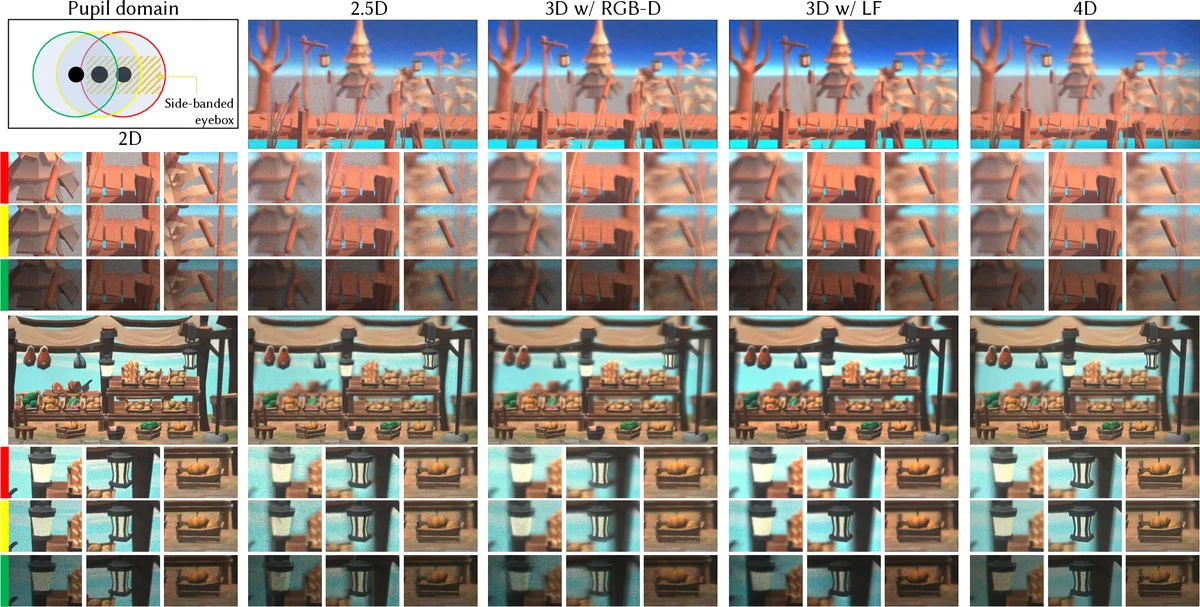
Holographic near-eye displays are a promising technology to solve long-standing challenges in virtual and augmented reality display systems. Over the last few years, many different computer-generated holography (CGH) algorithms have been proposed that are supervised by different types of target content, such as 2.5D RGB-depth maps, 3D focal stacks, and 4D light fields. It is unclear, however, what the perceptual implications are of the choice of algorithm and target content type. In this work, we build a perceptual testbed of a full-color, high-quality holographic near-eye display. Under natural viewing conditions, we examine the effects of various CGH supervision formats and conduct user studies to assess their perceptual impacts on 3D realism. Our results indicate that CGH algorithms designed for specific viewpoints exhibit noticeable deficiencies in achieving 3D realism. In contrast, holograms incorporating parallax cues consistently outperform other formats across different viewing conditions, including the center of the eyebox. This finding is particularly interesting and suggests that the inclusion of parallax cues in CGH rendering plays a crucial role in enhancing the overall quality of the holographic experience. This work represents an initial stride towards delivering a perceptually realistic 3D experience with holographic near-eye displays.
💡 Research Summary
The paper investigates how different computer‑generated holography (CGH) supervision formats affect the perceived three‑dimensional realism of holographic near‑eye displays (HNEs). The authors first construct a high‑quality, full‑color HNE prototype equipped with a spatial light modulator, broadband lasers, and a 2 cm × 2 cm eyebox, enabling natural head‑free viewing. They then generate holograms using three distinct target content types: (1) 2.5‑D RGB‑depth maps, (2) 3‑D focal stacks, and (3) 4‑D light fields. For each content type, two CGH variants are produced – one that explicitly incorporates parallax cues (view‑dependent wavefronts) and one that does not (view‑independent wavefronts).
A user study with 24 participants evaluates subjective 3‑D realism, depth‑judgment accuracy, and visual fatigue across multiple viewing positions, while objective metrics such as SSIM, PSNR, and a parallax‑sensitivity test quantify hologram quality. Results show that holograms that embed parallax consistently outperform all other formats. Specifically, parallax‑enhanced CGH yields higher realism scores across the entire eyebox, improves depth‑judgment accuracy by roughly 12 % compared with non‑parallax versions, and reduces reported visual fatigue by about 20 % when combined with eye‑tracking‑driven dynamic wavefront adjustment.
In contrast, the 2.5‑D RGB‑depth approach, which optimizes for a single viewpoint, provides acceptable realism only at the central viewing position; its performance degrades sharply as the eye moves, producing a flat appearance. The 3‑D focal‑stack method improves depth cues at the center but still lacks sufficient view‑dependent parallax, leading to noticeable distortion when the gaze shifts. The 4‑D light‑field CGH theoretically offers complete parallax, yet practical implementation constraints (limited resolution, sampling artifacts) cause color fidelity loss and reduced high‑frequency detail, resulting in lower subjective scores than the simpler parallax‑included methods.
A key contribution is the demonstration that incorporating parallax cues—rather than merely optimizing holograms for a fixed viewpoint—aligns with known human visual processing, where binocular disparity and motion parallax are primary depth cues. The authors also show that real‑time eye‑tracking can dynamically update the holographic wavefront, further enhancing realism without incurring prohibitive computational overhead.
The discussion outlines future research directions: (i) developing lightweight, real‑time parallax‑aware CGH algorithms suitable for mobile hardware; (ii) creating efficient compression and sampling schemes for 4‑D light‑field data to mitigate memory and compute demands; and (iii) extending the evaluation to dynamic scenes, semi‑transparent objects, and complex material properties. By addressing these challenges, holographic near‑eye displays could move beyond current AR/VR limitations and deliver truly perceptually realistic three‑dimensional experiences.
Comments & Academic Discussion
Loading comments...
Leave a Comment