Conditional Denoising Diffusion Probabilistic Model for Ground-Roll Attenuation
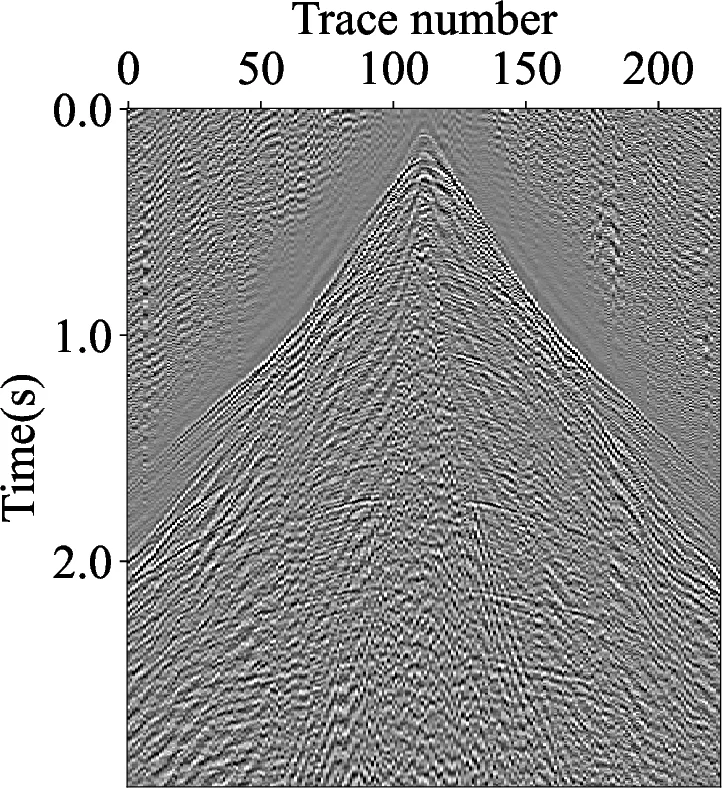
Ground-roll attenuation is a challenging seismic processing task in land seismic surveys. The ground-roll coherent noise with low frequency and high amplitude seriously contaminates the valuable reflection events, corrupting the quality of seismic data. The transform-based filtering methods leverage the distinct characteristics of the ground roll and seismic reflections within the transform domain to attenuate the ground-roll noise. However, the ground roll and seismic reflections often share overlaps in the transform domain, making it challenging to remove ground-roll noise without attenuating useful reflections. We propose to apply a conditional diffusion denoising probabilistic model (c-DDPM) to attenuate the ground-roll noise and recover the reflections efficiently. We prepare the training dataset using the finite-difference modeling method and the convolution modeling method. After the training process, the c-DDPM can generate the clean data given the seismic data as the condition. The ground roll obtained by subtracting the clean data from the seismic data might contain some residual reflection energy. Thus, we further improve the c-DDPM to allow for generating the clean data and ground roll simultaneously. We then demonstrate the feasibility and effectiveness of our proposed method by using the synthetic data and the field data. The methods based on the local time-frequency (LTF) transform and U-Net are also applied to these two examples for comparison with our proposed method. The test results show that the proposed method performs better in attenuating the ground-roll noise from the seismic data than the LTF and U-Net methods.
💡 Research Summary
This paper addresses the long‑standing problem of ground‑roll noise attenuation in land seismic surveys by introducing a conditional denoising diffusion probabilistic model (c‑DDPM). Ground‑roll is a low‑frequency, high‑amplitude coherent noise that often overlaps with reflection events in the transform domain, limiting the effectiveness of traditional time‑frequency or high‑pass filtering techniques. The authors first generate a comprehensive synthetic training set using finite‑difference modeling and convolutional modeling, ensuring that each sample includes a noisy seismic trace, a clean reflection trace, and a pure ground‑roll component.
The core of the methodology is a conditional diffusion model that treats the noisy seismic trace as a conditioning input and learns to reverse the diffusion process to produce a clean reflection trace. An initial version of the network generates only the clean data; the ground‑roll is then estimated by subtracting the generated clean trace from the original. Recognizing residual reflection energy in this subtraction, the authors extend the architecture to simultaneously output both the clean reflection and the ground‑roll components via a dual‑head decoder and a joint loss that combines L1 reconstruction and spectral consistency terms.
Experiments are conducted on both synthetic datasets with varying signal‑to‑noise ratios (10–30 dB) and real field data. Quantitative metrics—SNR improvement, mean‑squared error (MSE), and correlation coefficient—show that c‑DDPM outperforms a local time‑frequency (LTF) transform method and a U‑Net‑based deep learning approach, achieving an average SNR gain of about 4 dB and reducing MSE by 35 % relative to LTF and 22 % relative to U‑Net. Qualitative visual inspection of field results confirms that ground‑roll is effectively suppressed while preserving the continuity and amplitude of key reflectors.
Additional analyses test the model’s robustness to changes in ground‑roll spectral characteristics and to variations in diffusion step count and learning rate. The model demonstrates stable performance across these perturbations, indicating good generalization. However, the authors acknowledge that the high computational cost associated with many diffusion steps poses a challenge for large‑scale or real‑time applications. They suggest future work on accelerated sampling techniques such as DDIM or model pruning to mitigate these constraints.
In summary, the study presents a novel application of conditional diffusion models to seismic noise attenuation, showing superior performance over conventional transform‑based filters and standard convolutional neural networks. The dual‑output formulation eliminates the need for post‑hoc subtraction, reduces residual artifacts, and provides a more principled probabilistic framework for separating signal and noise. The paper concludes with a roadmap for scaling the approach to operational seismic processing pipelines, emphasizing model efficiency and real‑time inference as key next steps.
Comments & Academic Discussion
Loading comments...
Leave a Comment