Jaynes-Cummings interaction with a traveling light pulse
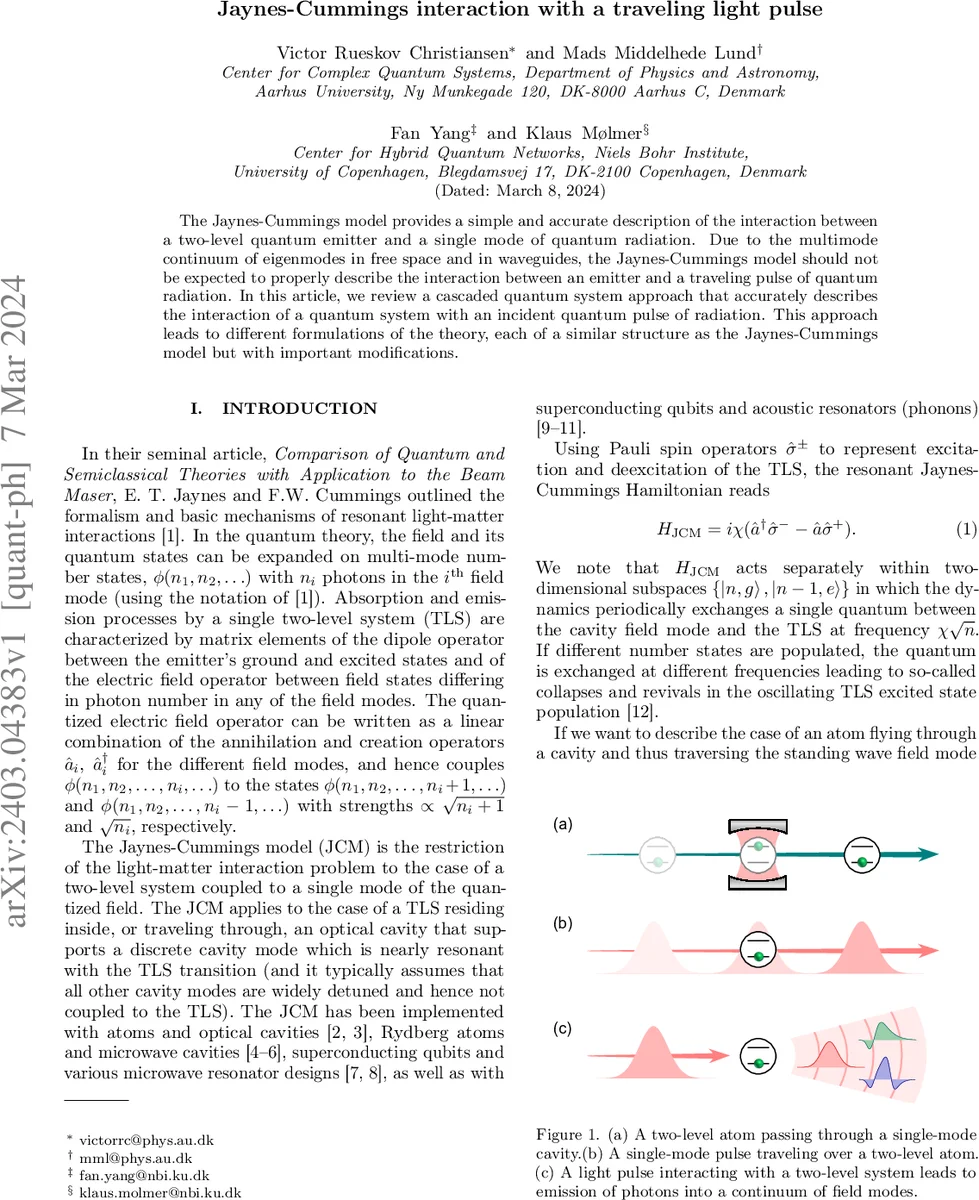
The Jaynes-Cummings model provides a simple and accurate description of the interaction between a two-level quantum emitter and a single mode of quantum radiation. Due to the multimode continuum of eigenmodes in free space and in waveguides, the Jaynes-Cummings model should not be expected to properly describe the interaction between an emitter and a traveling pulse of quantum radiation. In this article, we review a cascaded quantum system approach that accurately describes the interaction of a quantum system with an incident quantum pulse of radiation. This approach leads to different formulations of the theory, each of a similar structure as the Jaynes-Cummings model but with important modifications.
💡 Research Summary
**
The paper addresses a fundamental limitation of the conventional Jaynes‑Cummings model (JCM), which accurately describes the interaction between a two‑level quantum emitter and a single quantized field mode, but fails when the emitter is illuminated by a traveling light pulse that occupies a continuum of modes. In free space or one‑dimensional waveguides, a pulse is characterized by a temporal envelope u(t) and a broad spectrum of frequencies; photons absorbed from such a pulse can be re‑emitted into many different modes. Consequently, the simple picture of a constant coupling strength χ acting within isolated two‑dimensional subspaces {|n,g⟩,|n‑1,e⟩} is no longer valid.
To overcome this, the authors adopt a cascaded‑quantum‑system framework. They first map the incoming pulse onto an artificial single‑mode cavity that leaks photons with a time‑dependent out‑coupling amplitude g₍u₎(t) proportional to the pulse envelope. The two‑level system (TLS) is placed downstream of this cavity, so that energy can only flow forward (cavity → TLS → waveguide). The resulting interaction Hamiltonian has the Jaynes‑Cummings form but with a time‑dependent coupling:
H_JCM‑I(t)= (i/2)
Comments & Academic Discussion
Loading comments...
Leave a Comment