A universal formula for the entanglement asymmetry of matrix product states
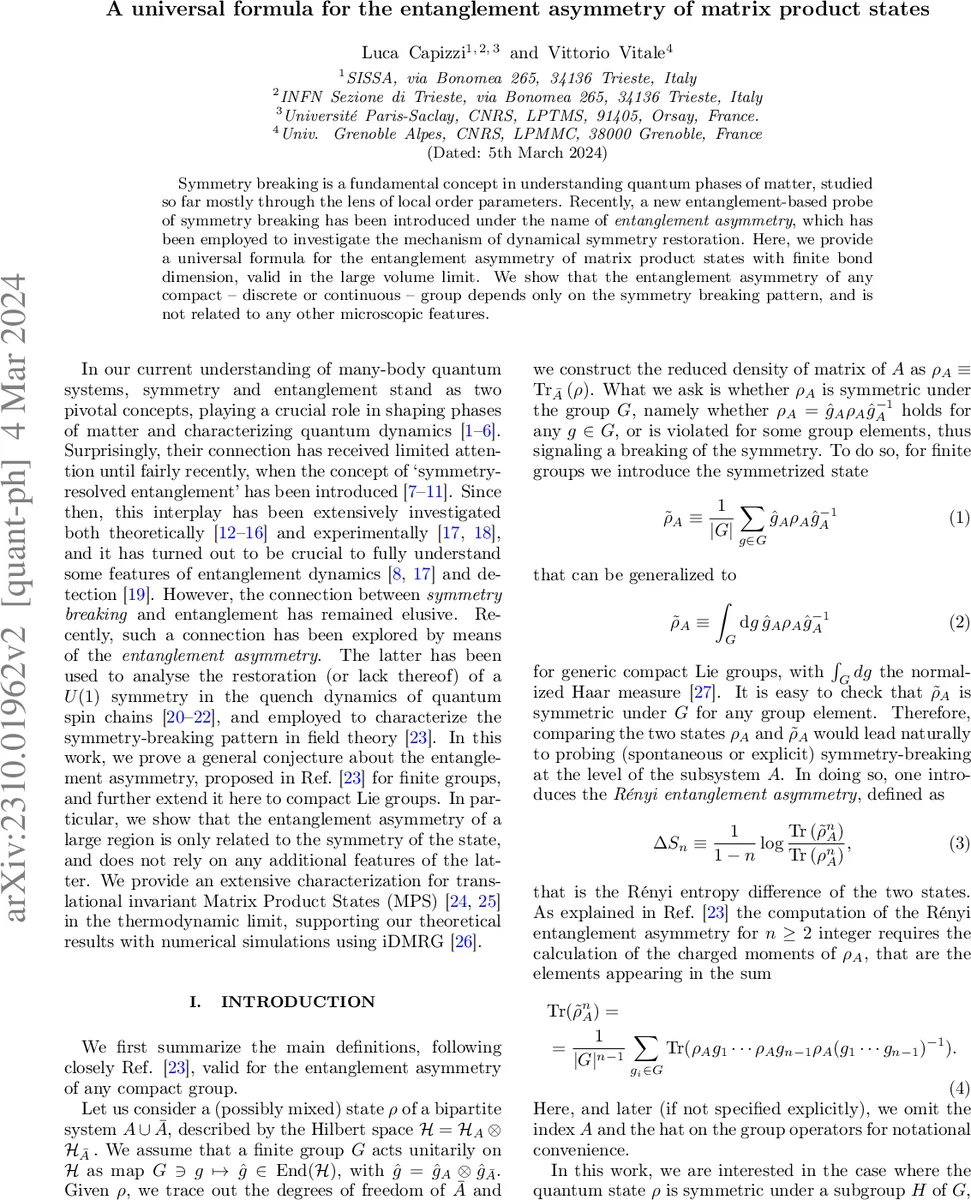
Symmetry breaking is a fundamental concept in understanding quantum phases of matter, studied so far mostly through the lens of local order parameters. Recently, a new entanglement-based probe of symmetry breaking has been introduced under the name of \textit{entanglement asymmetry}, which has been employed to investigate the mechanism of dynamical symmetry restoration. Here, we provide a universal formula for the entanglement asymmetry of matrix product states with finite bond dimension, valid in the large volume limit. We show that the entanglement asymmetry of any compact – discrete or continuous – group depends only on the symmetry breaking pattern, and is not related to any other microscopic features.
💡 Research Summary
The paper investigates the relationship between symmetry breaking and quantum entanglement by focusing on a recently introduced quantity called “entanglement asymmetry.” While traditional approaches to symmetry breaking rely on local order parameters, entanglement asymmetry provides a non‑local probe that compares the reduced density matrix of a subsystem with its symmetrized version under a given group G. Formally, for a (possibly mixed) state ρ on a bipartition A∪ Ā, one defines the reduced density matrix ρ_A = Tr_Ā ρ and its G‑symmetrized counterpart ˜ρ_A = ∫_G dg g_A ρ_A g_A⁻¹ (or a discrete average for finite groups). The Rényi‑n entanglement asymmetry is then ΔS_n = (1/(1‑n)) log
Comments & Academic Discussion
Loading comments...
Leave a Comment