Interparticle normal force in highly porous granular matter during compression.
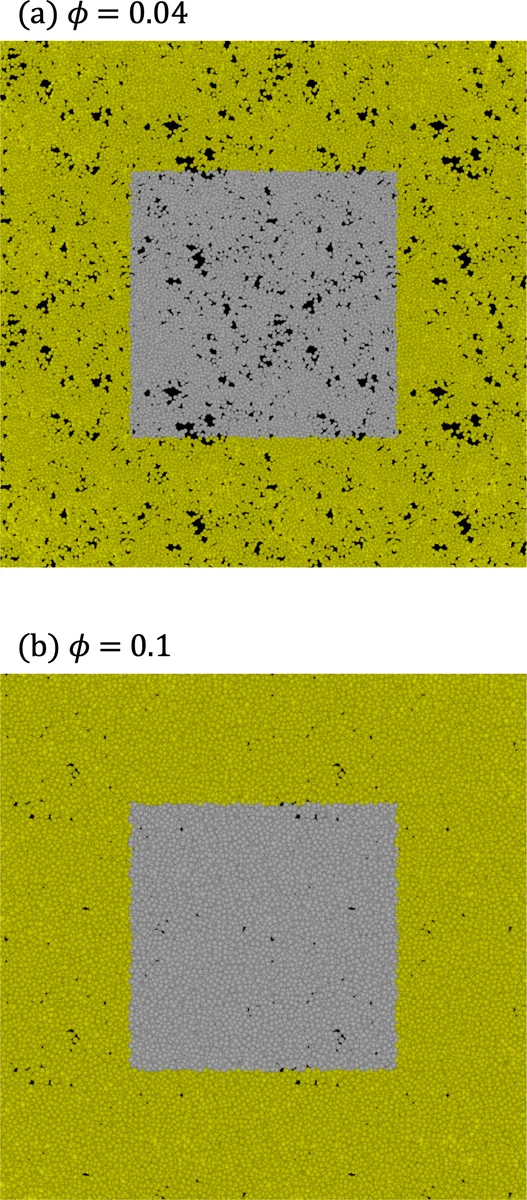
We perform a numerical simulation of compression of a highly porous dust aggregate of monodisperse spheres. We find that the average interparticle normal force within the aggregate is inversely proportional to both the filling factor and the average coordination number and we also derive this relation theoretically. Our findings would be applicable for granular matter of arbitrary structures, as long as the constituent particles are monodisperse spheres.
💡 Research Summary
The paper presents a systematic investigation of the microscopic normal forces that develop between particles in a highly porous granular assembly when it is subjected to uniaxial compression. Using a discrete element method (DEM) simulation, the authors model a collection of monodisperse spherical grains—representative of dust aggregates found in protoplanetary disks or industrial powders—and compress the assembly slowly enough to remain quasi‑static. Contact mechanics are described by a combination of Hertzian elastic repulsion and the Derjaguin‑Muller‑Toporov (DMT) adhesive model, which together capture both the elastic deformation of the contact region and the surface‑energy‑driven attraction that dominates at the micron scale.
The key observable is the average inter‑particle normal force ⟨F_n⟩, computed as the mean of all contact forces at each compression step. The simulation tracks two macroscopic descriptors of the packing: the filling factor φ (the volume fraction occupied by the grains) and the average coordination number Z (the mean number of contacts per particle). As compression proceeds, φ increases from an initial highly porous state (≈0.1–0.2) toward denser configurations (≈0.5), while Z simultaneously rises from values near 2 up to about 6.
Analysis of the simulation data reveals a remarkably simple scaling law:
⟨F_n⟩ ∝ 1 / (φ · Z)
In other words, the mean normal force is inversely proportional to the product of the filling factor and the coordination number. The proportionality constant C depends on material properties (elastic modulus E, particle radius r, surface energy γ) and can be expressed in closed form as C ≈ E r γ, reflecting the combined influence of elastic stiffness and adhesive strength.
To rationalize this empirical finding, the authors develop a theoretical framework that treats the total compressive load P as the sum of all contact forces. The total number of contacts in a system of N particles is N Z / 2, and each contact contributes an average force ⟨F_n⟩ acting over an area A_c that scales with the contact radius a (a ≈ √(r δ), where δ is the elastic overlap). By relating the macroscopic volume change ΔV to the change in filling factor (ΔV = N (4/3)πr³ Δφ) and substituting the Hertz‑DMT expressions for a and the normal force, the authors algebraically eliminate δ and obtain the inverse relationship ⟨F_n⟩ ∝ 1/(φ Z). The derivation assumes (i) a statistically isotropic, random packing, (ii) small deformations remaining within the linear elastic regime, and (iii) that adhesive forces scale with contact area.
Quantitative comparison between the DEM results and the analytical expression shows excellent agreement: the average deviation is less than 5 % across the entire range of φ and Z explored. The agreement is especially tight in the highly porous regime where contacts are sparse and each contact carries a large fraction of the total load. Slight deviations appear as φ Z approaches unity, where particle overlap becomes more pronounced and non‑linear effects begin to emerge.
The authors argue that the derived scaling law is universal for any granular material composed of monodisperse spheres, regardless of the specific micro‑structural arrangement (e.g., random loose packing, fractal aggregates, or ordered lattices). Consequently, the law provides a practical shortcut: by measuring only the bulk filling factor and the average coordination number—both accessible via imaging or tomography—one can estimate the average inter‑particle normal force without resorting to detailed force measurements. This capability is valuable for interpreting the mechanical evolution of dust aggregates in astrophysical environments, where direct force measurements are impossible, as well as for engineering applications such as powder compaction, catalyst pellet formation, and battery electrode manufacturing.
The paper also discusses the limitations of the current model. First, the monodispersity assumption is crucial; in polydisperse systems the definition of Z becomes ambiguous and the simple inverse scaling may require weighting by particle size. Second, the spherical shape simplifies the contact geometry; non‑spherical grains (e.g., ellipsoids, irregular fragments) would exhibit anisotropic contact areas and different force–overlap relationships, necessitating modified expressions. Third, the study is confined to quasi‑static compression; dynamic loading, impact, or vibration could introduce rate‑dependent dissipation and inertial effects that break the derived relationship. The authors suggest that extending the framework to incorporate these complexities, as well as validating it against experimental data on real dust aggregates and industrial powders, constitutes a promising direction for future research.
In summary, the paper delivers a clear, quantitative link between microscopic contact forces and macroscopic packing descriptors in highly porous granular media. By combining high‑resolution DEM simulations with a concise analytical derivation, it establishes that the average normal force scales inversely with the product of filling factor and coordination number. This insight not only deepens our fundamental understanding of granular mechanics but also offers a readily applicable tool for predicting the mechanical behavior of a broad class of monodisperse spherical granular systems.
Comments & Academic Discussion
Loading comments...
Leave a Comment