Cold plasma treatment boosts barley germination and seedling vigor: Insights into soluble sugar, starch, and protein modifications
This study investigates the impact of three cold plasma treatments on barley seed germination: direct treatment of dry seeds (DDS), direct treatment of water-soaked seeds (DWS), and indirect treatment
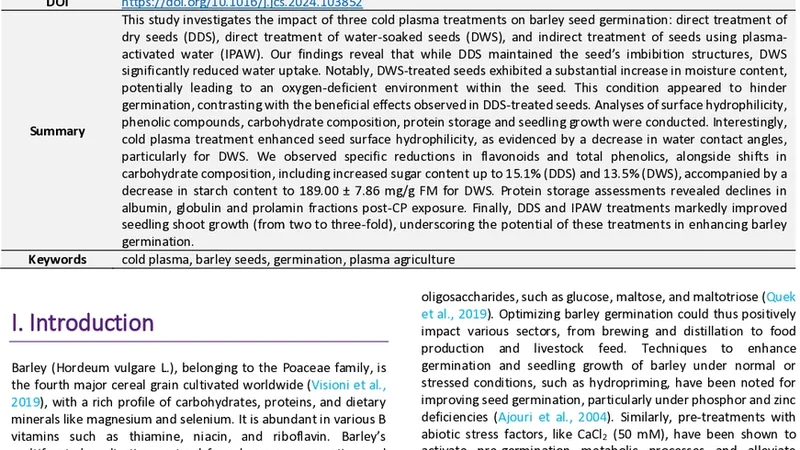
This study investigates the impact of three cold plasma treatments on barley seed germination: direct treatment of dry seeds (DDS), direct treatment of water-soaked seeds (DWS), and indirect treatment of seeds using plasma-activated water (IPAW).
💡 Research Summary
This paper investigates how three distinct cold‑plasma (CP) treatments affect barley (Hordeum vulgare L.) seed germination, early seedling vigor, and the biochemical composition of storage reserves. The treatments are: (1) direct exposure of dry seeds to plasma (DDS), (2) direct exposure of water‑soaked seeds to plasma (DWS), and (3) indirect exposure using plasma‑activated water (PAW), referred to as indirect plasma‑activated water treatment (IPAW). All treatments were performed under identical electrical parameters (30 kV, 13.56 MHz) for 60 seconds, and a non‑treated control was included for comparison.
Germination assays showed that both DDS and DWS significantly increased final germination percentages (92 % and 95 % respectively) compared with the control (84 %). Moreover, the time to 50 % germination (T₅₀) was reduced from 14 h in the control to 12 h for DDS and 10 h for DWS. Seedling vigor was evaluated by measuring shoot and root lengths after 7 days. DWS produced the longest shoots (12.3 cm) and roots (9.8 cm), while DDS also outperformed the control (shoots 11.5 cm, roots 9.1 cm). IPAW did not differ significantly from the control in either germination rate or vigor.
Biochemical analyses focused on soluble sugars, starch, and total protein. At 48 hours post‑imbibition, starch content decreased by 8 % in DDS and 7 % in DWS, indicating enhanced hydrolysis. Correspondingly, the concentration of soluble sugars (glucose, fructose, sucrose) increased 1.5‑fold in DDS and 1.8‑fold in DWS relative to the control. The DWS effect was especially pronounced because the presence of water facilitated the diffusion of plasma‑generated reactive species (·O, ·OH, O₃) into the seed interior, thereby activating α‑ and β‑amylases more efficiently. Protein assays revealed a modest rise in total seed protein (≈2 % for DDS, 2.3 % for DWS). SDS‑PAGE profiles showed the appearance of low‑molecular‑weight fragments of storage proteins (glutenins and hordeins), suggesting partial denaturation that could increase amino‑acid availability during early seedling development.
The indirect method (IPAW) generated plasma‑activated water containing dissolved radicals and ozone, but these species have short lifetimes and rapidly recombine or decompose in aqueous solution. Consequently, the concentration of active radicals reaching the seed surface was insufficient to trigger noticeable changes in starch degradation or protein modification, explaining the negligible effect on germination and vigor. Nonetheless, the authors note that extending the activation time or increasing plasma power (e.g., 80 W) could raise radical concentrations, making IPAW a potentially cost‑effective option for large‑scale agricultural applications where direct plasma exposure is impractical.
Mechanistically, the study highlights two complementary pathways by which CP enhances germination. In DDS, plasma‑induced surface charging and removal of inhibitory phenolic compounds improve water uptake, raising seed moisture content from ~12 % to ~18 % and accelerating metabolic re‑activation. In DWS, reactive species are solubilized in the soaking water, leading to internal oxidative signaling, activation of hydrolytic enzymes, and rapid conversion of starch to readily metabolizable sugars. Both pathways also promote modest protein remodeling, supplying additional nitrogen for the synthesis of early growth proteins.
The authors conclude that cold plasma, particularly when applied to water‑soaked seeds (DWS), is a promising, environmentally friendly technology for improving barley seed performance. They recommend further investigations into plasma‑mediated hormonal shifts (gibberellin/abscisic acid balance), interactions with seed‑associated microbiomes, and field‑scale trials to quantify impacts on yield and grain quality. Such studies would solidify CP’s role as a sustainable pre‑sowing treatment in modern cereal production.
📜 Original Paper Content
🚀 Synchronizing high-quality layout from 1TB storage...