Exactly $n$-resolvable Topological Expansions
For $ kappa$ a cardinal, a space $X=(X, sT)$ is $ kappa$-{ it resolvable} if $X$ admits $ kappa$-many pairwise disjoint $ sT$-dense subsets; $(X, sT)$ is { it exactly} $ kappa$-{ it resolvable} if it
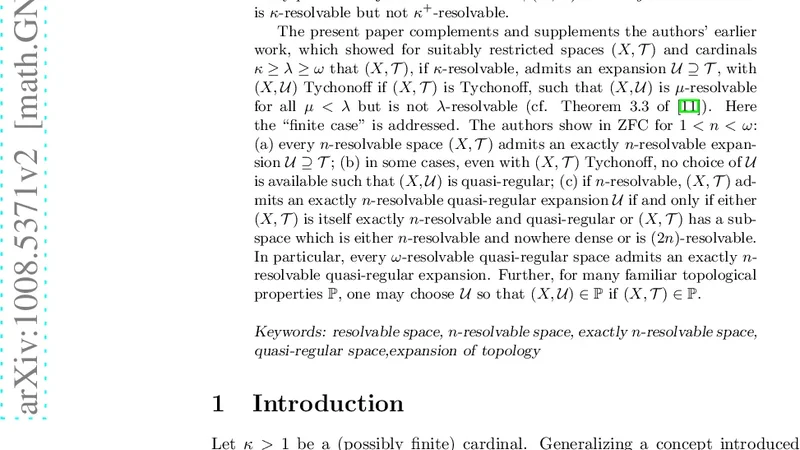
For $\kappa$ a cardinal, a space $X=(X,\sT)$ is $\kappa$-{\it resolvable} if $X$ admits $\kappa$-many pairwise disjoint $\sT$-dense subsets; $(X,\sT)$ is {\it exactly} $\kappa$-{\it resolvable} if it is $\kappa$-resolvable but not $\kappa^+$-resolvable. The present paper complements and supplements the authors’ earlier work, which showed for suitably restricted spaces $(X,\sT)$ and cardinals $\kappa\geq\lambda\geq\omega$ that $(X,\sT)$, if $\kappa$-resolvable, admits an expansion $\sU\supseteq\sT$, with $(X,\sU)$ Tychonoff if $(X,\sT)$ is Tychonoff, such that $(X,\sU)$ is $\mu$-resolvable for all $\mu<\lambda$ but is not $\lambda$-resolvable (cf. Theorem~3.3 of \cite{comfhu10}). Here the “finite case” is addressed. The authors show in ZFC for $1<n<\omega$: (a) every $n$-resolvable space $(X,\sT)$ admits an exactly $n$-resolvable expansion $\sU\supseteq\sT$; (b) in some cases, even with $(X,\sT)$ Tychonoff, no choice of $\sU$ is available such that $(X,\sU)$ is quasi-regular; (c) if $n$-resolvable, $(X,\sT)$ admits an exactly $n$-resolvable quasi-regular expansion $\sU$ if and only if either $(X,\sT)$ is itself exactly $n$-resolvable and quasi-regular or $(X,\sT)$ has a subspace which is either $n$-resolvable and nowhere dense or is $(2n)$-resolvable. In particular, every $\omega$-resolvable quasi-regular space admits an exactly $n$-resolvable quasi-regular expansion. Further, for many familiar topological properties $\PP$, one may choose $\sU$ so that $(X,\sU)\in\PP$ if $(X,\sT)\in\PP$.
💡 Research Summary
The paper investigates the fine structure of resolvability in topological spaces, focusing on the finite case. A space (X=(X,\mathcal T)) is called (\kappa)-resolvable if it contains (\kappa) many pairwise disjoint dense subsets; it is exactly (\kappa)-resolvable when it is (\kappa)-resolvable but not (\kappa^{+})-resolvable. Earlier work (Comfhu 2010) dealt with infinite cardinals (\lambda) and showed that, under suitable restrictions, a (\kappa)-resolvable space can be expanded to a topology (\mathcal U\supseteq\mathcal T) that is (\mu)-resolvable for every (\mu<\lambda) but fails to be (\lambda)-resolvable. The present article fills the gap for finite (n) (with (1<n<\omega)).
The authors prove three main theorems, all within ZFC.
-
Existence of exactly (n)-resolvable expansions.
For any (n)-resolvable space ((X,\mathcal T)) there is an expansion (\mathcal U) of (\mathcal T) such that ((X,\mathcal U)) is exactly (n)-resolvable. The construction proceeds by selecting (n) pairwise disjoint dense sets (D_{1},\dots,D_{n}) in ((X,\mathcal T)), refining each (D_{i}) into a family of smaller dense pieces, and declaring these pieces to be open in the new topology. By adding only the necessary closed sets, one preserves any pre‑existing separation axioms (e.g., Tychonoffness) while guaranteeing that no family of (n+1) disjoint dense sets can exist in the expanded space. -
Limits of quasi‑regularity.
The authors exhibit Tychonoff spaces for which no expansion can be made quasi‑regular while retaining exact (n)-resolvability. The counterexample is built from a family of dense sets whose closures intersect in a highly tangled way; any attempt to enlarge the topology without destroying the dense‑set structure inevitably creates a non‑quasi‑regular point (a non‑empty open set whose interior is empty). This shows that quasi‑regularity is not automatically obtainable in the finite resolvability context. -
Characterisation of quasi‑regular exactly (n)-resolvable expansions.
The central result gives a necessary and sufficient condition: an (n)-resolvable space ((X,\mathcal T)) admits an exactly (n)-resolvable quasi‑regular expansion (\mathcal U) iff either
(i) ((X,\mathcal T)) is already exactly (n)-resolvable and quasi‑regular, or
(ii) ((X,\mathcal T)) contains a subspace that is either (a) (n)-resolvable and nowhere dense, or (b) ((2n))-resolvable.
The proof of the “only‑if’’ direction analyses the structure of dense families in any quasi‑regular expansion and shows that failure of (i) forces the existence of one of the two subspaces described in (ii). Conversely, when (ii) holds, the authors give explicit constructions: in case (a) the nowhere‑dense subspace is turned into a closed nowhere‑dense set and the remaining dense families are split to achieve exact (n)-resolvability; in case (b) the richer ((2n))-resolvable subspace is used to extract a family of (n) dense sets while the other (n) are “collapsed’’ by adding suitable closed sets, thereby preserving quasi‑regularity.
A notable corollary is that every (\omega)-resolvable quasi‑regular space can be expanded to an exactly (n)-resolvable quasi‑regular space for any finite (n).
Beyond resolvability, the paper investigates the preservation of other topological properties under the expansions. For a wide class of properties (\mathcal P) (including Tychonoff, regular, normal, metrizability, compactness, etc.), the authors show that if ((X,\mathcal T)) satisfies (\mathcal P) then the constructed expansion ((X,\mathcal U)) can be chosen to satisfy (\mathcal P) as well. This is achieved by ensuring that the added open sets are formed from (\mathcal P)-compatible closed sets, so the separation axioms and other structural features are retained.
The paper concludes with a discussion of the implications of these results for the broader theory of resolvability, suggesting further lines of inquiry such as the interaction between exact resolvability and other refinement processes, and the potential extension of the characterisation to infinite cardinals. Overall, the work provides a comprehensive treatment of finite exact resolvability, clarifying when quasi‑regular expansions are possible and demonstrating that many desirable topological properties can be preserved during the expansion process.
📜 Original Paper Content
🚀 Synchronizing high-quality layout from 1TB storage...