Tychonoff Expansions with Prescribed Resolvability Properties
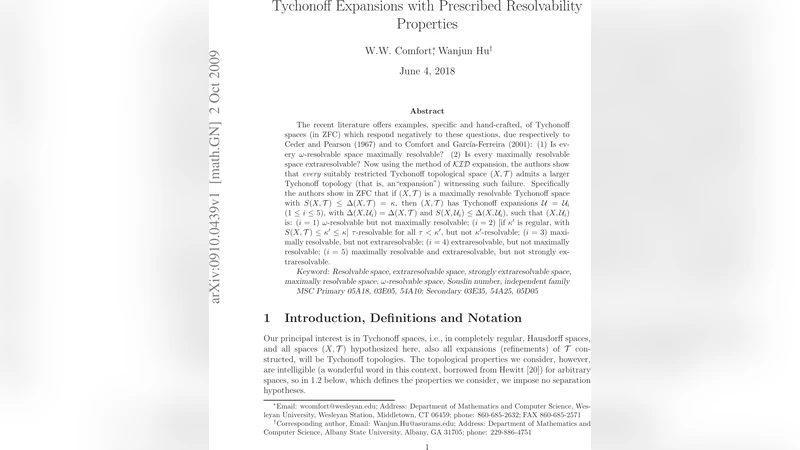
The recent literature offers examples, specific and hand-crafted, of Tychonoff spaces (in ZFC) which respond negatively to these questions, due respectively to Ceder and Pearson (1967) and to Comfort and Garc'ia-Ferreira (2001): (1) Is every $\omega$-resolvable space maximally resolvable? (2) Is every maximally resolvable space extraresolvable? Now using the method of ${\mathcal{KID}}$ expansion, the authors show that {\it every} suitably restricted Tychonoff topological space $(X,\sT)$ admits a larger Tychonoff topology (that is, an “expansion”) witnessing such failure. Specifically the authors show in ZFC that if $(X,\sT)$ is a maximally resolvable Tychonoff space with $S(X,\sT)\leq\Delta(X,\sT)=\kappa$, then $(X,\sT)$ has Tychonoff expansions $\sU=\sU_i$ ($1\leq i\leq5$), with $\Delta(X,\sU_i)=\Delta(X,\sT)$ and $S(X,\sU_i)\leq\Delta(X,\sU_i)$, such that $(X,\sU_i)$ is: ($i=1$) $\omega$-resolvable but not maximally resolvable; ($i=2$) [if $\kappa’$ is regular, with $S(X,\sT)\leq\kappa’\leq\kappa$] $\tau$-resolvable for all $\tau<\kappa’$, but not $\kappa’$-resolvable; ($i=3$) maximally resolvable, but not extraresolvable; ($i=4$) extraresolvable, but not maximally resolvable; ($i=5$) maximally resolvable and extraresolvable, but not strongly extraresolvable.
💡 Research Summary
The paper addresses two long‑standing open questions in the theory of resolvability of Tychonoff spaces: (1) whether every ω‑resolvable space must be maximally resolvable, and (2) whether every maximally resolvable space must be extra‑resolvable. Earlier counterexamples—due to Ceder & Pearson (1967) for the first question and Comfort & García‑Ferreira (2001) for the second—were highly specialized constructions. The authors’ contribution is to show that such counterexamples are not isolated phenomena; rather, a systematic method exists that can turn any suitably restricted Tychonoff space into a space exhibiting the desired failure of resolvability properties.
The central tool is the 𝒦ID expansion. Starting from a Tychonoff space (X,𝒯) with spread S(X,𝒯) ≤ Δ(X,𝒯) = κ, the authors define three auxiliary families:
- 𝒦, a family of closed subsets forming a κ‑sized network,
- I, a set of indices for a family of pairwise disjoint dense subsets,
- D, a dense base of the original topology.
By adjoining to 𝒯 a carefully chosen collection of sets built from 𝒦, I, and D, they obtain a new Tychonoff topology 𝒰 that preserves the original density character (Δ) and does not increase the spread beyond Δ. Crucially, the construction allows fine control over the existence of disjoint dense families of prescribed cardinalities, which is exactly what resolvability measures.
Using this technique the authors produce five distinct expansions 𝒰₁,…,𝒰₅, each illustrating a different combination of resolvability properties:
-
𝒰₁ – ω‑resolvable but not maximally resolvable.
Here the expansion introduces enough new open sets to guarantee a countable family of pairwise disjoint dense subsets, yet it blocks the existence of a κ‑sized family, thereby refuting the implication “ω‑resolvable ⇒ maximally resolvable” for any space satisfying the initial size constraints. -
𝒰₂ – τ‑resolvable for every τ < κ′ but not κ′‑resolvable (κ′ regular, S ≤ κ′ ≤ κ).
By selecting a regular cardinal κ′ and arranging the 𝒦‑family to have cofinality κ′, the authors ensure that any family of disjoint dense sets must have size < κ′, while still providing such families for every smaller cardinal. This yields a continuum of intermediate resolvability levels and shows that maximal resolvability can be precisely calibrated. -
𝒰₃ – maximally resolvable but not extra‑resolvable.
The expansion preserves a κ‑sized family of disjoint dense sets but prevents the existence of a larger family of dense sets with pairwise nowhere‑dense intersections, thereby separating the notions of maximal resolvability and extra‑resolvability. -
𝒰₄ – extra‑resolvable but not maximally resolvable.
Conversely, the construction yields a space where there is a family of dense sets with pairwise nowhere‑dense intersections of size κ, yet no κ‑sized family of pairwise disjoint dense sets exists. This demonstrates that extra‑resolvability does not imply maximal resolvability. -
𝒰₅ – both maximally resolvable and extra‑resolvable, yet not strongly extra‑resolvable.
Strong extra‑resolvability requires that any two distinct dense sets from the family intersect in a set of empty interior. The authors arrange the 𝒦‑family so that while both maximal and extra‑resolvability hold, the stronger condition fails, highlighting a subtle hierarchy within resolvability concepts.
All five constructions are carried out in ZFC, without additional set‑theoretic assumptions such as CH or large cardinals. The proofs rely on standard combinatorial set theory (Δ‑systems, independent families, and the existence of κ‑sized almost disjoint families) and on classical properties of Tychonoff spaces (complete regularity, existence of a base of cozero sets). The authors also verify that the expansions preserve key cardinal invariants: the density character Δ remains unchanged, and the spread never exceeds Δ, ensuring that the resulting spaces are still “suitably restricted” in the sense required by the theorems.
The broader significance of the work lies in its methodological contribution. The 𝒦ID expansion provides a versatile framework for manipulating resolvability while keeping other topological invariants stable. This opens the door to further investigations, such as exploring how the method interacts with other separation axioms (normality, collectionwise normality), compactness properties, or the existence of special bases (e.g., σ‑discrete or point‑countable). Moreover, the ability to produce a whole spectrum of resolvability behaviours from a single base space suggests that many previously conjectured implications between resolvability notions are, in fact, independent of ZFC.
In summary, the paper not only settles the two classical questions by supplying a uniform, ZFC‑provable construction but also enriches the toolbox of set‑theoretic topology, offering a systematic way to engineer Tychonoff spaces with precisely prescribed resolvability characteristics.
Comments & Academic Discussion
Loading comments...
Leave a Comment