Bubble-Induced Entrainment at Viscoplastic-Newtonian Interfaces
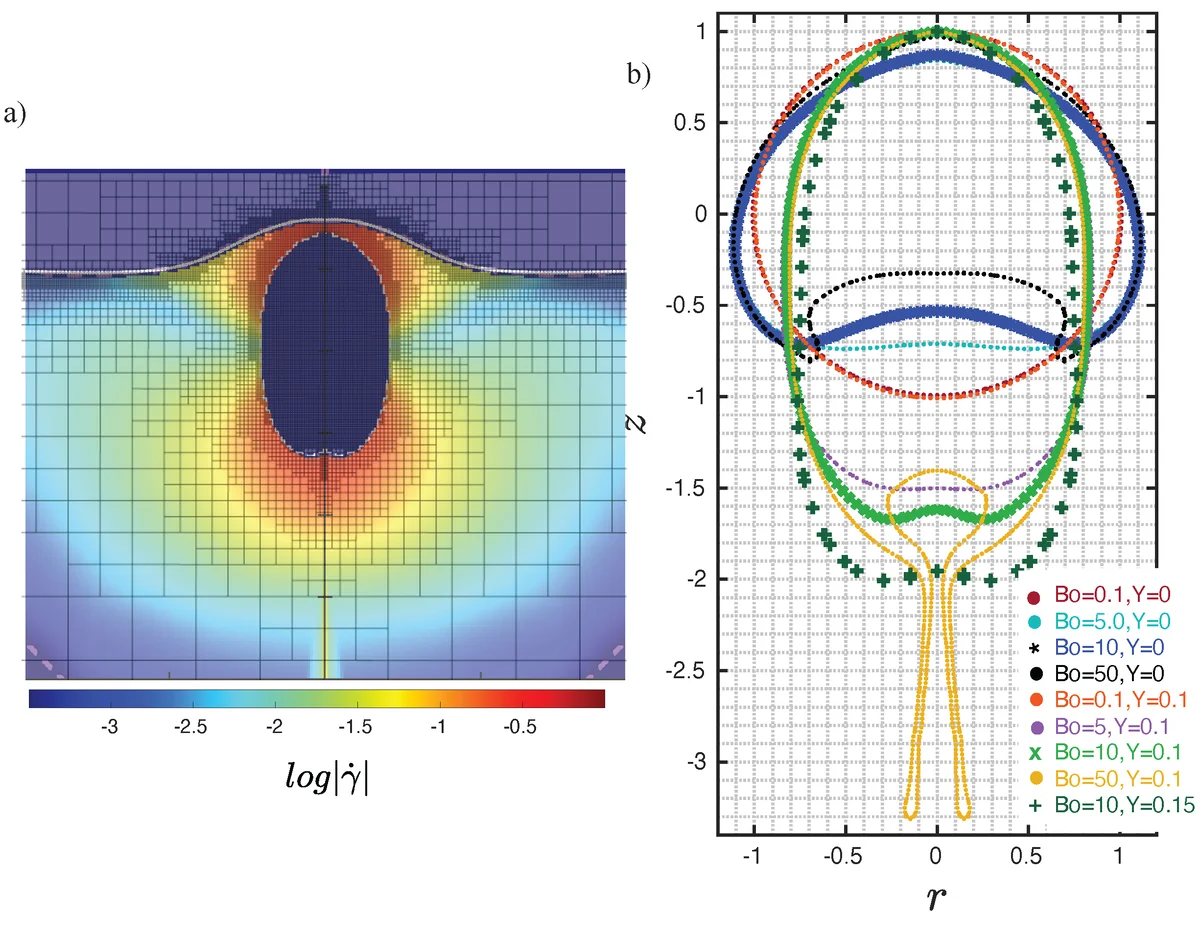
The passage of single air bubbles through the horizontal interface between miscible viscoplastic and Newtonian fluids, considering various combinations of densities and viscosities for the fluid layers, is studied computationally. The primary focus is on the quantity of liquid transferred from the lower layer (Viscoplastic fluid) to the upper layer (Newtonian fluid) as a result of the bubble’s ascent, a factor with significant implications for the turbidity of methane-emitting lakes and water bodies. The results show that at $ Bo>1 $ and moderate $ Ar $, prolate-shaped bubbles crossing the interface undergo elongation in the direction of their poles. This elongation is further accentuated when the viscosity of upper layer is less than the plastic viscosity of the lower layer. The bubble is found to break up when leaving the lower layer, of a critical capillary number, $ Ca_c \approx 5 $. The results show a significant reduction in the volume of entrainment compared to the Newtonian counterpart. This suggests disturbances caused by the rising bubble at the interface dissipate over a smaller region. Four distinct entrainment regimes are identified, mainly indicating the height to which the entrained fluid can be transported away from the interface. In contrast to Newtonian fluids, the volume of entrainment increases by decreasing the viscosity of the upper layer. Interestingly, the heavy yield stress fluid that has been dragged up into the the light Newtonian fluid does not recede down by time.
💡 Research Summary
**
The paper presents a comprehensive computational investigation of a single air bubble rising through the horizontal interface between a viscoplastic (Bingham) lower layer and a Newtonian upper layer. Motivated by observations in methane‑emitting lakes such as Alberta’s Base Mine Lake, where gas bubbles appear to transport fine tailings from a deep viscoplastic “fluid‑fine tailings” (FFT) layer into the overlying water column, the authors aim to quantify the entrainment of the lower‑layer fluid into the upper layer and to understand how rheology, density, and interfacial forces affect this process.
The governing equations are the incompressible Navier–Stokes equations with a volume‑of‑fluid (VOF) formulation for the three‑phase system (air bubble, viscoplastic fluid, Newtonian fluid). Lengths are scaled by the equivalent bubble radius ( \hat R_b ) and velocities by a buoyancy‑viscous balance ( \hat U = \hat\rho_1 \hat g \hat R_b^2 / \hat\mu_p ). The dimensionless groups that emerge are the Archimedes number (Ar) (gravity versus effective viscosity), Bond number (Bo) (gravity versus surface tension), density ratio ( \rho = \rho_2/\rho_1 ), viscosity ratio ( m = \mu_2/\mu_1 ), and yield number (Y = \tau_Y \hat R_b/(\hat\rho_1 \hat g) ). The lower layer is modeled with a regularized Bingham law using the Papanastasiou formulation, while the upper layer follows a Newtonian law. Both fluids are treated as miscible, but the Peclet number is assumed extremely large so that molecular diffusion is negligible.
Simulations are performed in an axisymmetric domain using the open‑source Basilisk solver with adaptive quadtree refinement, height‑function surface tension, and a time‑splitting projection scheme. Boundary conditions are no‑slip on the side and top walls, and a zero‑gradient open condition at the bottom. The drag coefficient is monitored to ensure dynamic equilibrium.
Key findings:
-
Bubble deformation and elongation – For (Bo>1) and moderate (Ar), bubbles adopt a prolate shape elongated along the polar axis as they cross the interface. This elongation is amplified when the upper‑layer viscosity is lower than the plastic viscosity of the lower layer, indicating that a less viscous upper fluid offers less resistance to pole‑ward stretching.
-
Critical capillary number and breakup – Bubbles break up upon exiting the viscoplastic layer at a critical capillary number (Ca_c \approx 5). This threshold is higher than typical Newtonian‑Newtonian cases, reflecting the additional resistance supplied by the yield stress. After breakup, a portion of the viscoplastic fluid remains entrained in the Newtonian layer and does not recede, suggesting that the yield stress prevents the entrained slug from yielding again under gravity alone.
-
Four entrainment regimes – The authors identify four distinct regimes based on the maximum height reached by the entrained slug: (i) shallow penetration, (ii) intermediate rise, (iii) high‑rise, and (iv) post‑breakup residual. The regime depends primarily on the interplay of (Ar), (Bo), (m), and (Y).
-
Effect of viscosity ratio – Contrary to Newtonian‑Newtonian studies where decreasing the upper‑layer viscosity reduces entrainment, here a lower (m) (i.e., a less viscous upper fluid) actually increases the entrained volume. The authors attribute this to the more localized disturbance field in a viscoplastic medium; a low‑viscosity upper fluid allows the bubble to pull a larger “plug” of the lower fluid upward before the stresses decay below the yield threshold.
-
Effect of density ratio – Simulations with (\rho = 1) (equal densities) and (\rho = 0.7) (lighter upper fluid) show that a larger density contrast shortens the residence time of the bubble at the interface, thereby reducing entrainment. This aligns with earlier experimental observations (Greene et al., 1988) that density differences suppress entrainment.
-
Comparison with Newtonian‑Newtonian literature – Across the parameter space examined, entrained volumes in the viscoplastic‑Newtonian system are markedly smaller than those reported for purely Newtonian interfaces. The presence of a yield stress confines the disturbed region to a few bubble radii, limiting the amount of lower‑layer fluid that can be lifted.
The study concludes that bubble‑induced entrainment in viscoplastic‑Newtonian systems is fundamentally different from the classic Newtonian‑Newtonian case. The reduced entrainment has direct implications for predicting turbidity spikes in methane‑rich lakes and tailings ponds, where previous models may have over‑estimated bubble‑driven mixing. Moreover, the persistence of a viscoplastic slug in the upper layer suggests a long‑term alteration of the fluid composition that could affect contaminant transport and ecological dynamics.
Future work is suggested to explore multi‑bubble interactions, non‑Bingham rheologies (e.g., Herschel‑Bulkley), and experimental validation to broaden the applicability of the findings to real environmental scenarios.
Comments & Academic Discussion
Loading comments...
Leave a Comment