Data Science at the Singularity
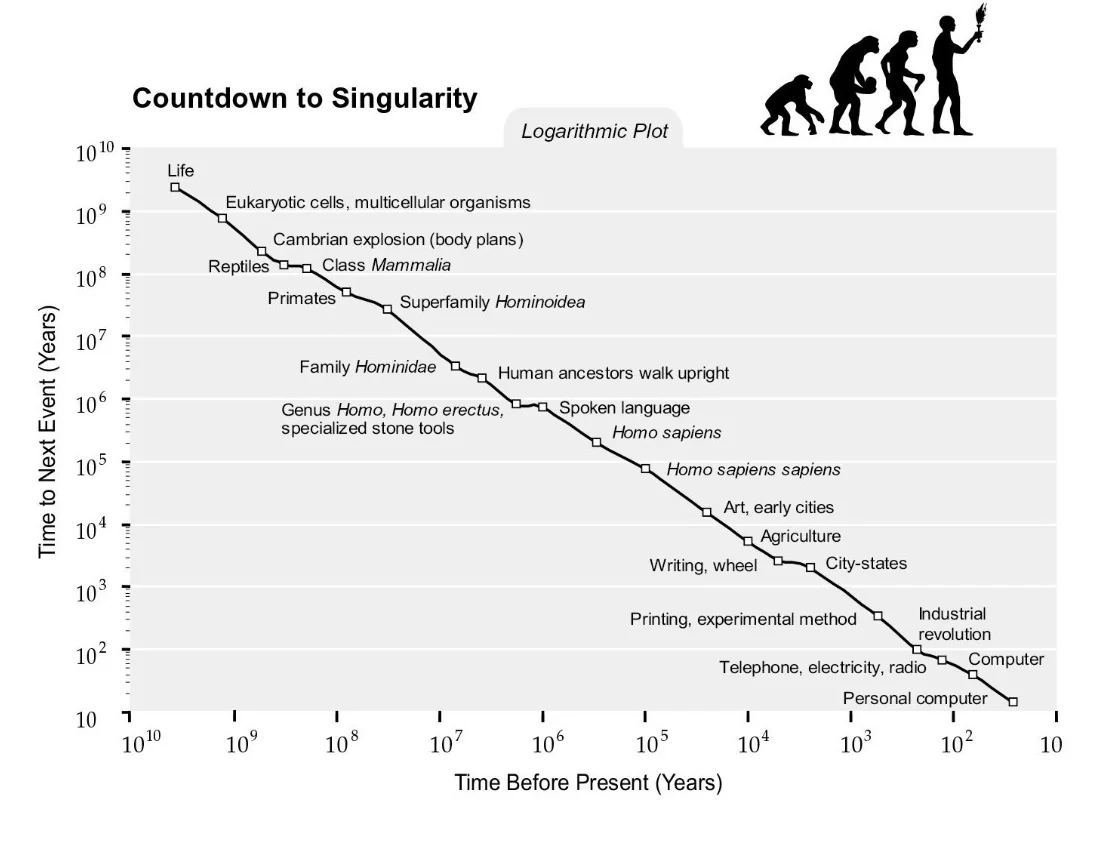
A purported AI Singularity' has been in the public eye recently. Mass media and US national political attention focused on AI Doom’ narratives hawked by social media influencers. The European Commission is announcing initiatives to forestall AI Extinction'. In my opinion, AI Singularity’ is the wrong narrative for what’s happening now; recent happenings signal something else entirely. Something fundamental to computation-based research really changed in the last ten years. In certain fields, progress is dramatically more rapid than previously, as the fields undergo a transition to frictionless reproducibility (FR). This transition markedly changes the rate of spread of ideas and practices, affects mindsets, and erases memories of much that came before. The emergence of frictionless reproducibility follows from the maturation of 3 data science principles in the last decade. Those principles involve data sharing, code sharing, and competitive challenges, however implemented in the particularly strong form of frictionless open services. Empirical Machine Learning (EML) is todays leading adherent field, and its consequent rapid changes are responsible for the AI progress we see. Still, other fields can and do benefit when they adhere to the same principles. Many rapid changes from this maturation are misidentified. The advent of FR in EML generates a steady flow of innovations; this flow stimulates outsider intuitions that there’s an emergent superpower somewhere in AI. This opens the way for PR to push worrying narratives: not only `AI Extinction’, but also the supposed monopoly of big tech on AI research. The helpful narrative observes that the superpower of EML is adherence to frictionless reproducibility practices; these practices are responsible for the striking progress in AI that we see everywhere.
💡 Research Summary
The paper challenges the prevailing “AI Singularity” and “AI Doom” narratives that dominate media, politics, and public discourse, arguing that they mischaracterize the true drivers of recent rapid advances in artificial intelligence. The author proposes that the fundamental shift occurring across computation‑based research over the past decade is not a mysterious emergence of super‑intelligent systems but a transition to what he calls “frictionless reproducibility” (FR). FR is defined as the systematic, low‑friction ability to reproduce, extend, and validate scientific work, and it rests on three mature data‑science principles: open data sharing, open code sharing, and competitive challenges. When these principles are implemented through robust, cloud‑based open services—such as Kaggle, OpenML, Hugging Face Hub, and GitHub—they become automatic parts of the research workflow, eliminating the logistical and cultural barriers that previously slowed idea diffusion.
Empirical Machine Learning (EML) is presented as the flagship field that has fully embraced FR. In EML, massive datasets, model repositories, benchmark suites, and evaluation metrics are publicly available and continuously updated. Researchers worldwide can instantly download data, clone code, run experiments on shared compute resources, and submit results to leaderboards. This environment creates a steady pipeline of incremental innovations—new architectures, training tricks, hyper‑parameter schedules—that accumulate at a pace far exceeding that of earlier periods when each group had to rebuild the stack from scratch. The author argues that the perception of an “emergent super‑power” in AI is a misinterpretation of this pipeline; the rapid flow of reproducible experiments fuels outsider intuition that AI is spontaneously gaining agency, which in turn fuels sensationalist PR and policy narratives about existential risk and monopoly by big tech.
The paper further contends that FR is not exclusive to EML. Fields such as genomics, computational physics, and social‑science data analysis can reap similar benefits if they adopt the same open‑data, open‑code, and challenge‑based culture. The author cites examples where public repositories of genome sequences, simulation code, and survey data have already accelerated discovery, but notes that many disciplines still lag behind EML in institutionalizing FR, creating a “progress gap.” Bridging this gap would require coordinated policy support: long‑term preservation of data and code, equitable access to open challenge platforms, and the inclusion of reproducibility metrics in research assessment.
From a policy perspective, the author warns against reactionary regulation motivated by the AI Doom narrative. Regulations aimed at “preventing AI extinction” risk stifling the very openness that fuels progress. Instead, the paper recommends that governments and funding bodies invest in infrastructure that lowers the cost of sharing and reproducing research—e.g., funding open‑source platforms, standardizing metadata, and incentivizing the publication of reproducible pipelines. By doing so, the “super‑power” behind AI advances is recognized as a cultural and technical infrastructure rather than a mysterious, uncontrollable intelligence.
In conclusion, the paper reframes the story of AI’s recent acceleration: the rapid progress is not evidence of an imminent singularity but the natural outcome of frictionless reproducibility practices that have become entrenched in Empirical Machine Learning. Recognizing FR as the true engine of innovation clarifies the role of open science, guides more constructive policy, and points the way for other scientific domains to achieve comparable breakthroughs.
Comments & Academic Discussion
Loading comments...
Leave a Comment