Searching for an equation: Dirac, Majorana and the others
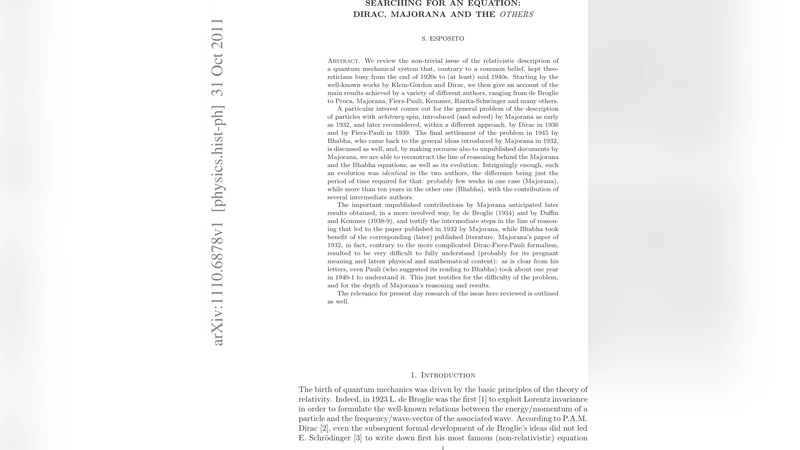
We review the non-trivial issue of the relativistic description of a quantum mechanical system that, contrary to a common belief, kept theoreticians busy from the end of 1920s to (at least) mid 1940s. Starting by the well-known works by Klein-Gordon and Dirac, we then give an account of the main results achieved by a variety of different authors, ranging from de Broglie to Proca, Majorana, Fierz-Pauli, Kemmer, Rarita-Schwinger and many others. A particular interest comes out for the general problem of the description of particles with \textit{arbitrary} spin, introduced (and solved) by Majorana as early as 1932, and later reconsidered, within a different approach, by Dirac in 1936 and by Fierz-Pauli in 1939. The final settlement of the problem in 1945 by Bhabha, who came back to the general ideas introduced by Majorana in 1932, is discussed as well, and, by making recourse also to unpublished documents by Majorana, we are able to reconstruct the line of reasoning behind the Majorana and the Bhabha equations, as well as its evolution. Intriguingly enough, such an evolution was \textit{identical} in the two authors, the difference being just the period of time required for that: probably few weeks in one case (Majorana), while more than ten years in the other one (Bhabha), with the contribution of several intermediate authors. Majorana’s paper of 1932, in fact, contrary to the more complicated Dirac-Fierz-Pauli formalism, resulted to be very difficult to fully understand (probably for its pregnant meaning and latent physical and mathematical content): as is clear from his letters, even Pauli (who suggested its reading to Bhabha) took about one year in 1940-1 to understand it. This just testifies for the difficulty of the problem, and for the depth of Majorana’s reasoning and results.
💡 Research Summary
The paper provides a comprehensive historical and technical review of the long‑standing problem of formulating relativistic wave equations for quantum particles of arbitrary spin, a challenge that occupied theorists from the late 1920s through at least the mid‑1940s. It begins with the well‑known Klein‑Gordon equation for spin‑0 particles and Dirac’s 1928 four‑component equation for spin‑½, highlighting how Dirac’s construction resolved the negative‑probability issue of Klein‑Gordon but could not be straightforwardly extended to higher spins. Subsequent developments are traced: de Broglie and Proca introduced a spin‑1 equation; Kemmer and Rarita‑Schwinger tackled spin‑1 and spin‑3/2 respectively; and Fierz‑Pauli in 1939 formulated a systematic approach based on Lorentz‑covariant tensor‑spinors.
The centerpiece of the review is Ettore Majorana’s 1932 paper, which proposed a unified linear equation capable of describing particles of any integer or half‑integer spin. Majorana’s method enlarged the representation space to a dimension proportional to 2(2s + 1), thereby providing the minimal matrix size required for each spin and embedding Lorentz symmetry and conserved currents directly into the formalism. Although mathematically elegant, the paper was notoriously opaque; correspondence shows that Wolfgang Pauli needed an entire year (1940‑41) to fully grasp its content.
Dirac independently rediscovered a similar scheme in 1936, and Fierz‑Pauli later refined the algebraic structure, emphasizing the role of subsidiary conditions that eliminate unphysical degrees of freedom. The narrative culminates with Homi J. Bhabha’s 1945 “Bhabha‑Majorana” equation, which, by revisiting Majorana’s unpublished notes, supplied a complete Lagrangian formulation, clarified the constraint structure, and demonstrated how to couple arbitrary‑spin fields consistently to external potentials. Bhabha’s work essentially closed the problem, confirming that Majorana’s ideas were correct and complete, albeit ahead of their time.
Through a careful examination of unpublished manuscripts, letters, and secondary literature, the authors reconstruct the parallel reasoning streams of Majorana and Bhabha, showing that the two arrived at essentially the same conclusions within weeks for Majorana and over a decade for Bhabha, with several intermediate contributors bridging the gap. The paper argues that this episode illustrates the deep interplay between mathematical sophistication and physical insight in the development of high‑spin field theory, and it underscores the lasting impact of Majorana’s early vision on modern frameworks such as supergravity and string theory, where consistent descriptions of high‑spin states remain a central challenge.
Comments & Academic Discussion
Loading comments...
Leave a Comment