The complexity of the fermionant, and immanants of constant width
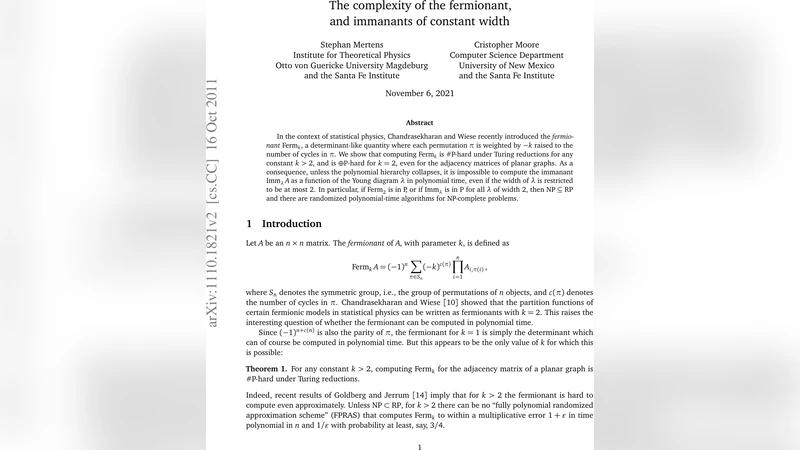
In the context of statistical physics, Chandrasekharan and Wiese recently introduced the \emph{fermionant} $\Ferm_k$, a determinant-like quantity where each permutation $\pi$ is weighted by $-k$ raised to the number of cycles in $\pi$. We show that computing $\Ferm_k$ is #P-hard under Turing reductions for any constant $k > 2$, and is $\oplusP$-hard for $k=2$, even for the adjacency matrices of planar graphs. As a consequence, unless the polynomial hierarchy collapses, it is impossible to compute the immanant $\Imm_\lambda ,A$ as a function of the Young diagram $\lambda$ in polynomial time, even if the width of $\lambda$ is restricted to be at most 2. In particular, if $\Ferm_2$ is in P, or if $\Imm_\lambda$ is in P for all $\lambda$ of width 2, then $\NP \subseteq \RP$ and there are randomized polynomial-time algorithms for NP-complete problems.
💡 Research Summary
The paper investigates the computational complexity of the fermionant, a determinant‑like function introduced by Chandrasekharan and Wiese in the context of statistical physics. For a matrix A, the fermionant Fermₖ(A) is defined as the sum over all permutations π of (−k)^{c(π)}·∏{i}A{i,π(i)}, where c(π) denotes the number of cycles in π. When k = 1 this reduces to the ordinary determinant, and when k = 0 it becomes the permanent, but for other integer values the complexity was previously unknown.
The authors first prove that for any constant k > 2, computing Fermₖ is #P‑hard under Turing reductions. The proof proceeds by constructing a parsimonious reduction from the problem of counting perfect matchings in a graph (a classic #P‑complete problem) to the evaluation of Fermₖ on the adjacency matrix of that graph. Crucially, the reduction preserves planarity, so the hardness holds even when the input matrix is the adjacency matrix of a planar graph.
For the special case k = 2, the weight (−2)^{c(π)} introduces a sign that depends on the parity of the number of cycles. The authors show that Ferm₂ is ⊕P‑hard by reducing the ⊕P‑complete problem of determining whether the number of even‑cycle permutations is odd to the evaluation of Ferm₂. Consequently, if Ferm₂ were in P then ⊕P would collapse to P, implying NP ⊆ RP and yielding randomized polynomial‑time algorithms for all NP‑complete problems.
The second major contribution connects these results to immanants. The immanant Imm_λ(A) associated with a Young diagram λ is defined as the sum over permutations weighted by the character χ_λ(π) of the symmetric group representation indexed by λ. The authors focus on diagrams of bounded width, particularly width ≤ 2 (i.e., diagrams with at most two columns). They demonstrate that for any such λ, Imm_λ(A) can be expressed as a linear combination of fermionants with k = 2, and in fact there exists a polynomial‑time Turing reduction from Imm_λ to Ferm₂. Hence, computing Imm_λ for width‑2 diagrams is at least as hard as computing Ferm₂.
Putting the pieces together, the paper establishes two theorems: (1) For every constant k > 2, Fermₖ is #P‑hard even on planar adjacency matrices; (2) Ferm₂ is ⊕P‑hard, and consequently the immanant for any Young diagram of width at most two is ⊕P‑hard as well. The authors argue that unless the polynomial hierarchy collapses, no polynomial‑time algorithm can exist for these problems.
The significance of these findings is twofold. From a physics perspective, they show that the fermionant, despite its appealing algebraic similarity to the determinant, is computationally intractable for the parameter ranges that arise in realistic models. From a representation‑theoretic viewpoint, the results demonstrate that restricting the width of a Young diagram does not alleviate the inherent difficulty of evaluating the corresponding immanant; even the simplest non‑trivial width (two columns) already yields a problem as hard as counting solutions to #P‑complete or ⊕P‑complete problems. This bridges combinatorial complexity theory with algebraic combinatorics and suggests that any efficient algorithmic approach to these quantities would require fundamentally new techniques, possibly exploiting additional structure beyond planarity or bounded width.
Comments & Academic Discussion
Loading comments...
Leave a Comment