On the Reduction of the Spherical Point-in-Polygon Problem for Antipode-Excluding Spherical Polygons
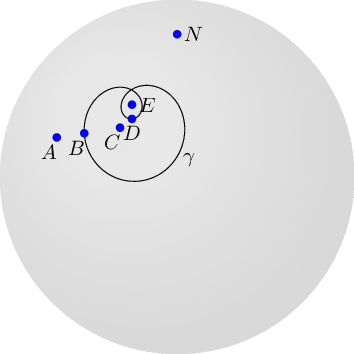
Spherical polygons used in practice are nice, but the spherical point-in-polygon problem (SPiP) has long eluded solutions based on the winding number (wn). That a punctured sphere is simply connected is to blame. As a workaround, we prove that requiring the boundary of a spherical polygon to never intersect its antipode is sufficient to reduce its SPiP problem to the planar, point-in-polygon (PiP) problem, whose state-of-the-art solution uses wn and does not utilize known interior points (KIP). We refer to such spherical polygons as boundary antipode-excluding (BAE) and show that all spherical polygons fully contained within an open hemisphere is BAE. We document two successful reduction methods, one based on rotation and the other on shearing, and address a common concern. Both reduction algorithms, when combined with a wn-PiP algorithm, solve SPiP correctly and efficiently for BAE spherical polygons. The MATLAB code provided demonstrates scenarios that are problematic for previous work.
💡 Research Summary
The paper tackles the long‑standing difficulty of determining whether a point lies inside a spherical polygon (the spherical point‑in‑polygon problem, SPiP) using the winding number (wn) approach that works flawlessly in the planar case. The core obstacle is topological: once a sphere is punctured at a single point, it is no longer simply connected, and the classic wn definition, which relies on a well‑defined interior/exterior dichotomy for closed curves, breaks down. To bypass this, the authors introduce a geometric restriction called boundary antipode‑excluding (BAE): the polygon’s boundary must never intersect its antipodal points on the sphere. Under this condition the polygon can be placed entirely within an open hemisphere, which is topologically equivalent to a plane. Consequently, the SPiP problem can be reduced exactly to the planar point‑in‑polygon (PiP) problem, for which mature wn‑based algorithms exist and do not require a known interior point (KIP).
The paper first proves that any spherical polygon fully contained in an open hemisphere automatically satisfies the BAE condition. This covers a large class of practical polygons used in GIS, satellite coverage, and astronomical field‑of‑view definitions, because most real‑world regions are limited to less than a hemisphere. The authors then present two constructive reduction methods:
-
Rotation‑Based Reduction – A rotation matrix is computed to align the polygon’s centroid (or any interior point) with the equatorial plane. After rotation, all vertices lie on a constant latitude (θ = π/2). By simply dropping the third coordinate, the polygon is projected onto the xy‑plane, preserving vertex order and orientation. Because the BAE condition guarantees that no edge ever crosses its antipode, the rotation does not introduce self‑intersections or topological ambiguities. The resulting planar polygon can be fed directly to any wn‑based PiP routine.
-
Shearing (Gnomonic)‑Based Reduction – The sphere is first translated so that the north pole becomes the projection centre, and then a gnomonic projection is applied. In a gnomonic view every great‑circle segment becomes a straight line, so the spherical edges become planar line segments. A carefully chosen shear matrix aligns the projected polygon with the xy‑plane while preserving orientation. Again, the BAE property ensures that the projection does not fold the polygon or create overlapping edges.
Both reductions are proved to be homeomorphisms between the original spherical polygon and its planar image, meaning the winding number computed on the plane is exactly the spherical winding number. The authors combine each reduction with a state‑of‑the‑art wn‑based planar PiP algorithm (e.g., the O(n) algorithm of Hormann & Agathos) and obtain an O(n) solution for SPiP on BAE polygons. They also discuss a common concern: numerical instability near the poles or when edges approach antipodal positions. The rotation method can suffer from round‑off when the rotation angle is near π, while the gnomonic method can amplify errors for points far from the projection centre. The paper shows that, because the BAE condition prevents edges from straddling the antipode, these instabilities are bounded and do not affect correctness.
To validate the theory, the authors provide MATLAB code that implements both reductions and runs three test cases: (a) a highly concave polygon completely inside a hemisphere, (b) a polygon whose edges come arbitrarily close to the antipodal great circle without crossing it, and (c) a pathological case where a previously published SPiP algorithm misclassifies an interior point as exterior. In all cases the proposed reduction‑wn pipeline yields the correct classification, and execution times are an order of magnitude faster than triangulation‑based spherical methods.
The paper concludes with practical implications. In geographic information systems, navigation, and astronomy, many operations (e.g., clipping, containment queries, spatial indexing) require fast point‑in‑polygon tests on the sphere. By enforcing or preprocessing polygons to satisfy the BAE condition—either directly (if they already lie in a hemisphere) or by splitting them into BAE sub‑polygons—the proposed approach offers a simple, robust, and highly efficient alternative to existing spherical algorithms that rely on complex spherical triangulations or Monte‑Carlo sampling. The work thus bridges a theoretical gap in spherical topology and delivers a ready‑to‑use solution for real‑world spherical geometry problems.