Guarding Polyominoes Under $k$-Hop Visibility
💡 Research Summary
This paper introduces a novel visibility model for grid‑based polyominoes called k‑hop visibility: two unit squares u and v can see each other if and only if the shortest path between them in the dual graph (a grid graph) has length at most k. The model captures scenarios where a user is willing to walk at most k cells, making it relevant for applications such as placement of car‑sharing stations in a city represented as a polyomino with obstacles (holes).
Two equivalent problem formulations are studied. The Minimum k‑Hop Guarding Problem (M k GP) asks for the smallest set of unit‑square guards whose k‑hop visibility regions together cover every cell of a given polyomino. The Minimum k‑Hop Dominating Set Problem (M k DSP) asks for a minimum‑size k‑hop dominating set in the corresponding grid graph. Because the dual graph of a polyomino is a grid graph, the two problems are interchangeable.
The authors first analyze the VC dimension of the set system induced by k‑hop visibility. They define “shattering” in the usual way: a set D of d guards is shattered if for every subset D_i ⊆ D there exists a viewpoint u such that exactly the guards in D_i see u (or, symmetrically, u sees exactly those guards). Using a “rest‑budget” observation (the remaining hop distance a guard can still see after passing through an intermediate cell) they prove two structural lemmas that are repeatedly used in the VC‑dimension arguments.
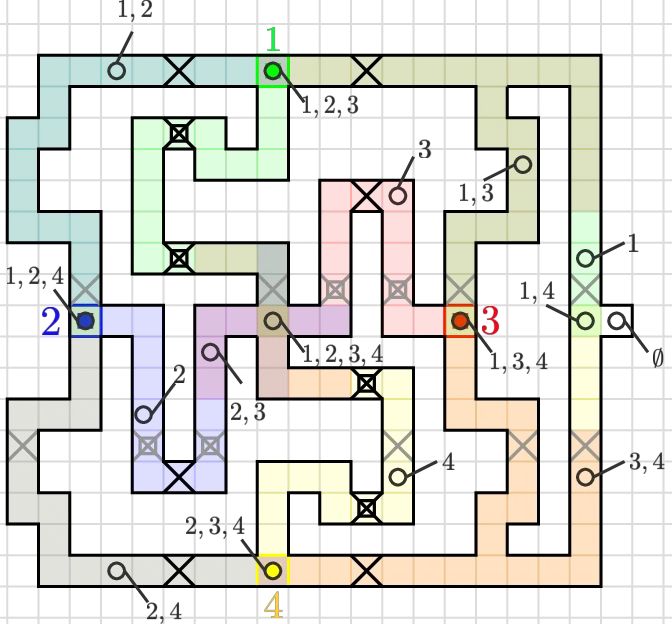
- Theorem 6 shows that for any k ≥ 1 the VC dimension of k‑hop visibility in a simple polyomino (no holes) is exactly 3. A constructive lower‑bound with three guards and eight viewpoints is given (Figure 4). The upper bound follows from geometric constraints: any four guards would force a configuration that violates the rest‑budget property.
- Theorem 7 extends the analysis to polyominoes with holes and proves that the VC dimension rises to 4. The extra freedom provided by a hole allows a fourth guard to be added while still shattering all 2⁴ subsets.
These VC‑dimension results are significant because a constant VC dimension implies that the associated set‑cover problem admits an O(log OPT) approximation (Brönnimann–Goodrich). Moreover, they provide a precise measure of the combinatorial richness of k‑hop visibility, which is lower than that of L₁ visibility (VC = 5) or boundary visibility (VC = 6) studied previously.
The paper then turns to computational complexity.
- Theorem 9 proves that for any k ≥ 2 the decision version of M k GP is NP‑complete, even when the input polyomino is 1‑thin (it contains no 2 × 2 block of cells). The reduction is from Planar Monotone 3‑SAT. The construction uses a “double‑comb” polyomino where each tooth has length k; each tooth’s tip hosts a witness whose k‑hop visibility region is isolated from all others, forcing a separate guard. This forces a one‑to‑one correspondence between satisfying assignments and guard placements.
- Theorem 12 presents a linear‑time 4‑approximation algorithm for the problem on 2‑thin simple polyominoes (no 3 × 3 block). The algorithm partitions the polyomino into constant‑size blocks, computes locally optimal guard placements for each block, and then merges them while ensuring that any cell left uncovered by a block is covered by a neighboring block’s guard. The analysis shows that the total number of guards is at most four times the optimum, and the runtime is O(n) where n is the number of cells.
The authors situate their work within a broad literature on guarding problems. The classic Art Gallery Problem (AGP) with straight‑line visibility is NP‑hard and even ∃ℝ‑complete. Variants using orthogonal, staircase, or limited‑turn visibility have been studied, often yielding NP‑hardness but also fixed‑parameter tractable algorithms when the underlying graph has bounded treewidth or is a tree. The Minimum k‑Hop Dominating Set problem is known to be NP‑complete in general graphs, solvable in linear time on trees, and FPT on graphs of bounded treewidth (dynamic programming in O((2k+1)^{tw}·n)). Recent works provide PTAS/EPTAS for planar and H‑minor‑free graphs. This paper’s contribution is to bring these ideas into the specific setting of grid‑based polyominoes with a distance‑bounded visibility model, establishing both lower bounds (NP‑completeness) and upper bounds (constant‑factor approximation) that are tailored to the geometric constraints of thin polyominoes.
In conclusion, the paper delivers a comprehensive theoretical treatment of k‑hop guarding in polyominoes: it precisely characterizes the VC dimension (3 for simple, 4 with holes), proves NP‑completeness even for highly restricted thin shapes, and supplies a practical linear‑time 4‑approximation for 2‑thin simple polyominoes. These results deepen our understanding of distance‑limited visibility in discrete geometric domains and open avenues for future work, such as extending the model to three‑dimensional polycubes, exploring tighter approximations using treewidth‑based PTAS, or integrating stochastic demand models for real‑world facility placement.
Comments & Academic Discussion
Loading comments...
Leave a Comment