Explicit Evidence Systems with Common Knowledge
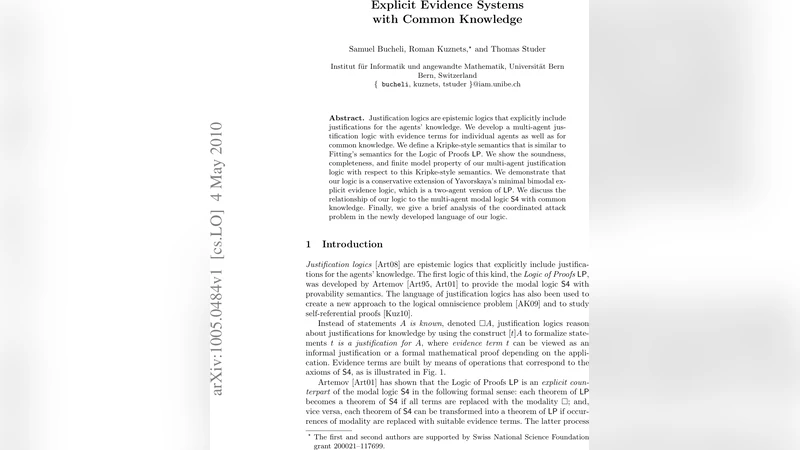
Justification logics are epistemic logics that explicitly include justifications for the agents’ knowledge. We develop a multi-agent justification logic with evidence terms for individual agents as well as for common knowledge. We define a Kripke-style semantics that is similar to Fitting’s semantics for the Logic of Proofs LP. We show the soundness, completeness, and finite model property of our multi-agent justification logic with respect to this Kripke-style semantics. We demonstrate that our logic is a conservative extension of Yavorskaya’s minimal bimodal explicit evidence logic, which is a two-agent version of LP. We discuss the relationship of our logic to the multi-agent modal logic S4 with common knowledge. Finally, we give a brief analysis of the coordinated attack problem in the newly developed language of our logic.
💡 Research Summary
The paper introduces a multi‑agent justification logic that explicitly incorporates evidence for both individual agents and for common knowledge, called Explicit Evidence Systems with Common Knowledge (EECK). Building on the Logic of Proofs (LP) and Yavorskaya’s minimal bimodal explicit evidence logic (EEL), the authors extend the language with a new class of evidence terms t_c that stand for common‑knowledge justifications, alongside the usual agent‑specific terms t_i.
The semantics is a Kripke‑style model in the tradition of Fitting’s semantics for LP. A model consists of a set of worlds W, an accessibility relation R_i for each agent i, and a common‑knowledge relation R_c defined as the intersection of all R_i. Truth of a formula t_i:φ at a world w means that the evidence function E_i assigns φ to the pair (w, t_i); similarly, t_c:φ is true at w when the common‑evidence function E_c assigns φ to (w, t_c). The evidence functions satisfy the usual closure conditions for application, sum, and iteration, and they are required to respect the interaction between individual and common evidence (e.g., if each agent has evidence for φ, then a combined common term can be constructed).
The proof theory includes axioms for propositional reasoning, justification‑specific axioms (t:φ → φ, application, sum, and positive introspection), and additional axioms governing the common‑knowledge operator, such as Cφ ↔ t_c:φ and distribution over implication. The authors prove soundness by showing that every inference rule preserves truth in the Kripke models. Completeness is obtained via a canonical model built from maximally consistent sets that also contain appropriate “common‑evidence” witnesses; the construction guarantees that if a formula is not provable, a counter‑model can be extracted. A finite‑model property is established by bounding the size of the canonical model using the finite number of subterms occurring in the formula, which yields decidability of the logic.
A key contribution is the demonstration that EECK is a conservative extension of Yavorskaya’s EEL. When the common‑knowledge term t_c and its associated axioms are omitted, the remaining fragment coincides exactly with EEL, preserving all previously proved results. Moreover, the paper relates EECK to the multi‑agent modal logic S4 with common knowledge: the modal fragment of EECK is provably equivalent to S4, while the justification layer refines each modal operator by attaching explicit evidence. Consequently, EECK can be seen as an “evidence‑enriched” version of S4, offering a finer granularity for epistemic reasoning.
To illustrate the expressive power, the authors formalize the classic coordinated attack problem. In the standard modal setting, the problem shows that achieving common knowledge of an agreement requires an infinite exchange of messages. In EECK, each message transmission is represented by a concrete evidence term (e.g., m_1, m_2). The analysis shows how, after a finite number of exchanges, a compound common‑knowledge term can be built (using the ⊗ operation) that serves as a justification for the statement “both parties know the attack time”. This demonstrates that EECK can capture not only the existence of common knowledge but also the exact evidential structure that leads to it, providing a tool for reasoning about protocol reliability and message‑loss scenarios.
The paper concludes by highlighting potential applications in distributed systems, blockchain consensus, and multi‑agent coordination, where explicit evidence for common knowledge can improve verification and fault‑tolerance. Future work is suggested on complexity analysis, automated proof search, and extensions to probabilistic or resource‑bounded evidence.
Comments & Academic Discussion
Loading comments...
Leave a Comment