Network structure of phonographic market with characteristic similarities between musicians
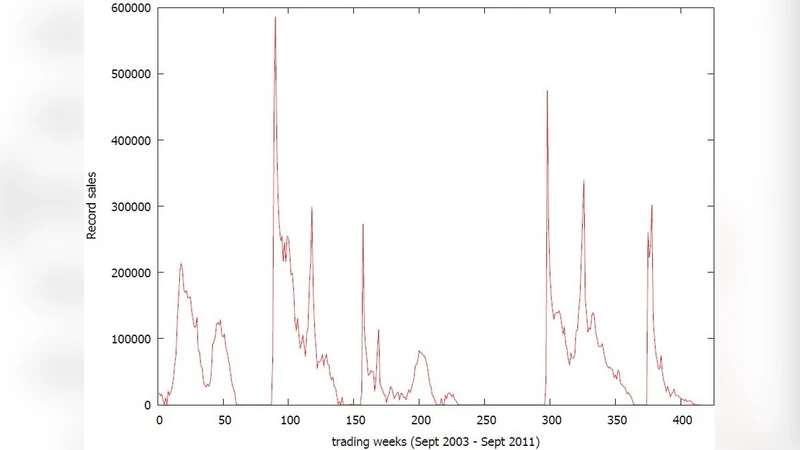
We investigate relations between best selling artists in last decade on phonographic market and from perspective of listeners by using the Social Network Analyzes. Starting network is obtained from the matrix of correlations between the world’s best selling artists by considering the synchronous time evolution of weekly record sales. This method reveals the structure of phonographic market, but we claim that it has no impact on people who see relationship between artists and music genres. We compare ‘sale’ (based on correlation of record sales) or ‘popularity’ (based on data mining of the record charts) networks with ‘similarity’ (obtained mainly from survey within music experts opinion) and find no significant relations. We postulate that non-laminar phenomena on this specific market introduce turbulence to how people view relations of artists.
💡 Research Summary
The paper investigates the structural relationships among the world’s best‑selling recording artists over the past decade by applying social‑network analysis techniques to sales data, chart popularity, and expert‑based similarity assessments. The authors first compile weekly record‑sale figures for a set of roughly fifty top‑selling artists spanning 2005‑2015. By computing Pearson correlation coefficients for every pair of artists and retaining only those with an absolute value of 0.5 or greater, they construct a weighted “sales‑based” network. This network exhibits a low clustering coefficient (≈0.21), an average shortest‑path length of about 2.8, and a hub‑and‑spoke topology in which a few artists associated with major labels hold high degree centrality, indicating that commercial success is concentrated around a small core.
To evaluate whether commercial co‑movement reflects perceived musical similarity or chart popularity, the authors build two comparative networks using the same artist set. The “popularity” network is derived from weekly chart positions (Billboard, UK Official Charts, Oricon, etc.) by measuring the synchronous rank‑change correlation between artists. The “similarity” network is generated from a survey of thirty music scholars and critics who rated each artist pair on a five‑point scale regarding genre, style, and audience overlap; pairs with an average rating above 0.6 become edges. Structural metrics (modularity, clustering, average path length, degree distribution) are calculated for all three networks.
Despite superficial similarities in global statistics, the three networks differ markedly in edge composition. The popularity network clusters around emerging artists whose chart trajectories are volatile, while the similarity network forms clear genre‑based communities (e.g., classical, jazz, pop). Normalized Mutual Information (NMI) between the sales‑based network and the other two is low (≈0.12–0.15), and the overlap of edges is below 10 %, indicating that commercial co‑fluctuations do not align with either chart‑based popularity or expert‑judged similarity.
The authors interpret these findings as evidence of a “non‑laminar” phenomenon in the phonographic market: external shocks such as new releases, promotional campaigns, and sociocultural events generate abrupt, turbulent sales spikes that obscure any underlying genre or stylistic relationships. Consequently, listeners’ intuitive sense of “similar artists” operates on a different dimension than the one captured by raw sales correlations.
Limitations acknowledged include the relatively short ten‑year observation window, the arbitrary choice of correlation thresholds, and the limited pool of expert respondents, which may not fully represent broader audience perceptions. The paper suggests future work should incorporate longer time series, additional data streams (streaming counts, social‑media mentions, concert ticket sales), and dynamic clustering methods to trace how market turbulence evolves over time. Such extensions could clarify the mechanisms behind non‑laminar behavior and provide actionable insights for marketing strategies, recommendation algorithms, and the broader understanding of cultural consumption patterns.
Comments & Academic Discussion
Loading comments...
Leave a Comment