Preisach images of a simple mechanical system
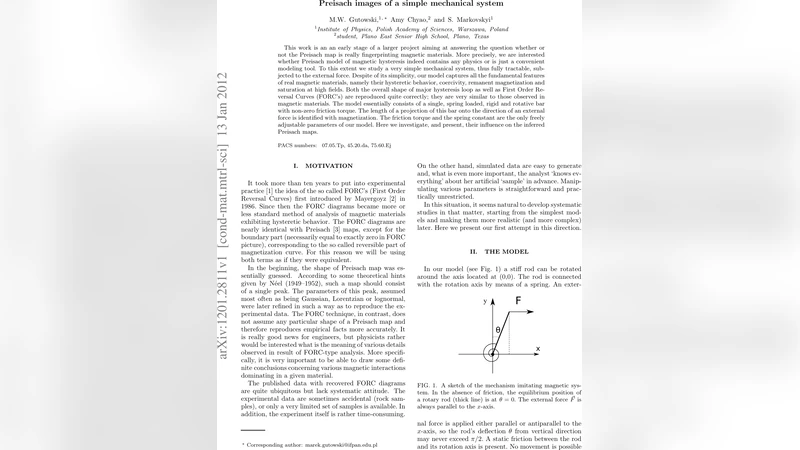
This work is an an early stage of a larger project aiming at answering the question whether or not the Preisach map is really fingerprinting magnetic materials. More precisely, we are interested whether Preisach model of magnetic hysteresis indeed contains any physics or is just a convenient modeling tool. To this extent we study a very simple mechanical system, thus fully tractable, subjected to the external force. Despite of its simplicity, our model captures all the fundamental features of real magnetic materials, namely their hysteretic behavior, coercivity, remanent magnetization and saturation at high fields. Both the overall shape of major hysteresis loop as well as First Order Reversal Curves (FORC’s) are reproduced quite correctly; they are very similar to those observed in magnetic materials. The model essentially consists of a single, spring loaded, rigid and rotative bar with non-zero friction torque. The length of a projection of this bar onto the direction of an external force is identified with magnetization. The friction torque and the spring constant are the only freely adjustable parameters of our model. Here we investigate, and present, their influence on the inferred Preisach maps.
💡 Research Summary
The paper investigates whether the Preisach model, widely used to describe magnetic hysteresis, captures genuine physical mechanisms or merely serves as a convenient phenomenological tool. To address this question, the authors construct an analytically tractable mechanical analogue consisting of a single rigid bar that can rotate about a fixed axis, attached to a linear spring and subjected to a constant friction torque. An external horizontal force, analogous to an applied magnetic field, acts on the bar; the projection of the bar onto the force direction is identified as the “magnetization.” The model therefore has only two adjustable parameters: the spring constant (controlling the restoring torque) and the friction torque (providing a threshold that must be overcome before motion occurs).
By sweeping the external force up and down, the authors generate a major hysteresis loop that exhibits the classic features of magnetic materials: a finite coercive field, a non‑zero remanent magnetization, and saturation at high fields. They then perform First‑Order Reversal Curve (FORC) measurements by reversing the force at various points along the major loop. From the family of FORCs they reconstruct a Preisach distribution (the “Preisach map”). The resulting map displays a characteristic “bearing” or “diamond” shape that is strikingly similar to those obtained experimentally from real ferromagnets.
Systematic variation of the two model parameters reveals clear, physically interpretable trends. Increasing the friction torque shifts the central peak of the Preisach distribution away from the origin and broadens it, reflecting larger coercivity and remanence. Raising the spring constant raises the saturation magnetization and stretches the distribution along the axis associated with reversible processes, indicating a stronger restoring force. These observations demonstrate that the Preisach parameters can be directly linked to concrete mechanical quantities (energy barriers and elastic stiffness) in the analogue system.
Despite its extreme simplicity—only one degree of freedom and linear elastic response—the model reproduces all essential hysteretic phenomena observed in complex magnetic media. This suggests that the Preisach formalism does not require a multitude of microscopic magnetic domains to be meaningful; rather, it can emerge from any system that possesses a threshold (friction) and a reversible restoring element (spring). Consequently, the Preisach map can be viewed as a genuine fingerprint of the underlying energy landscape rather than a purely empirical fitting function.
The authors conclude that their mechanical analogue validates the physical relevance of Preisach modeling and provides a clear pathway for future extensions. By adding multiple bars, nonlinear springs, or temperature‑dependent friction, one could emulate anisotropy, domain interactions, and thermal activation effects observed in real materials. Such extensions would enable quantitative comparison with experimental FORC data and further cement the Preisach model as a bridge between phenomenology and microscopic physics.