Stellar populations in the Galactic bulge
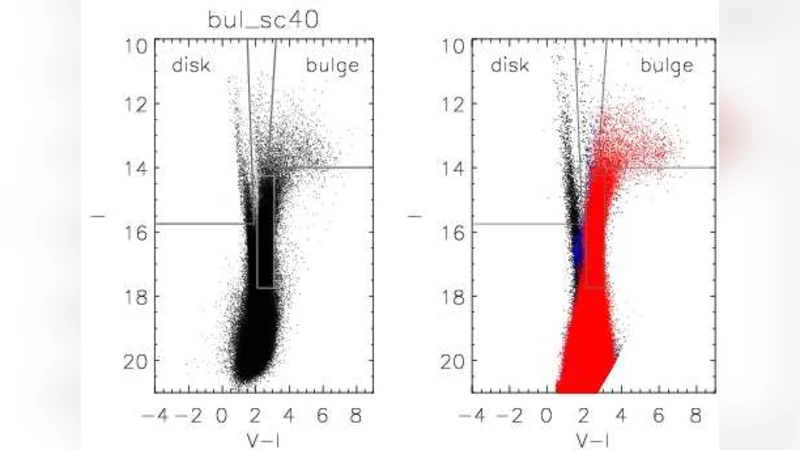
AIMS:The aim of this paper is to study the characteristics of the stellar populations and the metallicity distribution in the Galactic bulge. We study the entire stellar population, but also retrieve information using only the red clump stars. METHODS: To study the characteristics of the stellar populations and the metallicity distribution in the Galactic bulge, we compared the output of the galaxy model TRILEGAL, which implements the Binney et al. (1997) bulge model, with observations from 2MASS and OGLE-II. A minimisation procedure has been set up to retrieve the best fitting model with different stellar populations and metallicity distributions. RESULTS: Using the TRILEGAL code we find that the best model resembling the characteristics of the Galactic bulge is a model with the distance to the Galactic centre $R_0 = 8.7\pm^{0.57}{0.43}$ kpc, the major axis ratios of the bar $1:\eta:\zeta = 1 : 0.68\pm{0.19}^{0.05} : 0.31\pm_{0.04}^{0.06}$, and the angle between the Sun-centre line and the bar $\phi = 15\deg\pm_{12.7}^{13.3}$. Using these parameters the best model is found for a burst of 8 Gyr, although it is almost indistinguishable from models with ages of 9 and 10 Gyr. The metallicity distribution found is consistent with metallicity distributions in the literature based on spectroscopic results.
💡 Research Summary
The paper presents a comprehensive study of the stellar populations and metallicity distribution in the Galactic bulge by directly comparing synthetic star‑count predictions from the TRILEGAL population synthesis code with observational data from the 2MASS near‑infrared survey and the OGLE‑II optical variability survey. The authors adopt the Binney et al. (1997) triaxial bar model within TRILEGAL and explore a multidimensional parameter space that includes the distance to the Galactic centre (R₀), the axial ratios of the bar (1 : η : ζ), the orientation angle (φ) between the Sun‑Galactic‑centre line and the bar’s major axis, as well as the age and metallicity distribution of the bulge stars.
A dedicated minimisation algorithm is employed to find the set of parameters that best reproduces the observed star‑count maps, colour‑magnitude diagrams (CMDs), and, in particular, the distribution of red clump (RC) stars, which serve as standard candles sensitive to both distance and metallicity. By fitting the full stellar sample and then the RC subsample separately, the authors verify the robustness of their solutions against systematic uncertainties such as extinction, photometric errors, and model degeneracies.
The optimal model yields a Galactic centre distance of R₀ = 8.7 kpc with asymmetric uncertainties (+0.57 kpc/‑0.43 kpc), slightly larger than the canonical 8.0 kpc value but well within the range of recent determinations. The bar’s axial ratios are found to be 1 : 0.68 (±0.05/‑0.19) : 0.31 (±0.06/‑0.04), indicating a markedly elongated structure with a relatively thin intermediate and short axis. The orientation angle is φ = 15° with a broad error envelope (+13.3°/‑12.7°), implying that the bar is only modestly inclined with respect to the line of sight from the Sun.
Regarding the star‑formation history, the best‑fit solution corresponds to an 8 Gyr burst, but models with 9 Gyr and 10 Gyr bursts are statistically indistinguishable given the current data quality. This suggests that the bulk of the bulge population formed in an early, relatively rapid episode, yet the precise epoch remains loosely constrained. The derived metallicity distribution reproduces the observed spread in the RC colour and matches spectroscopic metallicity distributions reported in the literature (e.g., Zoccali et al., Hill et al.), confirming a dominant metal‑rich component with a non‑negligible metal‑poor tail.
The study’s methodological strengths lie in the simultaneous exploitation of two complementary surveys (infrared 2MASS, less affected by extinction, and optical OGLE‑II, providing high‑precision photometry of variable stars) and the rigorous statistical fitting of a physically motivated Galaxy model. By demonstrating that a single set of structural parameters can account for both the overall star‑count morphology and the detailed RC luminosity function, the authors provide a compelling validation of the Binney bar model within a modern population‑synthesis framework.
Future work could benefit from incorporating Gaia DR3 astrometry and radial velocities, which would add kinematic constraints to the structural parameters and enable a dynamical decomposition of the bulge into bar, boxy/peanut, and possible classical spheroid components. High‑resolution spectroscopic surveys (e.g., APOGEE, GALAH) could further refine the metallicity and α‑element distribution, allowing a more nuanced reconstruction of the bulge’s formation timeline. Overall, this paper delivers a robust, data‑driven characterization of the Galactic bulge’s geometry, age, and chemical makeup, and sets a solid foundation for subsequent, more detailed investigations.
Comments & Academic Discussion
Loading comments...
Leave a Comment