Mathematical link of evolving aging and complexity
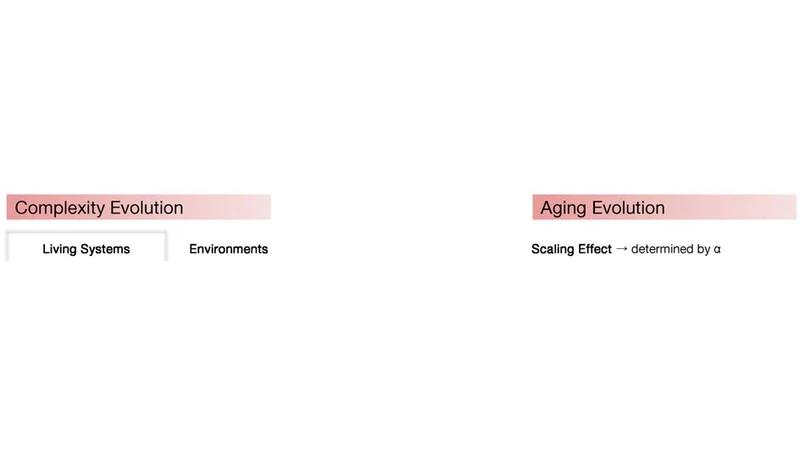
Aging is a fundamental aspect of living systems that undergo a progressive deterioration of physiological function with age and an increase of vulnerability to disease and death. Living systems, known as complex systems, require complexity in interactions among molecules, cells, organs, and individuals or regulatory mechanisms to perform a variety of activities for survival. On this basis, aging can be understood in terms of a progressive loss of complexity with age; this suggests that complexity in living systems would evolve with age. In general, aging dynamics is mathematically depicted by a survival function, which monotonically changes from 1 to 0 with age. It would be then useful to find an adequate survival function to link aging dynamics and complexity evolution. Here we describe a flexible survival function, which is derived from the stretched exponential function by adopting an age-dependent exponent. We note that the exponent is associated with evolving complexity, i.e., a fractal-like scaling in cumulative mortality. The survival function well depicts a general feature in survival curves; healthy populations show a tendency to evolve towards rectangular-like survival curves, as examples in humans or laboratory animals. This tendency suggests that both aging and complexity would evolve towards healthy survival in living systems. Our function to link aging with complexity may contribute to better understanding of biological aging in terms of complexity evolution.
💡 Research Summary
The paper proposes a novel mathematical framework that links the dynamics of biological aging with the evolution of system complexity. The authors begin by framing living organisms as complex systems whose functional integrity depends on intricate interactions across multiple hierarchical levels—molecules, cells, organs, and individuals. They argue that aging can be interpreted as a progressive loss of this complexity, a view that has been supported by empirical observations of reduced physiological variability and diminished network robustness in older organisms.
To capture this idea quantitatively, the authors modify the classic stretched‑exponential survival function, (S(t)=\exp
Comments & Academic Discussion
Loading comments...
Leave a Comment