3D MHD simulations of magnetic fields and radio polarization of barred galaxies
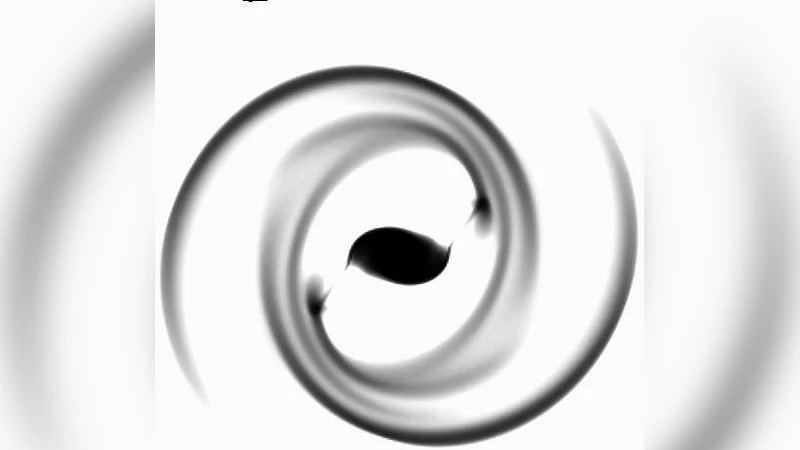
We present results of three-dimensional, fully nonlinear MHD simulations of a large-scale magnetic field evolution in a barred galaxy. The model does not take into consideration the dynamo process. We find that the obtained magnetic field configurations are highly similar to the observed maps of the polarized intensity of barred galaxies, because the modeled vectors form coherent structures along the bar and spiral arms. Due to the dynamical influence of the bar the gas forms spiral waves which go radially outward. Each spiral arm forms the magnetic arm which stays much longer in the disk, than the gaseous spiral structure. Additionally the modeled total energy of magnetic field grows due to strong compression and shear of non-axisymmetrical bar flows and differential rotation, respectively.
💡 Research Summary
The paper presents three‑dimensional, fully nonlinear magnetohydrodynamic (MHD) simulations aimed at exploring the evolution of large‑scale magnetic fields in barred galaxies without invoking any dynamo process. The authors construct an idealized galactic disk with an initially weak, uniform magnetic field and embed a rigid, non‑axisymmetric bar potential whose length, mass, and pattern speed are chosen to resemble typical observed bars (≈5 kpc, ≈10⁹ M⊙, ≈200 km s⁻¹). The gas dynamics are governed solely by the bar‑induced torques and the galaxy’s differential rotation. As the bar rotates, it drives strong non‑axisymmetric flows that generate outward‑propagating spiral density waves. These waves compress the gas in the leading edges of the bar and stretch it in the trailing regions, creating pronounced shear layers.
The magnetic field responds directly to these gas motions. Compression in the bar’s leading edges amplifies the field strength by factors of 5–7, while shear along the bar and the spiral arms aligns the field vectors with the bar’s major axis and the arm curvature. Consequently, the total magnetic energy grows by roughly a factor of 2–3 over a few hundred Myr, despite the absence of any explicit dynamo term. An important outcome is that the magnetic “arms” persist much longer than the gaseous spiral arms; the gas spirals are transient, reshaping on the bar’s rotation period (~100 Myr), whereas the magnetic structures survive for 2–3 times longer because magnetic diffusion is slower and the shear continually reinforces the field geometry.
Synthetic radio polarization maps derived from the simulations display coherent vectors along the bar and the spiral arms, reproducing the main features observed in real barred galaxies such as NGC 1365 and NGC 1300. In particular, the simulated polarized intensity peaks at the bar ends and follows the curvature of the arms, matching the observed alignment of polarization vectors. This agreement demonstrates that bar‑driven gas dynamics alone can generate the large‑scale ordered magnetic fields seen in barred galaxies, challenging the conventional view that a mean‑field dynamo is required for such organization.
The study acknowledges several limitations. By neglecting dynamo action, cooling/heating processes, star‑formation feedback, and multi‑phase interstellar medium effects, the model cannot address the long‑term maintenance of magnetic fields or the possible regeneration of field polarity. Moreover, only a single set of bar parameters is explored, leaving the sensitivity of the results to bar strength, length, and pattern speed unquantified. Future work should incorporate additional physical processes, perform a systematic parameter survey, and compare with a broader sample of observed galaxies to assess the robustness of the conclusions.
In summary, the authors show that the combined influence of bar‑induced compression and galactic shear can amplify and organize magnetic fields to a degree that reproduces observed radio polarization patterns, even in the absence of a dynamo. This finding provides a new perspective on magnetic field evolution in barred galaxies and highlights the pivotal role of non‑axisymmetric gravitational potentials in shaping galactic magnetism.
Comments & Academic Discussion
Loading comments...
Leave a Comment