A B"uchi-Elgot-Trakhtenbrot theorem for automata with MSO graph storage
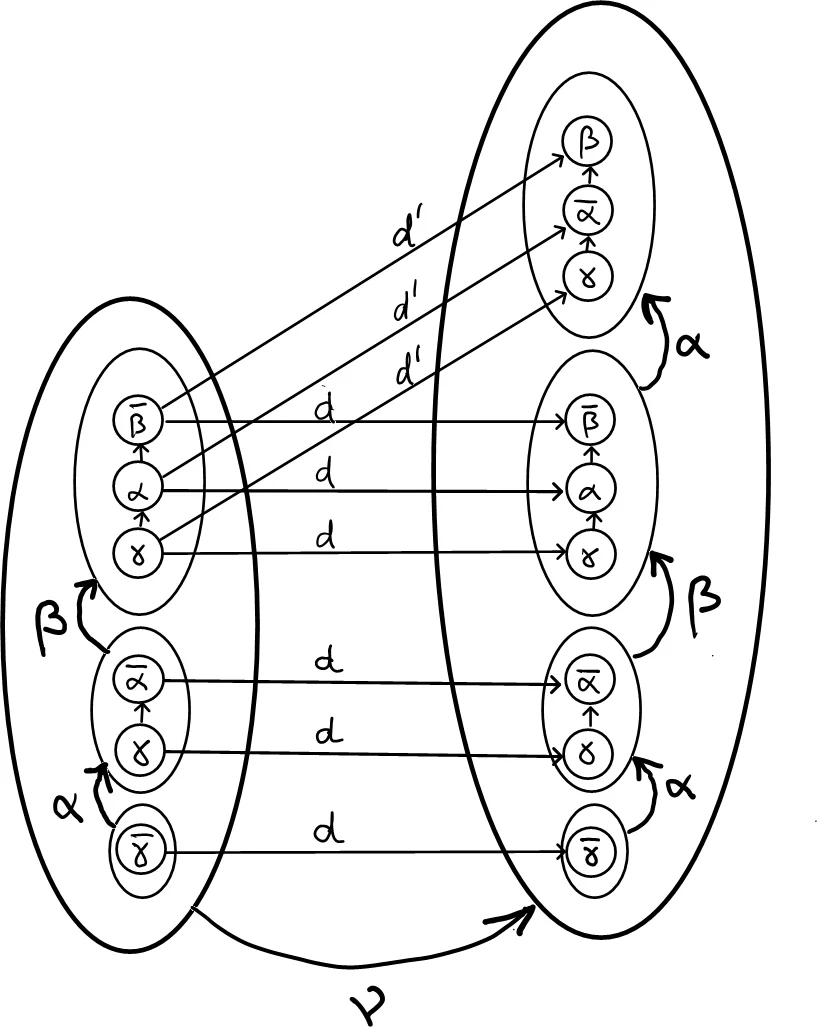
We introduce MSO graph storage types, and call a storage type MSO-expressible if it is isomorphic to some MSO graph storage type. An MSO graph storage type has MSO-definable sets of graphs as storage configurations and as storage transformations. We consider sequential automata with MSO graph storage and associate with each such automaton a string language (in the usual way) and a graph language; a graph is accepted by the automaton if it represents a correct sequence of storage configurations for a given input string. For each MSO graph storage type, we define an MSO logic which is a subset of the usual MSO logic on graphs. We prove a B"uchi-Elgot-Trakhtenbrot theorem, both for the string case and the graph case. Moreover, we prove that (i) each MSO graph transduction can be used as storage transformation in an MSO graph storage type, (ii) every automatic storage type is MSO-expressible, and (iii) the pushdown operator on storage types preserves the property of MSO-expressibility. Thus, the iterated pushdown storage types are MSO-expressible.
💡 Research Summary
The paper introduces a new class of storage types called MSO graph storage types and studies automata that use such storage. A storage type S is traditionally defined by a set C of configurations, an initial configuration, a finite set Θ of instructions, and a meaning function m that maps each instruction to a binary relation on C (the possible configuration changes). The authors enrich this framework by representing both configurations and the transformations induced by instructions as graphs that are definable in monadic second‑order logic (MSO).
To capture the relationship between a configuration before and after an instruction, they define pair graphs: a graph partitioned into two components g₁ and g₂ (the “before” and “after” configurations) together with ν‑labeled edges from every node of g₁ to every node of g₂, plus optional intermediate edges that encode which nodes stay unchanged. Each instruction θ∈Θ is given by a closed MSO formula that defines a set of such pair graphs; the storage transformation m(θ) is precisely the set of ordered pairs (g₁,g₂) extracted from those pair graphs. When the set of all configurations C is itself MSO‑definable, the storage type is called MSO‑expressible.
The authors then consider sequential S‑automata (finite‑state control plus the storage) and associate two languages with each automaton:
- The usual string language L(A) consisting of input words accepted by the automaton.
- A graph language GL(A) consisting of “string‑like graphs”. A string‑like graph g is a sequence of component graphs (the configurations) linked by A‑labeled edges whose labels form the input word (the “trace”). Between consecutive components there are ν‑edges (representing the “next” relation) and possibly intermediate edges, exactly as in the pair‑graph definition.
To reason about such graphs the paper defines a tailored logic MSOL(S, A), a fragment of ordinary MSO on graphs. Formulas have an outer level that talks about the string‑like structure (edges labelled by input symbols) and an inner level that talks about storage behaviour via atomic predicates of the form next(θ, x, y), which assert that the two nodes x and y belong to consecutive components and that the induced pair graph satisfies the MSO formula θ. The outer level allows the usual Boolean connectives and quantification over vertices and sets, with a modified membership predicate x∈X replaced by x∈⁎X (true if x is in X or shares a component with a vertex of X).
The main technical contributions are two Büchi‑Elgot‑Trakhtenbrot (BET) theorems:
- String‑BET: A language L⊆A* is S‑recognizable (i.e., accepted by some S‑automaton) iff there exists a closed MSOL(S, A) formula ϕ such that
L = { w ∈ A* | ∃g∈G
Comments & Academic Discussion
Loading comments...
Leave a Comment