Planar 3-SAT with a Clause/Variable Cycle
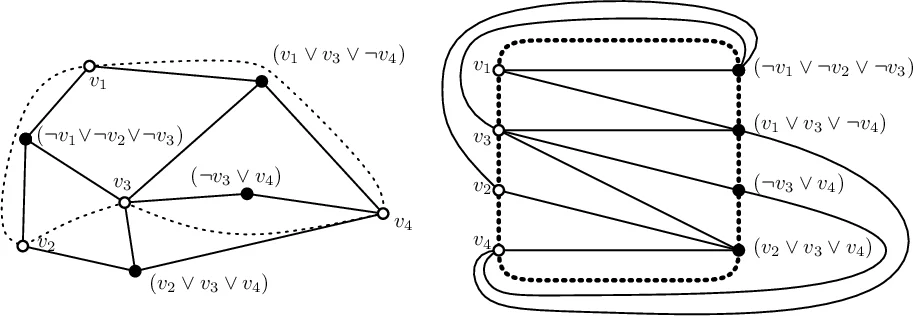
In the Planar 3-SAT problem, we are given a 3-SAT formula together with its incidence graph, which is planar, and are asked whether this formula is satisfiable. Since Lichtenstein’s proof that this problem is NP-complete, it has been used as a starting point for a large number of reductions. In the course of this research, different restrictions on the incidence graph of the formula have been devised, for which the problem also remains hard. In this paper, we investigate the restriction in which we require that the incidence graph can be augmented by the edges of a Hamiltonian cycle that first passes through all variables and then through all clauses, in a way that the resulting graph is still planar. We show that the problem of deciding satisfiability of a 3-SAT formula remains NP-complete even if the incidence graph is restricted in that way and the Hamiltonian cycle is given. This complements previous results demanding cycles only through either the variables or clauses. The problem remains hard for monotone formulas, as well as for instances with exactly three distinct variables per clause. In the course of this investigation, we show that monotone instances of Planar 3-SAT with exactly three distinct variables per clause are always satisfiable, thus settling the question by Darmann, D"ocker, and Dorn on the complexity of this problem variant in a surprising way.
💡 Research Summary
The paper investigates a refined version of the classic Planar 3‑SAT problem, where the incidence graph of a Boolean formula is required to admit a Hamiltonian cycle that first visits every variable vertex and then every clause vertex, while the union of the incidence graph and this cycle remains planar. This variant is called “Linked Planar 3‑SAT”. The authors prove that Linked Planar 3‑SAT is NP‑complete, even when the Hamiltonian cycle is supplied as part of the input.
To establish hardness, they start from an arbitrary planar 3‑SAT instance and embed its incidence graph on an integer grid with straight‑line edges. Variables are placed on even‑x coordinates, clauses on odd‑x coordinates, which guarantees that a vertical line intersects each edge at most once (x‑monotonicity). Inside a rectangular region R they draw a Hamiltonian cycle κ that alternates between vertical “variable segments” (even columns) and “clause segments” (odd columns). Every original edge that crosses κ is replaced by a chain of “connector gadgets”. Each gadget introduces two fresh variables x and x′ together with two clauses (¬x ∨ x′) and (¬x′ ∨ x), enforcing x = x′ in any satisfying assignment. By inserting enough gadgets, all crossings between the original edges and κ are eliminated, yielding a planar graph Gφ that contains κ as a subgraph. The construction preserves satisfiability: the new formula φ is satisfiable iff the original formula ˜φ is. Consequently, Linked Planar 3‑SAT is NP‑hard; membership in NP is trivial, so the problem is NP‑complete.
Beyond the base result, the paper explores several restricted versions. First, it shows that the problem remains NP‑complete for monotone formulas (all literals in a clause are either all positive or all negative). Second, it proves hardness when each clause contains exactly three distinct variables, a restriction often used in planar reductions. Third, it combines both restrictions, yielding “Monotone Exact‑3 Linked Planar 3‑SAT”. Surprisingly, the authors demonstrate that this combined restriction is always satisfiable: any monotone planar 3‑SAT instance where each clause has exactly three distinct variables admits a satisfying assignment. This resolves an open question posed by Darmann, Döcker, and Dorn, who had shown NP‑completeness for the “at most three variables per clause” case but left the exact‑three case unsettled. The proof relies on showing that such instances have bounded treewidth (they are essentially k‑outerplanar), allowing a polynomial‑time algorithm based on dynamic programming over tree decompositions.
The paper also discusses cases where the planarity condition is automatically satisfied by any satisfying assignment, such as formulas where each clause contains at least four variables; these are always satisfiable, extending earlier results by de Berg and Khosravi.
In summary, the authors introduce a unified “linked” framework that simultaneously enforces a variable cycle and a clause cycle, prove its NP‑completeness, and systematically analyze how additional structural constraints affect complexity. Their work both extends the landscape of planar SAT variants and settles a previously open monotone‑exact‑3 case, providing valuable insights for future reductions and for understanding the fine line between tractable and intractable planar Boolean formula problems.
Comments & Academic Discussion
Loading comments...
Leave a Comment