Initial Semantics for Reduction Rules
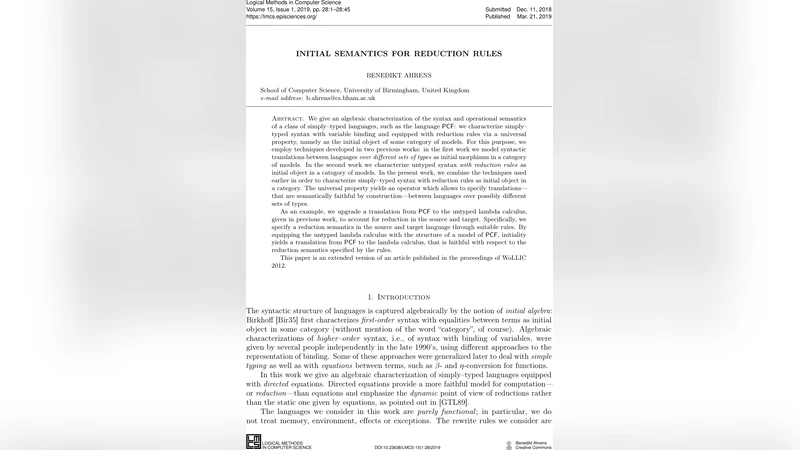
We give an algebraic characterization of the syntax and operational semantics of a class of simply-typed languages, such as the language PCF: we characterize simply-typed syntax with variable binding and equipped with reduction rules via a universal property, namely as the initial object of some category of models. For this purpose, we employ techniques developed in two previous works: in the first work we model syntactic translations between languages over different sets of types as initial morphisms in a category of models. In the second work we characterize untyped syntax with reduction rules as initial object in a category of models. In the present work, we combine the techniques used earlier in order to characterize simply-typed syntax with reduction rules as initial object in a category. The universal property yields an operator which allows to specify translations—that are semantically faithful by construction—between languages over possibly different sets of types. As an example, we upgrade a translation from PCF to the untyped lambda calculus, given in previous work, to account for reduction in the source and target. Specifically, we specify a reduction semantics in the source and target language through suitable rules. By equipping the untyped lambda calculus with the structure of a model of PCF, initiality yields a translation from PCF to the lambda calculus, that is faithful with respect to the reduction semantics specified by the rules. This paper is an extended version of an article published in the proceedings of WoLLIC 2012.
💡 Research Summary
The paper presents a categorical framework that unifies the syntax of simply‑typed languages with their operational semantics, expressed as reduction rules, by characterising them as an initial object in a suitable category of models. Building on two earlier works—one that treated syntactic translations between languages with different type sets as initial morphisms, and another that captured untyped syntax with reduction rules as an initial object—the authors combine these techniques to handle simply‑typed syntax with variable binding together with reduction relations. A model in the proposed category consists of (i) a set of types, (ii) the usual binding constructors (λ‑abstraction and application) forming a free algebraic structure, and (iii) a family of reduction rules presented as a relation (e.g., β‑reduction and conditional rules). Morphisms between models must preserve types, the algebraic constructors, and the reduction relation. The existence of an initial model I means that for any other model M there is a unique morphism I → M that automatically respects both the syntactic structure and the reduction semantics. Consequently, I embodies a canonical “syntax‑plus‑reduction” theory, and any translation derived from the initiality is guaranteed to be semantically faithful.
To demonstrate the approach, the authors instantiate the framework with PCF, a classic simply‑typed functional language, specifying its type system and reduction rules. They then consider the untyped λ‑calculus, equipped with a model of PCF obtained by interpreting PCF types and terms within the λ‑calculus. By the initiality of the PCF model, a unique translation from PCF to the λ‑calculus is derived; this translation not only maps terms but also maps each reduction step in PCF to a corresponding reduction step in the target, ensuring full reduction‑preserving fidelity without additional proof obligations.
The paper further discusses the generality of the construction. The categorical conditions required for the existence of an initial object are modest: the models must support a free algebraic syntax and a well‑behaved relational reduction structure. Hence the same methodology can be applied to richer type systems such as System F, ML‑style languages, or effectful calculi, and can be extended to capture evaluation strategies (call‑by‑value, call‑by‑name) by enriching the model with appropriate orderings.
In summary, the work introduces a powerful universal property—initial semantics for reduction rules—that simultaneously captures typing, binding, and operational behaviour. This property yields translations that are correct by construction, streamlining the design of language embeddings and providing a solid theoretical foundation for reasoning about reductions across disparate type systems.
Comments & Academic Discussion
Loading comments...
Leave a Comment