From structure mining to unsupervised exploration of atomic octahedral networks
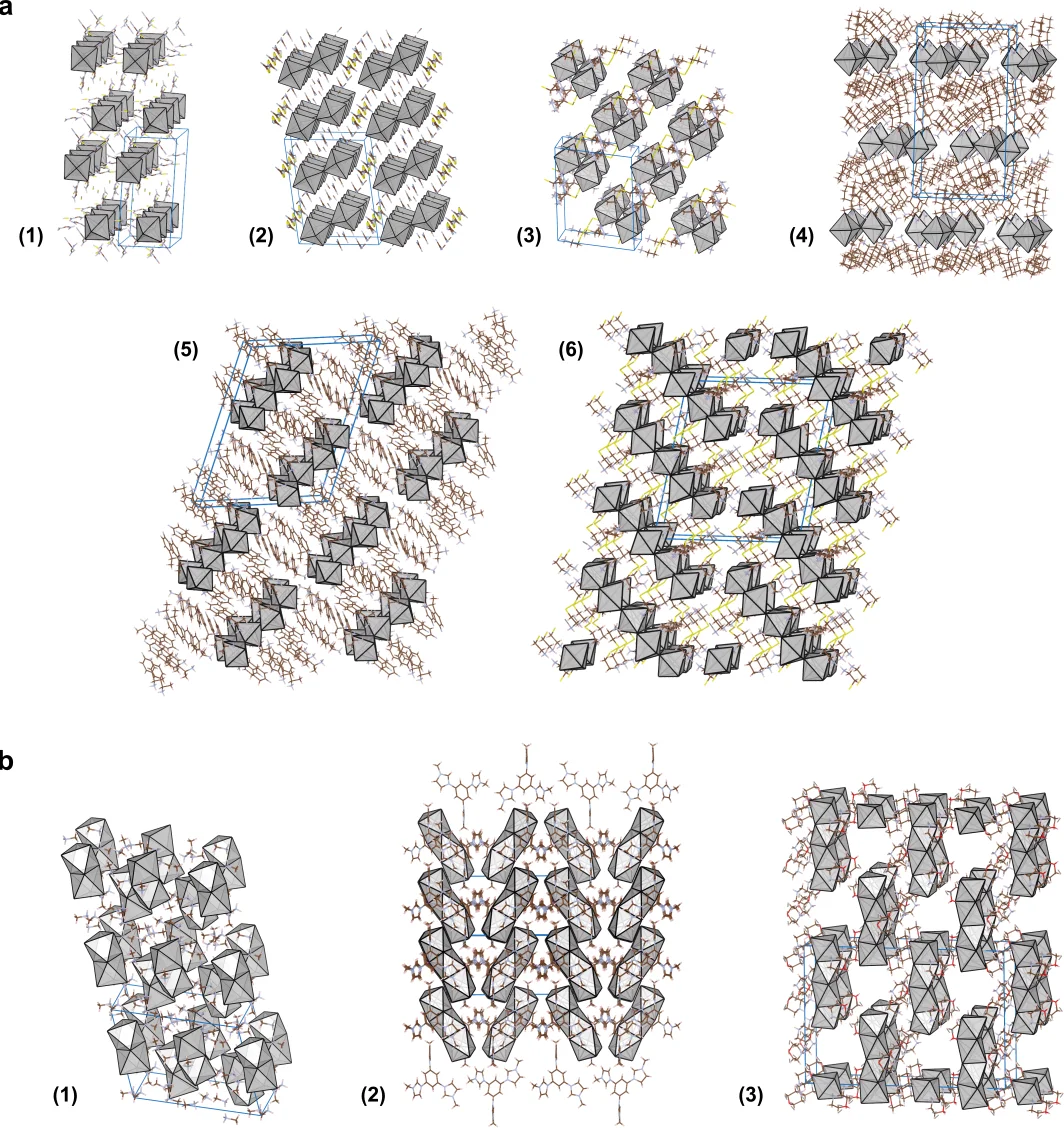
Networks of atom-centered coordination octahedra commonly occur in inorganic and hybrid solid-state materials. Characterizing their spatial arrangements and characteristics is crucial for relating structures to properties for many materials families. The traditional method using case-by-case inspection becomes prohibitive for discovering trends and similarities in large datasets. Here, we operationalize chemical intuition to automate the geometric parsing, quantification, and classification of coordination octahedral networks. We find axis-resolved tilting trends in ABO$_{3}$ perovskite polymorphs, which assist in detecting oxidation state changes. Moreover, we develop a scale-invariant encoding scheme to represent these networks, which, combined with human-assisted unsupervised machine learning, allows us to taxonomize the inorganic framework polytypes in hybrid iodoplumbates (A$_x$Pb$_y$I$_z$). Consequently, we uncover a violation of Pauling’s third rule and the design principles underpinning their topological diversity. Our results offer a glimpse into the vast design space of atomic octahedral networks and inform high-throughput, targeted screening of specific structure types.
💡 Research Summary
The paper presents a comprehensive computational workflow for the automatic parsing, quantification, and classification of atomic octahedral networks (ONs) that are ubiquitous in inorganic and hybrid solid‑state materials. The authors first develop a generalized definition of octahedral tilting angles that extends beyond the traditional Glazer system, which was limited to small distortions in orthogonal, corner‑sharing perovskites. By retaining the Cartesian axes as reference and measuring the angles between these axes and the octahedral body diagonals, the method captures axis‑resolved tilting for a broad range of lattice symmetries, including edge‑ and face‑sharing motifs. An algorithm assigns a right‑hand spiral ordering to the octahedron vertices, ensuring a consistent and automated determination of tilt angles even for oblique lattices.
Network construction is achieved through a dual‑graph representation. The “mesh graph” uses atoms as vertices and the unique edges of each coordination polyhedron as edges, faithfully describing the local coordination environment. The “inter‑unit graph” treats each octahedron as a vertex and encodes the type of sharing (corner, edge, face) as edges, thereby capturing the long‑range connectivity of the network. This bottom‑up approach bypasses distance‑based descriptors, granting scale invariance and enabling direct comparison across materials with vastly different unit‑cell dimensions.
Applying this pipeline to a high‑throughput dataset of more than 2,000 oxide perovskite polymorphs (derived from DFT calculations) reveals two salient trends. First, there is a clear global correlation between the Goldschmidt tolerance factor and the three axis‑resolved tilt angles for almost all non‑cubic Glazer classes. Second, periodic “micro‑trends” emerge when the data are ordered by the periodic table: lanthanide A‑site substitution series (e.g., LaTiO₃ → GdTiO₃ → LuTiO₃) show monotonic changes in tilt angles that track the lanthanide contraction, while analogous B‑site substitution series display similar systematic behavior across a broader set of cations. Outliers such as Eu‑ and Yb‑containing perovskites deviate from these trends; charge analysis confirms that they adopt a +2 oxidation state, indicating that octahedral tilt metrics can serve as proxies for detecting oxidation‑state changes in large screening studies.
The methodology is then extended to hybrid iodoplumbates (AₓPb_yI_z), a family of metal‑halide perovskite‑related compounds that combine inorganic PbI₆ octahedra with organic cations. Existing classification schemes for their connectivity (cleaving‑plane indices, homologous series, corrugated nets) are qualitative and unsuitable for high‑throughput screening. The authors introduce a scale‑invariant coordination network encoding (CNE) that translates each structure into a compact vector, which is subsequently fed into human‑assisted unsupervised machine learning (manifold learning and clustering). By mapping the Euler characteristic per octahedron against the number of octahedra, they automatically infer dimensionality (1D, 2D, 3D) and identify distinct framework polytypes. Remarkably, many iodoplumbates violate Pauling’s third rule—exhibiting face‑sharing octahedra that give each cation more than 12 anionic neighbors—yet remain stable, suggesting that the rule is not a strict constraint in these hybrid systems. The authors further uncover a power‑law distribution of polytype frequencies, hinting at underlying design principles governing topological diversity.
In summary, the paper delivers (1) an automated geometric parser for octahedral coordination environments, (2) a scale‑invariant dual‑graph representation that captures both local geometry and global connectivity, (3) a robust tilting analysis that links structural metrics to chemical factors such as tolerance factor and oxidation state, and (4) a human‑in‑the‑loop unsupervised learning pipeline that classifies complex hybrid frameworks and reveals violations of classical crystal‑chemical rules. These tools open the door to high‑throughput, property‑guided discovery of new materials across a vast design space of octahedral networks, and the approach is readily extensible to other polyhedral motifs and functional property targets.
Comments & Academic Discussion
Loading comments...
Leave a Comment