Formal Methods: From Academia to Industrial Practice. A Travel Guide
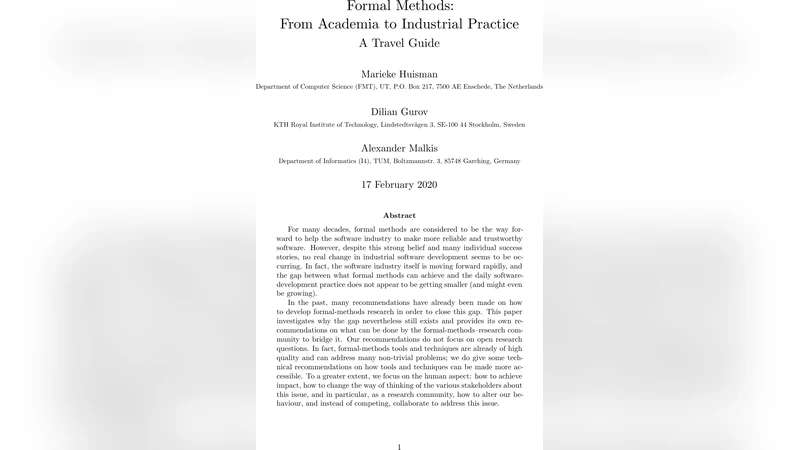
For many decades, formal methods are considered to be the way forward to help the software industry to make more reliable and trustworthy software. However, despite this strong belief and many individual success stories, no real change in industrial software development seems to be occurring. In fact, the software industry itself is moving forward rapidly, and the gap between what formal methods can achieve and the daily software-development practice does not appear to be getting smaller (and might even be growing). In the past, many recommendations have already been made on how to develop formal-methods research in order to close this gap. This paper investigates why the gap nevertheless still exists and provides its own recommendations on what can be done by the formal-methods-research community to bridge it. Our recommendations do not focus on open research questions. In fact, formal-methods tools and techniques are already of high quality and can address many non-trivial problems; we do give some technical recommendations on how tools and techniques can be made more accessible. To a greater extent, we focus on the human aspect: how to achieve impact, how to change the way of thinking of the various stakeholders about this issue, and in particular, as a research community, how to alter our behaviour, and instead of competing, collaborate to address this issue.
💡 Research Summary
The paper “Formal Methods: From Academia to Industrial Practice. A Travel Guide” examines why, despite decades of research and numerous isolated success stories, formal methods have not become a mainstream part of commercial software development. The authors argue that the gap between academic advances and industrial adoption is not merely a technical one; it is rooted in human, organizational, and cultural factors that have persisted or even widened as the software industry has accelerated.
First, the authors diagnose the current state of formal‑method tools. While the underlying theories and verification techniques are mature, most tools remain research prototypes with steep learning curves, cumbersome installation procedures, and limited integration with modern development environments (IDEs, CI/CD pipelines, version control systems). This creates a high barrier to entry for practitioners who need quick, reliable feedback within short development cycles.
Second, the paper highlights a mismatch in education and perception. Universities and research labs teach formal methods as abstract, theorem‑proving exercises, whereas industry prioritises rapid prototyping, time‑to‑market, and cost reduction. Consequently, engineers often view formal methods as an optional “add‑on” rather than a core component of the development workflow.
Third, organizational processes and culture are examined. Existing software development lifecycles rarely allocate dedicated verification stages, and there is a lack of standardized checkpoints where formal analysis could be inserted without disrupting delivery schedules. Without clear responsibility assignments and measurable quality goals, management is reluctant to invest in formal verification.
Fourth, the authors point out the fragmented nature of academia‑industry collaboration. Partnerships tend to be project‑based and short‑lived, providing little opportunity for continuous feedback, joint road‑mapping, or shared tooling development. This results in a “siloed” ecosystem where research outputs are not iteratively refined to meet real‑world constraints.
To bridge these gaps, the paper proposes ten concrete, practice‑oriented recommendations:
- User‑Centred Tool Design – Build intuitive GUIs, provide IDE plugins, and make seamless integration with CI/CD pipelines a default feature.
- Open‑Source Foundations and Standards – Release core verification algorithms under permissive licenses and align them with industry standards (e.g., ISO/IEC 25010) to foster interoperability.
- Hands‑On, Problem‑Driven Education – Replace lecture‑heavy curricula with workshops, hackathons, and mentorship programs that solve concrete industrial problems using formal methods.
- Pilot‑Project Funding – Establish government or consortium grants that lower the financial risk for companies willing to experiment with formal verification on a small scale.
- Success‑Story Dissemination – Document and circulate detailed case studies that quantify quality improvements, defect reductions, and ROI, thereby creating persuasive internal advocacy material.
- Joint Research‑Industry Roadmaps – Co‑define annual milestones, success metrics, and review cycles to ensure that research directions stay aligned with evolving market needs.
- Incentive Realignment – Academic evaluation should reward open‑source contributions, industry collaborations, and standard‑setting activities alongside traditional publications; corporate KPIs should incorporate formal‑method adoption metrics such as defect density reduction.
- Specialised Talent Pipelines – Develop joint degree or certification programs that blend formal‑method theory with practical software engineering, creating a workforce fluent in both domains.
- Cultural Shift Toward Quality as Infrastructure – Position formal methods as a foundational quality‑assurance layer rather than an optional testing technique, with executive sponsorship and strategic messaging.
- Collaborative Platforms – Deploy online hubs where researchers, tool developers, and practitioners can exchange ideas, report bugs, propose feature requests, and co‑author extensions in real time.
A central theme throughout the recommendations is the emphasis on human collaboration over competition. The authors argue that the formal‑methods community must move from a “publish‑first” mindset to one that values sustained partnership with industry, open‑source stewardship, and shared responsibility for delivering usable, reliable tools. Likewise, companies need to view early‑stage formal verification not as a cost centre but as a strategic investment that can reduce later rework, improve safety‑critical system assurance, and differentiate products in markets where trust is a competitive advantage.
In conclusion, the paper asserts that the technical capabilities of formal methods are already sufficient for many non‑trivial industrial problems. The remaining obstacles are usability, education, organizational alignment, and collaborative structures. By simultaneously improving tool accessibility, reforming curricula, incentivising joint work, and fostering a culture that treats formal verification as core infrastructure, the gap between academia and industry can be narrowed. The authors envision a future where formal methods are seamlessly embedded in everyday software development pipelines, leading to more reliable, trustworthy systems across all domains.
Comments & Academic Discussion
Loading comments...
Leave a Comment