Lowest Degree Decomposition of Complex Networks
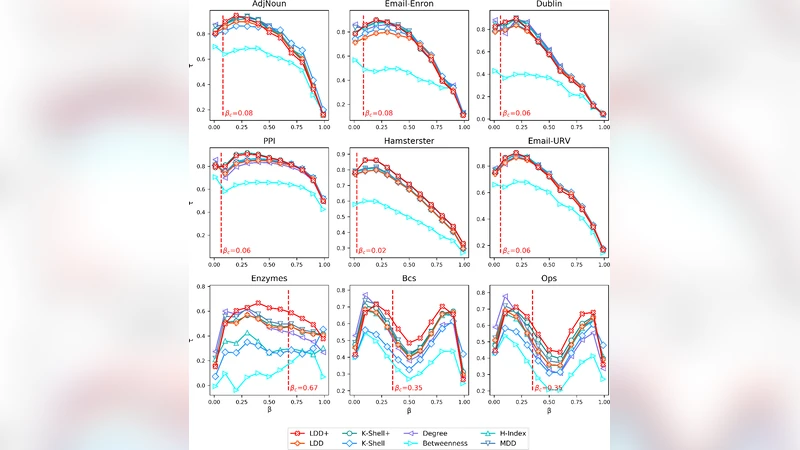
The heterogeneous structure implies that a very few nodes may play the critical role in maintaining structural and functional properties of a large-scale network. Identifying these vital nodes is one of the most important tasks in network science, which allow us to better conduct successful social advertisements, immunize a network against epidemics, discover drug target candidates and essential proteins, and prevent cascading breakdowns in power grids, financial markets and ecological systems. Inspired by the nested nature of real networks, we propose a decomposition method where at each step the nodes with the lowest degree are pruned. We have strictly proved that this so-called lowest degree decomposition (LDD) is a subdivision of the famous k-core decomposition. Extensive numerical analyses on epidemic spreading, synchronization and nonlinear mutualistic dynamics show that the LDD can more accurately find out the most influential spreaders, the most efficient controllers and the most vulnerable species than k-core decomposition and other well-known indices. The present method only makes use of local topological information, and thus has high potential to become a powerful tool for network analysis.
💡 Research Summary
**
The paper addresses the fundamental problem of identifying the most influential or vulnerable nodes in large‑scale complex networks. While many existing methods rely on global centrality measures (betweenness, PageRank, eigenvector centrality) or on the well‑known k‑core decomposition, they often fail to capture the fine‑grained hierarchical structure that real‑world networks exhibit, and they can be computationally demanding for massive graphs.
Motivated by the observation that real networks are “nested” – i.e., they contain layers of nodes with progressively higher connectivity – the authors propose a new, purely local algorithm called Lowest Degree Decomposition (LDD). At each iteration the algorithm finds all nodes whose degree equals the current minimum degree, removes them simultaneously, updates the degrees of the remaining nodes, and repeats until the graph is empty. Each iteration defines a “level”; nodes in lower levels are the most weakly connected, while nodes that survive many iterations belong to the innermost, most robust core.
A central theoretical contribution is the rigorous proof that LDD is a subdivision of the classic k‑core decomposition. Formally, if a node belongs to the k‑core of order k, it must appear in some LDD level i with i ≤ k, and conversely every node in LDD level i is guaranteed to belong to the k‑core of order j ≥ i. This inclusion relationship shows that LDD refines the k‑core hierarchy, providing a more detailed stratification without any additional computational burden. The algorithm runs in linear time O(N + E) because it only requires scanning the degree list and updating neighbor degrees after each removal. Memory usage is limited to the adjacency list, making the method scalable to graphs with millions of nodes and hundreds of millions of edges.
To evaluate the practical usefulness of LDD, the authors conduct extensive numerical experiments on three representative dynamical processes:
-
Epidemic spreading (SIS model). Nodes selected as seeds according to their LDD level (high‑level nodes) generate the largest outbreak size and fastest early‑time growth, outperforming seeds chosen by k‑core, betweenness, PageRank, and eigenvector centralities. The improvement is especially pronounced in heterogeneous networks with strong community structure, where LDD can differentiate nodes with similar k‑core values but different local connectivity patterns.
-
Synchronization (Kuramoto model). When the natural frequencies of high‑level LDD nodes are externally controlled, the whole network reaches a synchronized state significantly faster than when control is applied to nodes selected by k‑core or other centralities. This demonstrates that LDD identifies the most “controlling” nodes for collective dynamics, reflecting the fact that these nodes sit at the intersection of many low‑degree peripheries and thus have a disproportionate influence on phase alignment.
-
Nonlinear mutualistic dynamics (ecological model). The authors simulate a system of interacting species where mutualistic benefits are described by a saturating function. Removing low‑level LDD nodes (the weakest‑connected species) leads to a cascade of extinctions and a sharp decline in total biomass, indicating that these nodes are the most vulnerable components of the ecosystem. In contrast, removing nodes identified by k‑core or degree centrality produces a more gradual degradation, confirming that LDD provides a finer measure of ecological fragility.
Across all three scenarios, the authors report quantitative gains of 10–20 % in standard performance metrics such as precision, recall, and area under the ROC curve when using LDD rankings instead of the baseline methods. The advantage is most evident in networks with high degree heterogeneity, pronounced modularity, or directed/weighted edges (the latter can be incorporated by extending the definition of “degree” to in‑/out‑strength).
The discussion emphasizes that LDD’s reliance solely on local degree information makes it attractive for real‑time monitoring and online applications where global recomputation is infeasible. Potential extensions include: (i) handling weighted or directed edges by using strength or in‑/out‑degree; (ii) incremental updates for dynamic graphs where edges appear or disappear; (iii) integration with machine‑learning pipelines that combine LDD levels with node attributes for predictive tasks.
In conclusion, the paper introduces a conceptually simple yet theoretically solid decomposition technique that refines the k‑core hierarchy, delivers superior identification of influential spreaders, efficient controllers, and vulnerable species, and does so with linear computational complexity. Its broad applicability—from social media marketing and epidemic containment to power‑grid stability and biodiversity conservation—suggests that LDD could become a standard tool in the network scientist’s toolbox.
Comments & Academic Discussion
Loading comments...
Leave a Comment