A Review of Personality in Human Robot Interactions
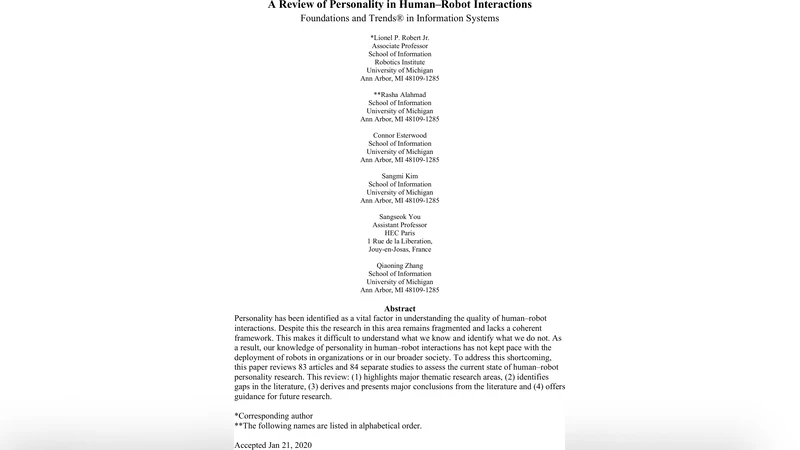
Personality has been identified as a vital factor in understanding the quality of human robot interactions. Despite this the research in this area remains fragmented and lacks a coherent framework. This makes it difficult to understand what we know and identify what we do not. As a result our knowledge of personality in human robot interactions has not kept pace with the deployment of robots in organizations or in our broader society. To address this shortcoming, this paper reviews 83 articles and 84 separate studies to assess the current state of human robot personality research. This review: (1) highlights major thematic research areas, (2) identifies gaps in the literature, (3) derives and presents major conclusions from the literature and (4) offers guidance for future research.
💡 Research Summary
The paper presents a comprehensive literature review of personality in Human‑Robot Interaction (HRI), covering 83 peer‑reviewed articles that report 84 distinct empirical studies. The authors begin by highlighting the growing recognition that a robot’s perceived personality—its consistent patterns of behavior, affect, and communication style—significantly shapes user trust, engagement, task performance, and long‑term relationship building. Despite this importance, the field remains fragmented: studies employ a wide variety of personality models (Big Five, MBTI, HEXACO, custom trait sets), robot platforms (social, service, collaborative, and telepresence robots), experimental contexts (laboratory, simulated, and limited field settings), and outcome measures (self‑report questionnaires, behavioral logs, physiological signals). This heterogeneity hampers synthesis and prevents the development of a unified theoretical framework.
Methodologically, the authors detail a systematic search across IEEE Xplore, ACM Digital Library, Scopus, and Web of Science, using keywords such as “personality,” “human‑robot interaction,” and “social robot.” Inclusion criteria required empirical work that explicitly examined robot personality or human perception of robot personality. Data extraction captured nine dimensions: research aim, personality model, robot type, experimental design, measurement instruments, sample characteristics, key findings, limitations, and suggested future work.
The analysis identifies four major thematic clusters.
-
Human Personality Perception and Projection – Studies show that users spontaneously attribute human‑like personality traits to robots, often projecting their own personality onto the machine. Traits such as extraversion and agreeableness, when perceived in a robot, consistently increase perceived warmth, likability, and willingness to cooperate.
-
Robot Personality Design Principles – Researchers manipulate vocal prosody, facial expressions, gestural repertoire, and physical appearance to instantiate specific personality profiles (e.g., friendly, professional, humorous). These designs have been linked to improved outcomes in education, healthcare, and customer service contexts, but design guidelines remain ad‑hoc and lack cross‑study validation.
-
Adaptive Interaction Mechanisms – A growing subset of work employs machine‑learning techniques (reinforcement learning, Bayesian inference, multimodal sensor fusion) to allow robots to adjust their personality in real time based on user affect, engagement metrics, or task performance. Pilot studies demonstrate short‑term gains in user satisfaction and efficiency, yet long‑term stability and user acceptance remain under‑explored.
-
Measurement and Evaluation Tools – While many studies rely on adapted human personality questionnaires, others develop robot‑specific scales or combine self‑report with behavioral and physiological data. The absence of a standardized, validated instrument for robot personality hampers comparability and meta‑analysis.
From this synthesis, the authors pinpoint critical gaps:
- Lack of an Integrated Theoretical Framework – No consensus exists on how personality constructs from psychology map onto robot design variables and interaction outcomes.
- Predominance of Short‑Term Laboratory Studies – Most experiments involve brief interactions (10–30 minutes) in controlled settings, limiting insights into sustained relationships or real‑world deployment.
- Cultural Homogeneity – The majority of work originates from North America and East Asia, with scant attention to cultural moderators of personality perception.
- Inconsistent Mapping Between Personality Models and Robot Types – Researchers select models arbitrarily, leading to contradictory findings about which traits are most effective for specific robot platforms.
- Ethical and Societal Considerations – Few papers discuss the implications of deliberately shaping robot personality to influence user behavior, raising concerns about manipulation, consent, and dependency.
To address these deficiencies, the authors propose a roadmap:
- Develop a Unified Personality‑HRI Framework that links psychological trait theory, robot embodiment variables, adaptive algorithms, and outcome metrics.
- Create Standardized, Open‑Source Measurement Instruments (e.g., a robot‑adapted Big Five scale) and share datasets to enable cross‑study replication.
- Conduct Longitudinal, In‑Situ Studies spanning months in workplaces, homes, and public spaces to assess durability of personality effects.
- Promote Multicultural, Multi‑Site Collaborations to uncover cultural nuances and ensure global applicability.
- Establish Ethical Guidelines that mandate transparency about personality manipulation, obtain informed consent, and define accountability mechanisms.
In conclusion, the review underscores that while personality is undeniably a pivotal factor in HRI, the field’s current fragmentation limits both theoretical advancement and practical implementation. By embracing a cohesive framework, standardized tools, and ethically grounded, long‑term field research, future work can harness robot personality to foster more natural, trustworthy, and effective human‑robot partnerships.
Comments & Academic Discussion
Loading comments...
Leave a Comment