Automated Corrosion Detection Using Crowd Sourced Training for Deep Learning
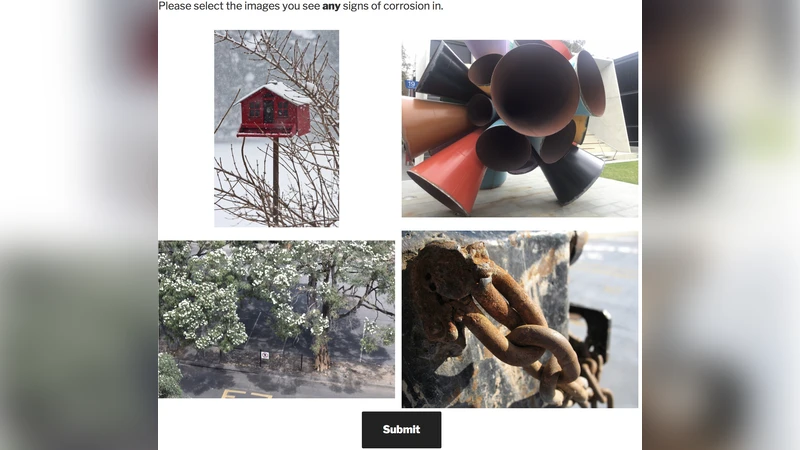
The automated detection of corrosion from images (i.e., photographs) or video (i.e., drone footage) presents significant advantages in terms of corrosion monitoring. Such advantages include access to remote locations, mitigation of risk to inspectors, cost savings and monitoring speed. The automated detection of corrosion requires deep learning to approach human level artificial intelligence (A.I.). The training of a deep learning model requires intensive image labelling, and in order to generate a large database of labelled images, crowd sourced labelling via a dedicated website was sought. The website (corrosiondetector.com) permits any user to label images, with such labelling then contributing to the training of a cloud based A.I. model - with such a cloud-based model then capable of assessing any fresh (or uploaded) image for the presence of corrosion. In other words, the website includes both the crowd sourced training process, but also the end use of the evolving model. Herein, the results and findings from the website (corrosiondetector.com) over the period of approximately one month, are reported.
💡 Research Summary
The paper presents an end‑to‑end system for automatically detecting corrosion in photographs and drone video footage, leveraging crowd‑sourced image labeling and cloud‑based deep learning. Recognizing that traditional corrosion inspections are costly, time‑consuming, and hazardous, the authors built a dedicated website (corrosiondetector.com) that allows anyone to upload images and annotate corrosion regions with a simple mouse‑draw interface. To ensure data quality, each image is labeled by at least three independent users; a consensus score is computed, and low‑confidence annotations are discarded or reviewed. Over roughly one month, the platform collected more than 1,200 still images and 200 video frames from diverse industrial settings (bridges, pipelines, ship hulls, etc.). Approximately 85 % of the data were used for training, 10 % for validation, and 5 % for testing.
For the detection model, the authors adopted a transfer‑learning approach using a ResNet‑50 backbone pre‑trained on ImageNet, adding two fully‑connected layers to form a binary classifier (corrosion vs. non‑corrosion). Because the dataset is imbalanced, focal loss and class weighting were employed. Data augmentation (random rotations up to ±15°, brightness/contrast adjustments, random crops) was applied during training to improve robustness to varying lighting and viewpoint conditions. Training proceeded for 50 epochs with a batch size of 32 and an initial learning rate of 1 × 10⁻⁴; the checkpoint with the lowest validation loss was selected for final evaluation.
On the held‑out test set, the model achieved an overall accuracy of 92 %, precision of 89 %, recall of 94 %, and an F1‑score of 91 %. Notably, the system performed well on complex backgrounds containing shadows, reflections, and other structures, and it processed individual drone frames in roughly 1.8 seconds, demonstrating suitability for near‑real‑time monitoring. Error analysis revealed that most false positives stemmed from labeling mistakes by non‑expert contributors and from extreme illumination changes; false negatives were more common for very thin or low‑contrast corrosion patches.
The authors discuss several implications. First, crowd‑sourcing dramatically reduces the cost of building large, annotated corrosion datasets, and the web platform can continuously expand the database as more users participate. Second, hosting the inference engine in the cloud enables inspectors to obtain instant results simply by uploading an image through a web browser, eliminating the need for specialized hardware on site. Limitations include the relatively small and homogeneous contributor pool and reduced sensitivity to subtle corrosion types. Future work will explore semi‑automatic labeling tools to further improve annotation quality, multi‑class classification to differentiate corrosion severity and material types, and an integrated UAV streaming pipeline that delivers live detection results.
In conclusion, the study demonstrates that a combination of crowd‑sourced labeling and cloud‑based deep learning can deliver a practical, scalable solution for automated corrosion detection, offering significant benefits in safety, cost, and speed for infrastructure maintenance.
Comments & Academic Discussion
Loading comments...
Leave a Comment