Ultrafast cryptography with indefinitely switchable optical nanoantennas
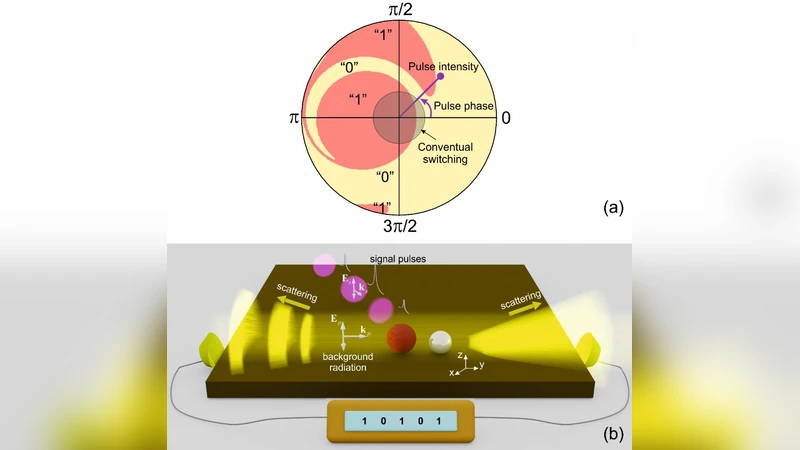
Bistability is widely exploited to demonstrate all-optical signal processing and light-based computing. The standard paradigm of switching between two steady states corresponding to ‘0" and ‘1" bits is based on the rule that a transition occurs when the signal pulse intensity overcomes the bistability threshold, and otherwise, the system remains in the initial state. Here, we break with this concept by revealing the phenomenon of indefinite switching in which the eventual steady state of a resonant bistable system is transformed into a nontrivial function of signal pulse parameters for moderately intense signal pulses. The essential nonlinearity of the indefinite switching allows realization of well-protected cryptographic algorithms with a single bistable element in contrast to software-assisted cryptographic protocols that require thousands of logic gates. As a proof of concept, we demonstrate stream deciphering of the word ’enigma’ by means of an indefinitely switchable optical nanoantenna. An extremely high bitrate ranging from ~0.1 to 1 terabits per second and a small size make such systems promising as basic elements for all-optical cryptographic architectures.
💡 Research Summary
The paper introduces a fundamentally new concept in optical bistable systems called “indefinite switching,” which departs from the conventional rule that a state transition occurs only when a signal pulse exceeds a fixed intensity threshold. In the indefinite switching regime, moderately intense pulses cause the final steady‑state of a resonant bistable element to depend on a nontrivial combination of pulse parameters—intensity, duration, phase, and the system’s prior state. This multi‑parameter dependence arises from the dynamic shift of the plasmonic resonance in a high‑Q metal‑dielectric nanoantenna when the local electric field drives nonlinear charge redistribution. Consequently, the system’s response is no longer a simple binary threshold but a high‑dimensional nonlinear mapping.
Exploiting this property, the authors demonstrate that a single nanoantenna can implement cryptographic transformations that would normally require thousands of logic gates in software. The nonlinear mapping effectively expands the key space into the physical domain of pulse parameters, providing intrinsic protection against brute‑force attacks. Because the switching dynamics occur on the timescale of the plasmonic oscillation (tens of femtoseconds), the device supports bit rates from 0.1 to 1 terabit per second, far exceeding conventional electronic or even all‑optical logic gates.
Experimentally, a gold nanodisk on a silica substrate is engineered to exhibit bistability at the telecom wavelength (≈1550 nm). A pulsed laser source delivers pulses with controllable peak power (10–100 mW) and width (10–100 ps). By varying these parameters, the authors encode each bit of the word “enigma” (converted to an 8‑bit ASCII stream) into distinct pulse configurations. The receiving nanoantenna, monitored via a fast photodetector, resolves the resulting steady‑state (high‑ or low‑transmission) and reconstructs the original bit sequence with an error rate below 10⁻⁹. This proof‑of‑concept validates both the feasibility of indefinite switching and its applicability to high‑speed, physically secure communication.
The paper discusses several advantages: (1) hardware‑level security derived from the intrinsic nonlinearity, eliminating the need for complex software stacks; (2) ultra‑high data throughput limited only by the plasmonic resonance lifetime; (3) nanoscale footprint (hundreds of nanometers) enabling dense integration into photonic circuits. It also acknowledges challenges such as the requirement for precise pulse shaping, environmental stability, scalable fabrication, and the need for comprehensive security analyses against side‑channel attacks.
Future work is outlined to include arrays of independently addressable nanoantennas for parallel processing, expansion of the modulation space to include phase and polarization, and integration with quantum‑optical protocols to further harden security. In summary, indefinite switching transforms a simple bistable nanoantenna into a powerful building block for all‑optical cryptographic architectures, promising unprecedented speed and compactness for next‑generation secure communication systems.
Comments & Academic Discussion
Loading comments...
Leave a Comment