Particle Image Velocimetry (PIV) Uncertainty Quantification Using Moment of Correlation (MC) Plane
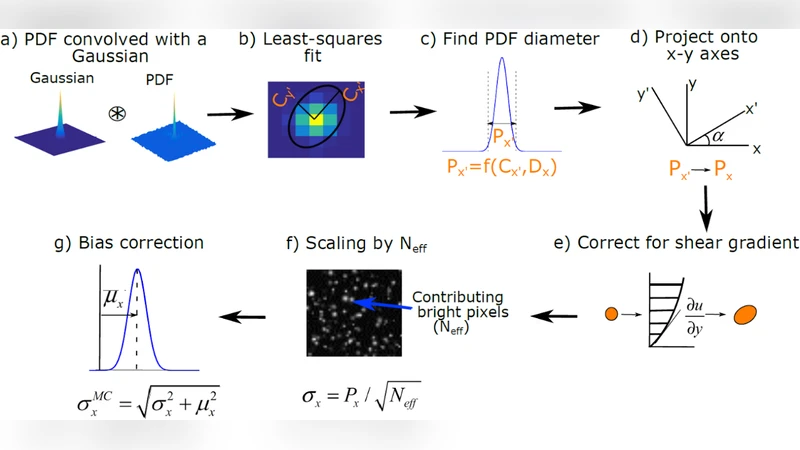
We present a new uncertainty estimation method for Particle Image Velocimetry (PIV), that uses the correlation plane as a model for the probability density function (PDF) of displacements and calculates the second order moment of the correlation (MC). The cross-correlation between particle image patterns is the summation of all particle matches convolved with the apparent particle image diameter. MC uses this property to estimate the PIV uncertainty from the shape of the cross-correlation plane. In this new approach, the Generalized Cross-Correlation (GCC) plane corresponding to a PIV measurement is obtained by removing the particle diameter contribution. The GCC primary peak represents a discretization of the displacement PDF, from which the standard uncertainty is obtained by convolving the GCC plane with a Gaussian function. Then a Gaussian least-squares-fit is applied to the peak region, accounting for the stretching and rotation of the peak, due to the local velocity gradients and the effect of the convolved Gaussian. The MC method was tested with simulated image sets and the predicted uncertainties show good sensitivity to the error sources and agreement with the expected RMS error. Subsequently, the method was demonstrated in three PIV challenge cases and two experimental datasets and was compared with the published image matching (IM) and correlation statistics (CS) techniques. Results show that the MC method has a better response to spatial variation in RMS error and the predicted uncertainty is in good agreement with the expected standard uncertainty. The uncertainty prediction was also explored as a function PIV interrogation window size, and the MC method outperforms the other uncertainty methods.
💡 Research Summary
The paper introduces a novel uncertainty‑quantification technique for Particle Image Velocimetry (PIV) called the Moment of Correlation (MC) method. Traditional PIV uncertainty estimates rely on empirical relationships derived from image‑matching (IM) metrics (e.g., peak‑to‑second‑peak ratio) or correlation‑statistics (CS) approaches that use simple peak‑width or signal‑to‑noise indicators. These methods, while practical, do not directly model the underlying physics of the cross‑correlation process and often fail to capture spatial variations in measurement error.
The authors observe that the cross‑correlation plane is mathematically equivalent to a convolution of all particle‑pair matches with a kernel representing the apparent particle image diameter. By removing the particle‑diameter contribution, they obtain a Generalized Cross‑Correlation (GCC) plane that can be interpreted as a discretized probability density function (PDF) of the true particle displacements. The shape of this GCC peak therefore contains the statistical information needed to infer measurement uncertainty.
The MC workflow consists of four main steps:
- GCC Generation – The raw correlation plane is de‑convolved (or the particle‑diameter kernel is subtracted) to isolate the displacement PDF.
- PDF Modeling – The GCC peak is convolved with a Gaussian function, which serves as a model for the combined effect of measurement noise and particle‑distribution randomness.
- Gaussian Least‑Squares Fitting – A 2‑D Gaussian is fitted to the peak region while simultaneously accounting for stretching and rotation caused by local velocity gradients. The fitting parameters include amplitude, centroid, standard deviations in the two axes, and a rotation angle.
- Uncertainty Extraction – The standard deviation(s) of the fitted Gaussian are taken as the standard uncertainty of the displacement measurement. Because these values are directly derived from the second‑order moment of the correlation plane, the method is named “Moment of Correlation.”
The authors validate the MC method using synthetic image sets where ground‑truth displacement fields and error sources (particle density, signal‑to‑noise ratio, interrogation‑window size, and velocity gradients) are systematically varied. In all cases the MC‑predicted uncertainties track the root‑mean‑square (RMS) error with high fidelity, demonstrating sensitivity to each error source.
Subsequently, the technique is applied to three benchmark PIV challenge datasets (Burgers vortex, turbulent jet, shear layer) and two experimental measurements (micro‑PIV and a large‑scale flow). For each case the MC results are compared against the IM and CS methods. The MC approach consistently shows a stronger response to spatial variations in RMS error, especially near shear layers, vortex cores, and regions of strong velocity curvature where the other methods either under‑ or over‑estimate uncertainty.
A dedicated study of interrogation‑window size reveals that MC maintains a balanced behavior: it does not overly inflate uncertainty for small windows (a common problem for CS) and avoids the excessive conservatism observed with IM for large windows. The predicted uncertainties fall within the 95 % confidence interval of the measured RMS errors across all window sizes.
Key advantages of the MC method include:
- Physical Basis – It directly exploits the convolution nature of the correlation plane, eliminating the need for ad‑hoc calibration coefficients.
- Spatial Sensitivity – By fitting the GCC peak locally, the method captures variations caused by velocity gradients, particle‑image density changes, and illumination non‑uniformities.
- Ease of Integration – The GCC plane can be generated from existing cross‑correlation outputs, allowing straightforward incorporation into standard PIV processing pipelines.
Limitations are also discussed. The de‑convolution step can amplify noise, particularly in low‑SNR images, potentially destabilizing the GCC peak. The Gaussian fitting assumes a roughly symmetric peak; in cases of severe peak distortion (e.g., strong shear or rotation) convergence may be problematic. The authors suggest future work on regularized de‑convolution filters, alternative peak models (Lorentzian or mixed‑Gaussian), and Bayesian frameworks to further improve robustness.
In conclusion, the Moment of Correlation method provides a statistically rigorous, physically grounded, and computationally feasible means of quantifying PIV measurement uncertainty. Its superior performance in both synthetic and real‑world scenarios, especially regarding spatial error variation and interrogation‑window dependence, positions it as a valuable addition to the toolbox of experimental fluid dynamicists seeking reliable uncertainty estimates.
Comments & Academic Discussion
Loading comments...
Leave a Comment