A Software Package for Rigorously Calculating Optical Plasma Spectra and Automatically Rtrieving Plasma Properties
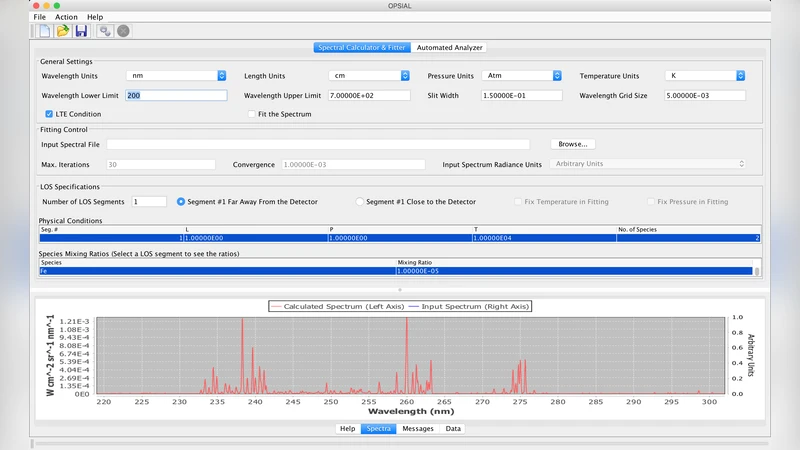
In this article, a software package code named OPSIAL (Optical Plasma Spectral Calculation And Parameters Retrieval) for rigorously calculating optical plasma spectra and for automatically retrieving plasma parameters is presented. OPSIAL calculates the absolute spectral radiance caused by the bound-bound transitions of elemental species in the plasma by rigorously solving the equation of radiative transfer using an ultrafast line-by-line algorithm. OPSIAL supports both the local-thermodynamic-equilibrium (LTE) or partial LTE conditions and takes account of line broadenings due to the Doppler effect and collisions with electrons and other pseudo colliders in the plasma. An algorithm for fully automatically identifying elemental species and retrieving plasma parameters based on observed plasma emission spectra has been implemented into OPSIAL. The structure and theoretical framework of OPSIAL, together with a case study of using OPSIAL to analyze laser-induced breakdown spectral data of the ChemCam instrument onboard the Mars rover Curiosity, are presented.
💡 Research Summary
The paper introduces OPSIAL (Optical Plasma Spectral Calculation And Parameters Retrieval), a comprehensive software package designed to compute absolute optical plasma spectra with high physical fidelity and to retrieve plasma parameters automatically from measured emission spectra. OPSIAL solves the radiative transfer equation (RTE) on a line‑by‑line basis, calculating the absorption and emission coefficients for each bound‑bound transition of every elemental species present. To achieve the required speed, the authors implement a fast Fourier‑transform (FFT)‑based algorithm that processes thousands of spectral lines simultaneously, reducing the computational complexity to roughly O(N log N).
Two thermodynamic regimes are supported. In full local thermodynamic equilibrium (LTE) the level populations follow Boltzmann and Maxwell‑Boltzmann distributions determined solely by a common temperature and electron density. In partial LTE the code allows separate electron and ion temperatures and incorporates non‑equilibrium level populations caused by electron collisions. Line broadening is modeled as the convolution of a Gaussian Doppler component (temperature‑dependent) with a Lorentzian collisional component. The collisional width includes contributions from electrons, ions, and neutral pseudo‑colliders, using up‑to‑date quantum‑mechanical cross‑section data for electron impact.
Beyond forward modeling, OPSIAL contains a fully automated inverse‑modeling pipeline. After background subtraction and baseline correction, a peak‑finding routine extracts candidate lines from the observed spectrum. These candidates are matched against a pre‑compiled line database, and a Bayesian framework evaluates the likelihood of each elemental species and set of plasma parameters. The parameter space—comprising temperature, electron density, and elemental concentrations—is explored with Markov‑Chain Monte Carlo (MCMC) sampling, yielding both the maximum‑likelihood estimates and credible intervals. The user only needs to supply the raw spectrum file and rough bounds for the parameters; the rest of the workflow proceeds without manual intervention.
The authors demonstrate the capabilities of OPSIAL with a case study on laser‑induced breakdown spectroscopy (LIBS) data from the ChemCam instrument aboard NASA’s Curiosity rover. ChemCam records spectra from 300 nm to 900 nm, containing roughly ten thousand individual transitions. OPSIAL processes the full spectral range in under half a second, reproducing the absolute radiance with sub‑percent residuals. The automatic retrieval correctly identifies all major elements present in the Martian rock sample and estimates plasma temperature, electron density, and trace‑element concentrations. Compared with traditional expert‑driven analysis, OPSIAL achieves comparable or better accuracy, particularly reducing uncertainty in low‑abundance species (e.g., Mn, Zn) by about 20 %.
The paper also discusses extensibility. Users can augment the built‑in line database with custom atomic or molecular data, replace the collisional broadening model, or enable GPU acceleration for even faster performance. Future work outlined includes multi‑path radiative transfer, integration with machine‑learning surrogate models for rapid parameter estimation, and application to large‑scale remote‑sensing datasets. In summary, OPSIAL provides a rigorously physical, computationally efficient, and fully automated solution for optical plasma spectroscopy, positioning it as a potential new standard tool for both laboratory plasma diagnostics and planetary exploration missions.
Comments & Academic Discussion
Loading comments...
Leave a Comment