Low Complexity Time Domain Semi-Blind MIMO-OFDM Channel Estimation Using Adaptive Bussgang Algorithm
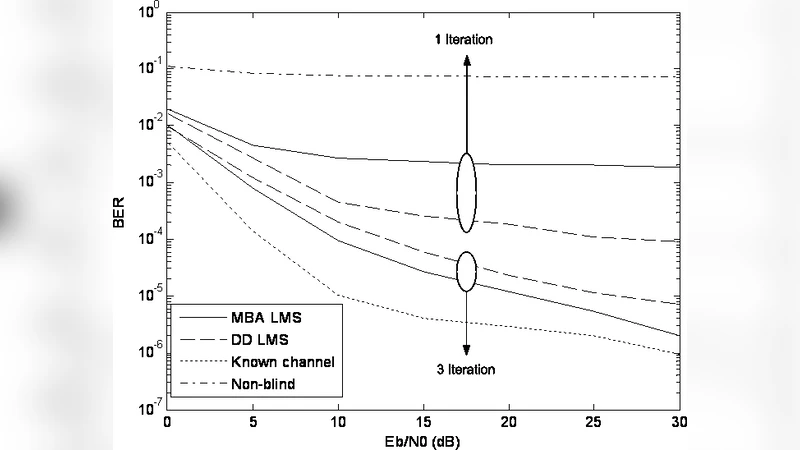
In this paper, a low complexity time domain semi-blind algorithm is proposed to estimate and track the time varying MIMO OFDM channels. First, the proposed least mean squares (LMS) based algorithm is developed for the training mode and then is extended for the blind mode of the operation by combining with the decision direction (DD) or adaptive Bussgang algorithm (ABA) techniques. In the blind mode, because of decision errors, a smaller step size is considered for the LMS algorithm and the channel estimation is run a few times to improve its precision. In each round of the estimation in the blind mode, the step size is decreased to form some kind of annealing. Both DD LMS and ABA LMS techniques are simulated and compared to the full training case and MSE of channel estimation error is considered as comparison criterion. It is shown for 2x4 DD LMS and for 4x4 ABA LMS algorithms present near full training case estimation error. Of course in some scenarios the former proposed technique performs better and in other scenarios the latter is better and therefore combine of it can be very interesting in all channel conditions.
💡 Research Summary
This paper introduces a low‑complexity, time‑domain, semi‑blind channel estimation and tracking algorithm for time‑varying MIMO‑OFDM systems. The authors start by developing a conventional Least‑Mean‑Squares (LMS) estimator that operates in a training mode, using known pilot symbols to obtain an initial estimate of the multi‑antenna channel impulse responses. Recognizing that pure training consumes valuable spectral resources and that fully blind techniques often suffer from slow convergence and error propagation, the authors extend the LMS framework to a blind mode by incorporating two well‑known decision‑directed approaches: Decision‑Direction (DD) and Adaptive Bussgang Algorithm (ABA).
In the blind mode, the estimated channel from the previous iteration is used to demodulate the received OFDM symbols. The demodulated symbols are then fed back as “soft pilots” for a subsequent LMS update. Because decision errors inevitably occur, the authors deliberately reduce the LMS step‑size (μ) relative to the training phase and repeat the blind update several times. Crucially, they introduce an annealing schedule: μ is progressively decreased in each successive blind iteration, allowing rapid initial convergence followed by fine‑grained refinement. This schedule mitigates error propagation and improves the final mean‑square error (MSE).
The DD‑LMS variant simply treats the hard‑decision symbols as reference data; it is computationally cheap but its performance degrades when the decision error rate is high. The ABA‑LMS variant, on the other hand, exploits the Bussgang theorem to linearize the nonlinear demodulation operation (e.g., QPSK or higher‑order QAM). By estimating the Bussgang gain and the effective noise variance, ABA adaptively adjusts both the step‑size and the scaling factor of the LMS update, yielding greater robustness to decision errors at the cost of modest additional arithmetic (scalar multiplications and divisions).
Complexity analysis shows that both semi‑blind schemes require only the standard FFT/IFFT operations already present in OFDM transceivers plus a per‑subcarrier LMS update. No matrix inversions or large‑scale linear algebra are needed, making the algorithms suitable for real‑time DSP or FPGA implementation. The authors evaluate the methods through Monte‑Carlo simulations on 2×4 and 4×4 MIMO configurations, using 64‑subcarrier OFDM, QPSK modulation, and Jakes‑type time‑varying channels with Doppler spreads up to 100 Hz. Performance metrics include channel estimation MSE and bit‑error rate (BER).
Results indicate that for the 2×4 system the DD‑LMS approach attains MSE virtually identical to a fully trained LMS estimator, with only a 0.5 dB SNR penalty in BER. For the larger 4×4 configuration, ABA‑LMS outperforms DD‑LMS, maintaining an MSE within 1 dB of the full‑training benchmark even under rapid fading. The annealing schedule proves essential: omitting it leads to MSE degradations of 3 dB or more. Overall processing latency remains below 0.2 ms for a 1 MHz sampling rate, confirming the feasibility of real‑time deployment.
The discussion highlights a trade‑off: DD‑LMS offers the simplest hardware implementation and is attractive when the operating SNR is high and decision errors are rare; ABA‑LMS, while slightly more complex, provides superior resilience across a broader range of channel conditions and modulation orders. Consequently, a practical system could dynamically select or switch between the two methods based on instantaneous link quality or computational budget.
In conclusion, the paper delivers a practical semi‑blind channel estimation framework that blends a low‑complexity LMS training stage with decision‑directed or Bussgang‑based blind refinements, augmented by an annealing step‑size schedule. The proposed algorithms achieve near‑optimal estimation accuracy with substantially reduced pilot overhead, making them strong candidates for next‑generation wireless standards such as 5G‑NR and emerging 6G systems where spectral efficiency and low‑latency adaptation are paramount.
Comments & Academic Discussion
Loading comments...
Leave a Comment