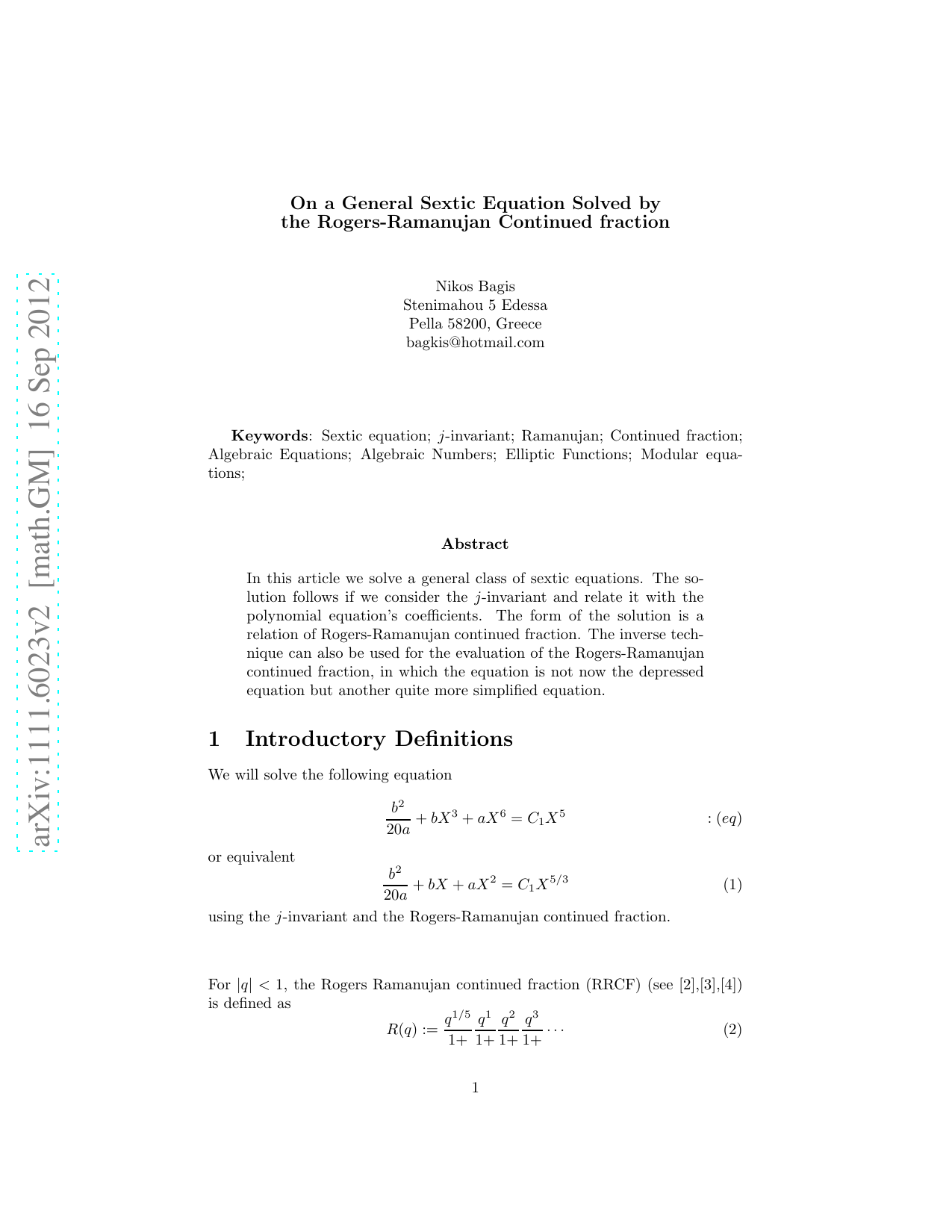
In this article we solve a general class of sextic equations. The solution follows if we consider the $j$-invariant and relate it with the polynomial equation's coefficients. The form of the solution is a relation of Rogers-Ramanujan continued fraction. The inverse technique can also be used for the evaluation of the Rogers-Ramanujan continued fraction, in which the equation is not now the depressed equation but another quite more simplified equation.
Deep Dive into On a General Sextic Equation Solved by the Rogers Ramanujan Continued Fraction.
In this article we solve a general class of sextic equations. The solution follows if we consider the $j$-invariant and relate it with the polynomial equation’s coefficients. The form of the solution is a relation of Rogers-Ramanujan continued fraction. The inverse technique can also be used for the evaluation of the Rogers-Ramanujan continued fraction, in which the equation is not now the depressed equation but another quite more simplified equation.
We will solve the following equation
using the j-invariant and the Rogers-Ramanujan continued fraction.
For |q| < 1, the Rogers Ramanujan continued fraction (RRCF) (see [2], [3], [4]) is defined as R(q) := q 1/5 1+
From the Theory of Elliptic functions the j-invariant (see [5], [8]) is
where
is the Dedekind’s eta function and
, τ = √ -r , r positive real.
We have also in the q-notation f (-q) := ∞ n=1
(1 -q n ).
(
In what follows we use the following known result (see Wolfram pages for ‘Rogers-Ramanujan Continued Fraction ’ and [17]): If R = R(e -2π √ r ), then:
From ( [3], [4]) we have 1 R 5 (q) -11 -R 5 (q) = f 6 (-q) qf 6 (-q 5 ) (
The general hypergeometric function is defined as The standard definition of the elliptic integral of the first kind (see [7], [8], [15]) is:
In the notation of Mathematica we have
The elliptic singular modulus k = k r is defined to be the solution of the equation:
In Mathematica’s notation
The complementary modulus is given by k ′ r = 1 -k 2 r . (For evaluations of k r see [5], [15], [16]). Also we call w r := √ k r k 25r noting that if one knows w = w r then (see [2]), knows k r and k 25r .
2 Theorems Proposition 1. (see [2]) If q = e -π √ r and r real positive then we define
then
Theorem 1.
Let a, b, C 1 be constants. One can solve the equation
finding r > 0 such that
Then (15) have solution
Proof.
For to solve the equation ( 15) find r such that
Consider also the transformation of the constants
and
, with inverse
.
where
Relation ( 19) is equivalent to equation ( 6), in view of (7). Hence from Proposition 1
and the proof is complete.
The j-invariant is connected with the singular modulus from the equation
We can solve (21) and express k r in radicals to an algebraic function of j r . The 5th degree modular equation which connects k 25r and k r is (see [3]):
We will evaluate the root of (1) first with parametrization and second with Rogers-Ramanujan continued fraction and the Elliptic-K function.
For this it have been showed (see [19]) that if
setting the following parametrization of w:
we get
(25) where M = 18 + L 64 + 3L From the above relations we get also
Hence we can consider the above equations as follows: Taking an arbitrary number L we construct an w. Now for this w we evaluate the two numbers k 25r and k r . Thus when we know the w, the k r and k 25r are given from (24),(25),(26).
The result is: We can set a number L and from this calculate the two inverse elliptic nome’s. But we don’t know the r. One can see (from the definition of k r ) that the r can evaluated from equation
Hence we define
However is very difficult to evaluate the r in a closed form, such as roots of polynomials or else when a number x is given. Some numerical evaluations indicate us that even if x are algebraic numbers, (not trivial as with k (-1) 2 -1/2 = 1 or the cases x = k r , r = 1, 2, 3, . . .) the r are not rational and may even not algebraics.
We know that (see [2]):
where x L = k r is the singular modulus which corresponds to some L.
The procedure is to select a number L and from (24),(25) evaluate w L , x L and
The solution X = X(L) of ( 1) is (29) and for this L holds
(33)
Hence we get the next:
One can find parametric solutions of (1) if for a given L construct the w L , x L and the complementary w ′ L (these values are given from ( 23),( 24),( 25),(31)). Also
The solution X = X L is given from
Note.
i) The above solution (37) works for parametric solutions (setting a L), as also for solutions which we know r, k r and k 25r . (For a related method on solving the quintic see Wolfram pages ‘Quintic Equation’) ii) In [16] it have been shown that when one knows for some r 0 the k r0 and k r0/25 then can evaluate any k 25 n r0 in radicals closed form for all n positive integers. But in general the values k r and k 25r can given from tables or with a simple PC (see [4],[5],[13], [15], [17]).
From the analysis in [2], the solution X of (1) can reduced with inverse functions as follows: Consider the function
The equation U (x) = t have known solution with respect to x, which we will call x = U (-1) (t). Hence
or
The function k (-1) (x) is that of (28).
The equation ( 1) have solution
where
Notes.
Observe here that we don’t need the value of w and the class invariant j.
From [10] we have
Hence the solution can expressed also in theta functions. That is if α = k r , r = 1, 2, 3, . . . then the solution of (1) reduced to that of evaluation of Rogers-Ramanujan continued fraction R(q) with q = e -π √ r . In view of [10] we have
The equation
hence a solution is
where
For this r the X is a solution.
Continuing one can set to
any value X = X 0 and C 1 = 1 then evaluate
equation ( 42) holds always and we get that
The result is the following parametrized evaluation of the Rogers-Ramanujan continued fraction Theorem 4.
and
Corollary.
where A, B, C, D rationals Theorem 5. If for a certain r > 0 we know the value of R(e -π √
…(Full text truncated)…
This content is AI-processed based on ArXiv data.