Diffusion Adaptation Strategies for Distributed Optimization and Learning over Networks
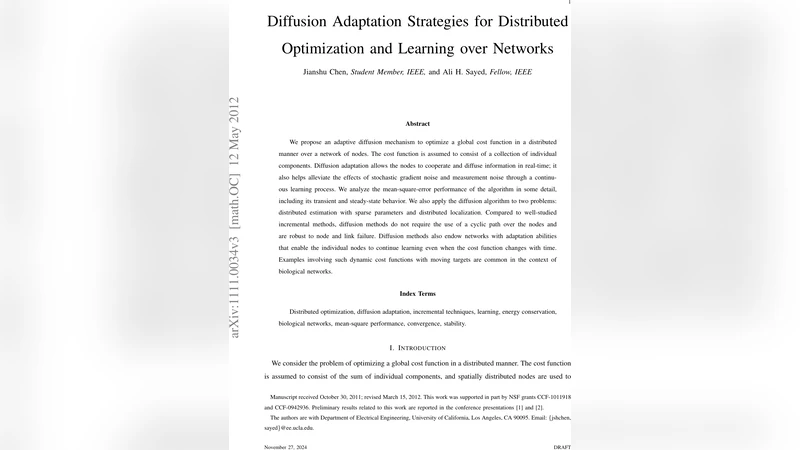
We propose an adaptive diffusion mechanism to optimize a global cost function in a distributed manner over a network of nodes. The cost function is assumed to consist of a collection of individual components. Diffusion adaptation allows the nodes to cooperate and diffuse information in real-time; it also helps alleviate the effects of stochastic gradient noise and measurement noise through a continuous learning process. We analyze the mean-square-error performance of the algorithm in some detail, including its transient and steady-state behavior. We also apply the diffusion algorithm to two problems: distributed estimation with sparse parameters and distributed localization. Compared to well-studied incremental methods, diffusion methods do not require the use of a cyclic path over the nodes and are robust to node and link failure. Diffusion methods also endow networks with adaptation abilities that enable the individual nodes to continue learning even when the cost function changes with time. Examples involving such dynamic cost functions with moving targets are common in the context of biological networks.
💡 Research Summary
The paper introduces a diffusion‑based adaptive strategy for solving distributed optimization and learning problems over a network of interconnected agents. Unlike traditional incremental methods that require a predetermined cyclic path through the nodes, the diffusion approach allows each node to process its own data locally and simultaneously exchange information with its neighbors. Two canonical diffusion schemes are examined: Adapt‑Then‑Combine (ATC) and Combine‑Then‑Adapt (CTA). In ATC, each node first performs a stochastic gradient descent step using its own instantaneous gradient, then forms a weighted average of the intermediate estimates received from its neighboring nodes. CTA reverses the order, first aggregating the neighbors’ current estimates and then applying the gradient update. The weight matrix governing the combination step is required to be left‑stochastic (non‑negative entries, rows summing to one), which ensures that the network behaves like a convex combination of local estimates.
The authors develop a rigorous mean‑square analysis of the diffusion algorithms. Under the standard assumptions of independent, zero‑mean gradient noise and measurement noise, and assuming the step‑size μ satisfies 0 < μ < 2/λmax(R) (where λmax(R) is the largest eigenvalue of the input covariance matrix), the network error vector converges in the mean to the optimal solution. By employing an energy‑conservation relation, they derive explicit recursions for the error covariance matrix, enabling closed‑form expressions for the transient mean‑square deviation (MSD) and the steady‑state mean‑square error (MSE). The analysis reveals that the convergence rate is dictated not only by the step‑size but also by the spectral properties of the combination matrix and the network topology (e.g., degree of connectivity). In steady state, the MSD is proportional to the step‑size and the aggregate noise power, confirming the well‑known trade‑off between adaptation speed and accuracy.
A key contribution of the work is the demonstration of robustness. Because each node’s update relies only on locally available information and weighted averages of its immediate neighbors, the algorithm gracefully tolerates node or link failures. The network continues to operate as long as the remaining graph stays connected, a property absent in cyclic incremental schemes where a single broken link can halt the entire process. Moreover, the diffusion framework naturally supports time‑varying cost functions. By maintaining a constant (or slowly varying) step‑size, the network can track drifting optimal parameters, making it suitable for dynamic environments such as moving target tracking in biological or sensor networks.
Two application domains are explored to validate the theory. The first is distributed sparse parameter estimation, where each node solves a local LASSO problem (ℓ1‑regularized least squares) and the diffusion mechanism enforces consensus on the sparse vector. Simulations show that Diffusion‑LASSO achieves faster convergence and lower steady‑state error than a comparable distributed LMS approach, especially in the presence of measurement noise. The second application is distributed localization: nodes measure noisy inter‑node distances (e.g., via RSSI or time‑of‑arrival) and iteratively refine their position estimates through diffusion. The results illustrate that even with a subset of malfunctioning nodes, the overall position error remains bounded and the algorithm converges to accurate locations.
In summary, the paper establishes diffusion adaptation as a powerful alternative to incremental methods for distributed optimization. Its main advantages are: (1) no need for a predefined traversal order, allowing flexible network topologies; (2) inherent resilience to node and link failures; (3) ability to continuously adapt to slowly changing objectives; and (4) analytical tractability that yields explicit performance predictions. The authors conclude with several promising research directions, including extensions to non‑convex cost functions, asynchronous update schedules, and privacy‑preserving diffusion schemes that incorporate cryptographic techniques. These avenues suggest that diffusion‑based learning will play a pivotal role in future large‑scale, adaptive, and resilient networked systems.
Comments & Academic Discussion
Loading comments...
Leave a Comment