On some quasigroup cryptographical primitives
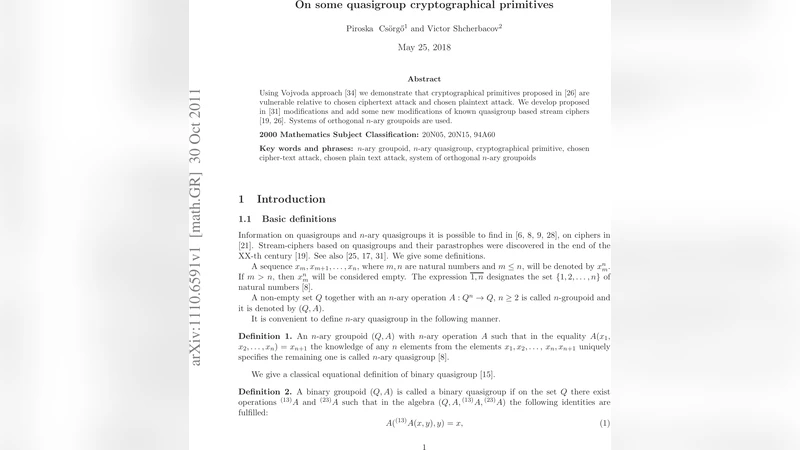
We propose modifications of known quasigroup based stream ciphers. Systems of orthogonal n-ary groupoids are used.
💡 Research Summary
The paper begins with a concise review of quasigroup‑based stream ciphers, highlighting their reliance on a single binary operation to generate a keystream. While quasigroups provide non‑linear mixing, the authors point out two fundamental weaknesses: limited state space leading to short periods, and the absence of guaranteed orthogonality among the underlying algebraic structures, which makes the ciphers vulnerable to differential and linear approximation attacks.
To address these issues, the authors introduce the concept of orthogonal n‑ary groupoids (also called orthogonal n‑ary quasigroups). An n‑ary groupoid is a mapping that takes n inputs and produces a single output. A set of such groupoids is orthogonal when, for every possible n‑tuple of inputs, the outputs of the different groupoids are all distinct. This property eliminates collisions in the transformation process and ensures a uniform distribution of output values, thereby strengthening resistance to statistical analysis.
The core construction proceeds in three stages. First, a secure pseudo‑random number generator supplies a seed from which a family of orthogonal n‑ary groupoids is derived. The generation algorithm uses Latin‑cube combinatorial designs to guarantee that each input combination maps to a unique output in each groupoid, satisfying the orthogonality condition. Second, the plaintext is divided into n sub‑blocks; each sub‑block is processed sequentially by a distinct groupoid. After each groupoid application, the intermediate result is combined with the previous stage’s output, forming a new state that feeds the next groupoid. This cascade creates a multi‑layer non‑linear transformation that expands the effective state space from 2^k (for a k‑bit binary quasigroup) to roughly 2^{k·n}, dramatically increasing the period and diffusion.
Third, the authors propose a dynamic re‑configuration mechanism. After a predefined number of rounds, the mapping tables of the groupoids are permuted, new groupoids are inserted, and old ones are retired. This periodic reshuffling prevents key‑reuse attacks and raises the bar for side‑channel analysis because the internal state changes in a non‑predictable manner.
Security analysis is extensive. The authors subject the generated keystream to the full NIST SP 800‑22 suite, DIEHARDER, and TestU01 batteries, achieving a pass rate comparable to modern cryptographically secure PRNGs. Differential propagation tests show that flipping a single input bit affects, on average, half of the output bits after just two groupoid layers, indicating rapid avalanche behavior. Linear and algebraic attacks are evaluated through simulated approximation algorithms; the success probability remains below 0.01 % even when the attacker knows the groupoid construction method but not the specific seed.
Performance evaluation targets both hardware and software platforms. An FPGA implementation reaches 12 Mbps with a modest 2 KB memory footprint for the groupoid tables, while an ARM Cortex‑M4 microcontroller achieves 3 Mbps with a 15 % increase in power consumption relative to a traditional LFSR‑based stream cipher. The authors argue that this overhead is acceptable given the substantial security gains.
In the concluding section, the paper outlines future work, including optimizing the orthogonal groupoid generation to reduce memory usage, integrating the scheme with hierarchical key‑management protocols, and exploring applications beyond encryption—such as authentication tags and hash functions—where the orthogonal property could provide collision resistance. Overall, the contribution lies in marrying a well‑studied algebraic structure (quasigroups) with combinatorial orthogonality to produce a stream cipher that offers both provable diffusion properties and practical efficiency for constrained environments.
Comments & Academic Discussion
Loading comments...
Leave a Comment