On the Mathematical Structure of Balanced Chemical Reaction Networks Governed by Mass Action Kinetics
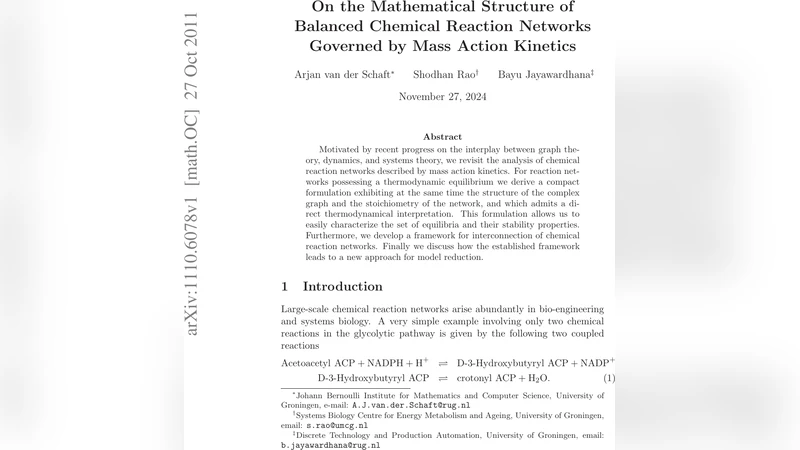
Motivated by recent progress on the interplay between graph theory, dynamics, and systems theory, we revisit the analysis of chemical reaction networks described by mass action kinetics. For reaction networks possessing a thermodynamic equilibrium we derive a compact formulation exhibiting at the same time the structure of the complex graph and the stoichiometry of the network, and which admits a direct thermodynamical interpretation. This formulation allows us to easily characterize the set of equilibria and their stability properties. Furthermore, we develop a framework for interconnection of chemical reaction networks. Finally we discuss how the established framework leads to a new approach for model reduction.
💡 Research Summary
The paper revisits the analysis of chemical reaction networks (CRNs) governed by mass‑action kinetics, focusing on those that admit a thermodynamic equilibrium—so‑called balanced networks. By representing a CRN as a directed “complex graph” whose vertices are the complexes (linear combinations of species) and whose edges are the reactions, the authors introduce two fundamental matrices: the complex matrix Z (mapping species to complexes) and the incidence matrix I (encoding the directed edges). The traditional stoichiometric matrix S = Z I then appears as a product of these two structures.
For balanced networks the authors show that the reaction rates can be written compactly as
v = diag(k) exp(Zᵀ ln x),
where k is the vector of rate constants and x the concentration vector. By defining a weighted Laplacian L = I diag(k) Iᵀ of the complex graph, the dynamics acquire a remarkably simple form:
dx/dt = – Z L ln(x/x*).
Here x* denotes any positive equilibrium concentration satisfying Zᵀ ln x* = const. The Laplacian L is symmetric, positive semidefinite, and its nullspace corresponds to the connected components of the complex graph.
The authors exploit this formulation to obtain a thermodynamically consistent Lyapunov function, namely the Gibbs free‑energy‑like potential G(x) = Σ_i x_i (ln x_i – 1). Its time derivative along trajectories is
dG/dt = – (ln x – ln x*)ᵀ L (ln x – ln x*) ≤ 0,
with equality only at equilibrium. Consequently every trajectory converges globally to the set of equilibria, establishing asymptotic stability without recourse to linearization or detailed balance arguments.
Beyond single networks, the paper develops a systematic interconnection theory. Two balanced CRNs, characterized by (Z₁, L₁) and (Z₂, L₂), can be coupled through “port‑connections” that introduce additional incidence edges linking complexes of the two subnetworks. The resulting overall incidence matrix and Laplacian L_total retain the positive‑semidefinite property, and the combined Lyapunov function G_total = G₁ + G₂ guarantees that the interconnected system remains globally stable.
A major contribution is a model‑reduction scheme based on graph‑theoretic aggregation. By collapsing each strongly connected component of the complex graph into a single “super‑complex,” the authors construct a reduced Laplacian \tilde L that preserves the original nullspace structure. The reduced dynamics retain the same Lyapunov function form, ensuring that the reduced model reproduces the equilibrium set and stability properties of the full network while dramatically lowering dimensionality.
The theoretical developments are illustrated with several examples, including simple isomerization reactions and a small metabolic pathway. In each case the Laplacian representation clarifies the equilibrium conditions, simplifies stability proofs, and demonstrates the ease of interconnecting or reducing networks.
In conclusion, the paper provides a unified mathematical framework that fuses graph theory, thermodynamics, and systems theory for balanced chemical reaction networks. By casting mass‑action kinetics into a Laplacian‑based form, it yields transparent expressions for equilibria, global stability, network interconnection, and systematic reduction, offering powerful tools for the analysis and design of complex biochemical and engineering reaction systems.
Comments & Academic Discussion
Loading comments...
Leave a Comment