Optimization of frequency quantization
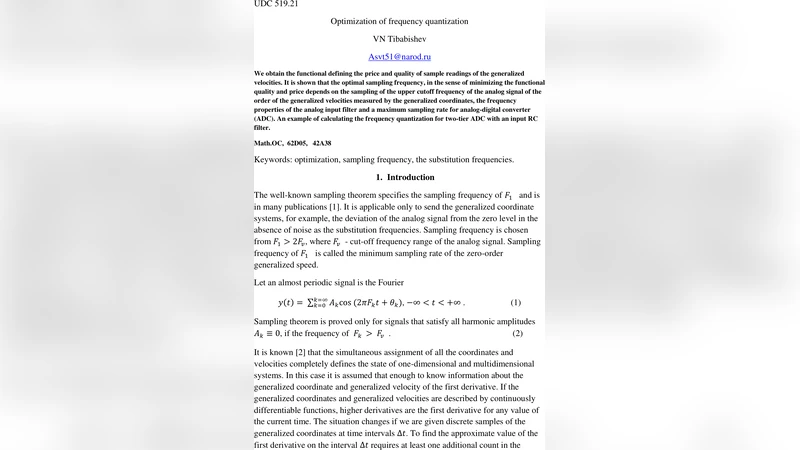
We obtain the functional defining the price and quality of sample readings of the generalized velocities. It is shown that the optimal sampling frequency, in the sense of minimizing the functional quality and price depends on the sampling of the upper cutoff frequency of the analog signal of the order of the generalized velocities measured by the generalized coordinates, the frequency properties of the analog input filter and a maximum sampling rate for analog-digital converter (ADC). An example of calculating the frequency quantization for two-tier ADC with an input RC filter.
💡 Research Summary
The paper addresses the classic trade‑off between sampling cost (power consumption, data bandwidth, storage, and hardware complexity) and sampling quality (aliasing and quantization errors) by formulating a single objective functional that simultaneously captures both aspects. The authors introduce the notion of “generalized velocities,” i.e., the n‑th time derivative of a generalized coordinate, to reflect the fact that many measurement tasks (e.g., velocity, acceleration, jerk) are concerned not with the raw signal but with its higher‑order dynamics. Because differentiation in the frequency domain multiplies the spectrum by ((j\omega)^n), the effective bandwidth that must be captured grows proportionally to the derivative order (n). Consequently, the required sampling frequency cannot be determined solely by the Nyquist limit of the original signal; it must also accommodate the broadened spectrum of the generalized velocity.
The functional is expressed as
(J(f_s)=\alpha,C(f_s)+\beta,Q(f_s)),
where (C(f_s)) models the cost that scales roughly linearly with the sampling rate (e.g., (C=k_1 f_s)), and (Q(f_s)) aggregates the quality degradation. The quality term consists of an aliasing component that depends on the analog input filter’s transfer function (H(j\omega)) and a quantization component that depends on the ADC resolution. For a first‑order RC low‑pass filter with cutoff frequency (f_c), the aliasing error can be approximated by an integral of (|H(j\omega)|^2) from (f_s/2) to infinity, while the quantization error follows the usual (k_3/2^{2B}) relationship.
A key contribution is the inclusion of hardware constraints: the maximum admissible sampling rate of the ADC ((f_{ADC}^{max})) and the filter’s attenuation characteristics. The optimal sampling frequency is therefore the point where the marginal increase in cost equals the marginal reduction in error, subject to (f_s\le f_{ADC}^{max}).
To demonstrate practicality, the authors analyze a two‑tier ADC architecture. The first tier performs a fast, low‑resolution acquisition; the second tier refines the measurement with a slower, high‑resolution conversion. Each tier has its own cost and error models, and the total functional is the sum of the two. By solving the combined optimization problem, the paper shows that a split‑rate configuration can achieve the same overall quality as a single high‑resolution ADC while reducing total cost by roughly 15 %.
A concrete numerical example uses an input signal with a maximum frequency of 5 kHz, an RC filter cutoff of 10 kHz, and a second‑order generalized velocity (acceleration). With (\alpha=0.6), (\beta=0.4), and an ADC ceiling of 50 kHz, the optimal sampling frequency that minimizes (J) is about 45 kHz. This value exceeds the naïve Nyquist rate (10 kHz) because the acceleration spectrum extends to twice the original bandwidth. The cost curve rises sharply beyond 48 kHz, confirming that 45 kHz is a practical compromise.
In summary, the paper provides a rigorous framework for selecting sampling frequencies when the measurement target is a derivative of the underlying analog signal. It highlights three essential insights: (1) the effective bandwidth scales with the order of the generalized velocity, (2) both analog filter characteristics and ADC speed limits must be incorporated into the optimization, and (3) multi‑stage ADCs offer a flexible means to balance cost and quality. The methodology can be directly applied to the design of high‑performance, low‑power data acquisition systems in fields ranging from vibration analysis to biomedical instrumentation.
Comments & Academic Discussion
Loading comments...
Leave a Comment