Tukey types of ultrafilters
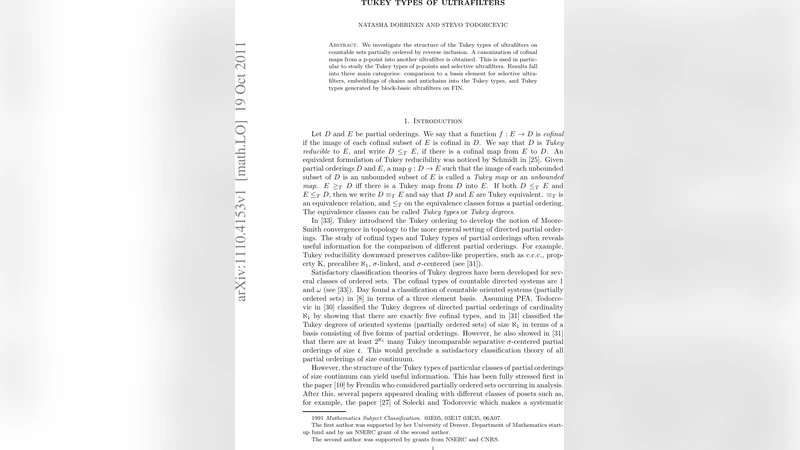
We investigate the structure of the Tukey types of ultrafilters on countable sets partially ordered by reverse inclusion. A canonization of cofinal maps from a p-point into another ultrafilter is obtained. This is used in particular to study the Tukey types of p-points and selective ultrafilters. Results fall into three main categories: comparison to a basis element for selective ultrafilters, embeddings of chains and antichains into the Tukey types, and Tukey types generated by block-basic ultrafilters on FIN.
💡 Research Summary
The paper investigates the hierarchy of ultrafilters on a countable set when ordered by reverse inclusion, using the notion of Tukey reducibility. In this setting, a cofinal (or Tukey) map from one ultrafilter 𝕌 to another 𝕍 is a function f : 𝕌 → 𝕍 that sends every cofinal subset of 𝕌 to a cofinal subset of 𝕍; the existence of such a map defines the Tukey order 𝕌 ≤_T 𝕍. The authors focus on three families of ultrafilters—p‑points, selective (Ramsey) ultrafilters, and block‑basic ultrafilters on FIN—and obtain a detailed picture of how their Tukey types are arranged.
Canonical cofinal maps from p‑points.
A central technical achievement is a canonization theorem for cofinal maps emanating from a p‑point. Given a p‑point 𝕌 and any ultrafilter 𝕍, every cofinal map f : 𝕌 → 𝕍 can be replaced by a “canonical” map g that is monotone, continuous with respect to finite intersections, and satisfies g(A) ⊆ A for all A ∈ 𝕌. This normal form shows that p‑points behave very regularly in the Tukey hierarchy: any ultrafilter above a p‑point can be reached by a map that essentially “refines” the original sets rather than reshaping them arbitrarily.
Selective ultrafilters as a basis element.
Using the canonization, the authors compare the Tukey type of a selective ultrafilter 𝔖 (also called a Ramsey ultrafilter) with arbitrary ultrafilters. Although selective ultrafilters are not minimal in the Tukey order, every ultrafilter 𝕌 admits a cofinal map onto 𝔖 that can be canonically reduced to a map preserving inclusion. Consequently, if an ultrafilter 𝕌 is Tukey‑equivalent to 𝔖, then the two are mutually reducible via such inclusion‑preserving maps. This positions the selective ultrafilter’s Tukey type as a natural “basis” for the whole structure: many other types collapse onto it under Tukey reduction, but the basis itself remains distinct from the minimal types.
Embedding long chains and large antichains.
The paper then demonstrates the richness of the Tukey ordering by constructing embeddings of both long chains and large antichains. An increasing chain of length ℵ₁ {𝕌_α : α < ℵ₁} is built so that each successive ultrafilter is strictly above its predecessor in the Tukey order. Simultaneously, a family of size 2^{ℵ₀} {𝕍_i : i < 2^{ℵ₀}} is produced in which no two members are Tukey‑comparable. These constructions show that the Tukey lattice of ultrafilters is far more intricate than the classical Rudin–Keisler or Rudin–Blass orders, which admit only relatively modest configurations.
Block‑basic ultrafilters on FIN.
Finally, the authors turn to ultrafilters generated by block‑basic families on FIN (the set of finite subsets of ℕ). A block‑basic ultrafilter is obtained from a sequence of pairwise disjoint finite blocks, and its structure is fundamentally different from that of p‑points or selective ultrafilters. The paper proves that each such ultrafilter yields a Tukey type that is incomparable with the types coming from p‑points and selective ultrafilters, and that there are infinitely many mutually incomparable block‑basic Tukey types. In effect, the block‑basic construction furnishes a new, “separated” region of the Tukey hierarchy.
Overall contribution.
By providing a canonical form for cofinal maps from p‑points, establishing the selective ultrafilter as a central benchmark, and exhibiting both long chains and large antichains, the authors map out a substantial portion of the Tukey landscape of ultrafilters. The addition of block‑basic ultrafilters further expands the known diversity of Tukey types. These results not only deepen our understanding of ultrafilter complexity beyond Rudin–Keisler equivalence but also open avenues for future work on the interaction between Tukey reducibility and other combinatorial properties of ultrafilters.
Comments & Academic Discussion
Loading comments...
Leave a Comment