Polynomial Modular Frobenius Manifolds
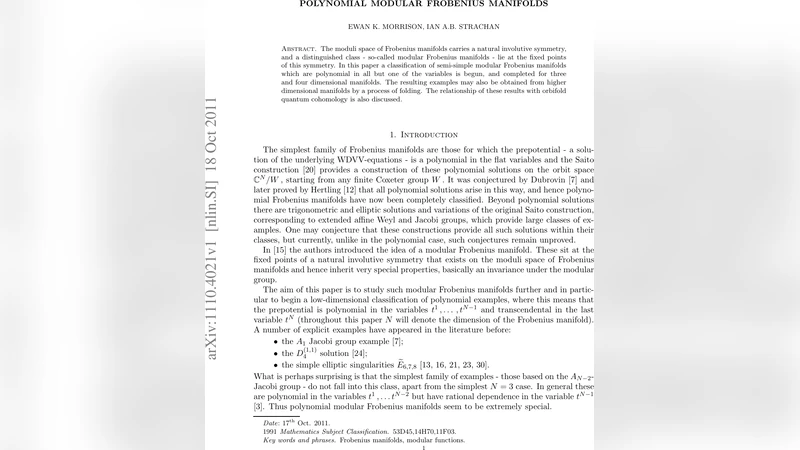
The moduli space of Frobenius manifolds carries a natural involutive symmetry, and a distinguished class - so-called modular Frobenius manifolds - lie at the fixed points of this symmetry. In this paper a classification of semi-simple modular Frobenius manifolds which are polynomial in all but one of the variables is begun, and completed for three and four dimensional manifolds. The resulting examples may also be obtained from higher dimensional manifolds by a process of folding. The relationship of these results with orbifold quantum cohomology is also discussed.
💡 Research Summary
The paper investigates a distinguished subclass of Frobenius manifolds—so‑called modular Frobenius manifolds—defined as the fixed points of a natural involutive symmetry on the moduli space of Frobenius manifolds. This symmetry, originally introduced by Dubrovin, sends the flat coordinates (t^i) to (t^i/t^n) (with (t^n) the distinguished scaling coordinate) while preserving the multiplication, metric, and Euler vector field. A Frobenius manifold that remains invariant under this transformation, up to an elementary quadratic term, is called modular.
The authors focus on semi‑simple modular Frobenius manifolds whose potential (F) is polynomial in all but one variable. The polynomial ansatz dramatically simplifies the highly non‑linear WDVV equations, allowing the authors to treat the problem algebraically. By imposing the homogeneity condition dictated by the Euler vector field, together with the modular invariance condition \
Comments & Academic Discussion
Loading comments...
Leave a Comment