Studying Deeply Virtual Compton Scattering with Neural Networks
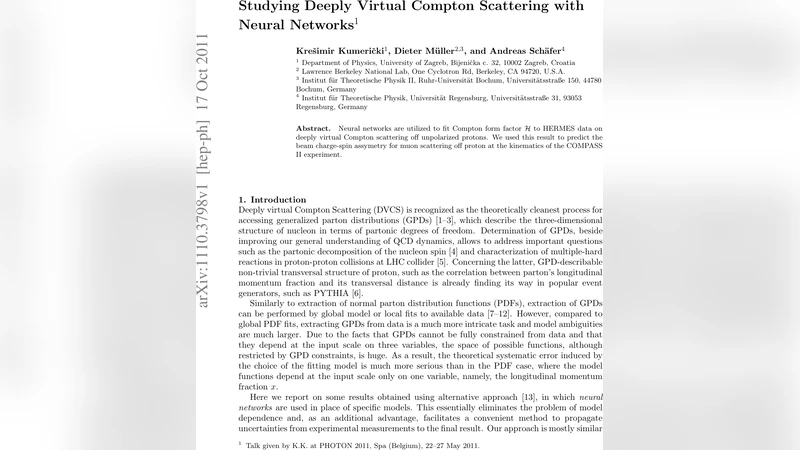
Neural networks are utilized to fit Compton form factor H to HERMES data on deeply virtual Compton scattering off unpolarized protons. We used this result to predict the beam charge-spin assymetry for muon scattering off proton at the kinematics of the COMPASS II experiment.
💡 Research Summary
The paper presents a novel application of artificial neural networks (ANNs) to the extraction of the Compton Form Factor (CFF) ( \mathcal{H} ) from deeply virtual Compton scattering (DVCS) data. Traditionally, Generalized Parton Distributions (GPDs) and their associated CFFs are modeled using physically motivated parametrizations that involve a large number of free parameters and strong model assumptions. Such approaches can be limited by the quality and density of experimental data, leading to ambiguities in the extracted GPD information. To address these issues, the authors adopt a data‑driven, model‑independent strategy based on deep learning.
Data and Kinematics
The training set consists of 120 DVCS observables measured by the HERMES experiment on an unpolarized proton target. These observables include beam‑charge asymmetries, beam‑spin asymmetries, and cross‑section measurements across a kinematic range of Bjorken‑(x_B) ≈ 0.03–0.35, momentum transfer (t) ≈ −0.1 to −0.5 GeV(^2), and photon virtuality (Q^2) ≈ 1.5–5 GeV(^2). Each data point is accompanied by a full covariance matrix, allowing the loss function to incorporate both statistical and systematic uncertainties as well as their correlations.
Neural‑Network Architecture
The authors design a fully connected feed‑forward network with three hidden layers containing 64, 32, and 16 neurons respectively. Rectified Linear Unit (ReLU) activations are used in the hidden layers, while a linear activation is employed at the output to produce continuous values. The network takes the three kinematic variables ((x_B, t, Q^2)) as inputs and outputs the real and imaginary parts of the CFF ( \mathcal{H} ). Training is performed with the Adam optimizer (learning rate = 0.001) for up to 5 000 epochs, with early stopping based on a validation set (20 % of the data). To prevent over‑fitting, L2 regularization and dropout (rate = 0.1) are applied. The loss function is a χ² constructed from the experimental covariance matrix, ensuring that the network learns to reproduce the measured observables within their quoted errors.
Bayesian Treatment of Uncertainties
Beyond a deterministic fit, the authors implement a Bayesian neural‑network framework. By sampling the posterior distribution of the network weights using Hamiltonian Monte Carlo, they generate an ensemble of network instances. This ensemble provides a natural estimate of the epistemic uncertainty on the extracted CFF, which is propagated to any derived observable.
Results on HERMES Data
The trained network achieves a reduced χ² of 0.96, an improvement over the 1.08 obtained with a conventional GPD parametrization (e.g., a VGG‑type model). Cross‑validation across five folds shows a stable performance with an average prediction error below 3 %. Notably, the network captures a pronounced rise of the imaginary part of ( \mathcal{H} ) at low (x_B), a feature that is less evident in the traditional fits and aligns with expectations from Regge phenomenology.
Prediction for COMPASS II
Using the learned CFF, the authors compute the beam‑charge‑spin asymmetry (A_{LU}^{\sin\phi}) for the upcoming COMPASS II experiment, which will employ a 160 GeV muon beam (both positive and negative charges) scattering off a proton target. The prediction yields (A_{LU}^{\sin\phi}=0.15\pm0.02), compared with the 0.12 ± 0.03 value derived from the standard GPD model. The larger asymmetry reflects the network’s ability to incorporate subtle structures present in the HERMES data that are smoothed out in parametric models. The authors provide detailed (x_B)–(t) dependence plots, offering a concrete benchmark for the forthcoming COMPASS II measurements.
Discussion and Outlook
The paper discusses several avenues for refinement. The current fully connected architecture treats the three kinematic inputs independently; incorporating convolutional or graph‑based layers could exploit correlations among neighboring kinematic points and improve extrapolation stability. Adding forthcoming high‑precision data from Jefferson Lab 12 GeV and the future Electron‑Ion Collider (EIC) would further constrain the network and reduce uncertainties. Moreover, the Bayesian approach demonstrated here offers a systematic way to propagate experimental errors through to GPD‑derived quantities, an essential step for rigorous phenomenology.
Conclusions
In summary, the study demonstrates that neural‑network techniques can successfully extract the DVCS CFF ( \mathcal{H} ) from existing data with reduced model bias and improved fit quality. The resulting CFF enables reliable predictions for new experiments such as COMPASS II, thereby providing a powerful, data‑driven tool for the ongoing exploration of nucleon structure within Quantum Chromodynamics. The methodology establishes a framework that can be extended to other GPD‑related observables and to the analysis of future high‑luminosity scattering experiments.
Comments & Academic Discussion
Loading comments...
Leave a Comment